
Quick Read
- By 2025, Oxford had produced more than 70 Nobel Prize winners and 31 UK prime ministers.
- Indira Gandhi went to Somerville College, Oxford, and Manmohan Singh went to Nuffield College while she was at Oxford.
- At Oxford, to be eligible for their first year of college, Indian students need to have a minimum of 90% in Class XII (CBSE: A1 in four courses).
- Oxford tuition for Indian students: Rs.48.4 lakhs–Rs.1.15 crore per year.
Oxford University Notable Alumni Record: The Numbers Behind the Name
Oxford has a remarkable alumni record, and it is not only a marketing claim; the world knows it. Oxford is associated with more than 70 Nobel Prize winners; the exact count varies by methodology, with Oxford’s own award winners page listing laureates across all six prize categories. According to the University of Oxford’s British Prime Ministers page, the university has educated 31 UK prime ministers. According to the Times Higher Education World University Rankings, the graduates’ network of these schools has more than 250,000 people, including more than 120 Olympic medalists. Oxford has been ranked #1 in the THE World University Rankings for 2025–2026 and has held the #1 spot for ten years in a row.
The numbers matter for an Indian student because they indicate what kind of school you’re going to, not just because they’re cool to talk about. An Oxford degree commands more respect in Indian law firms, consulting firms, the civil service, and schools than almost any other foreign degree.
List of Oxford University’s Notable Alumni

Choose your dream country
 UK
UK
 USA
USA
 Germany
 Australia
 Ireland
 Canada
 UAE
UAE
 France
 Sweden
 Italy
Italy
 Other
Other
When do you want to study abroad?
What's your highest level of education?
Have you completed Class 12th?
What was your Class 12 CGPA/percentage?
Are you a student or a parent/guardian?
What do you want to study?
Select your current city
How Leap will help you

Personalised University Shortlist

Express Applications with Quicker Admits

End-to-End Application Support
India has a profound relationship with Oxford that dates back before independence. Indian students have come to Oxford since 1871, according to Oxford Today. The University of Oxford’s India page lists famous Indian graduates by name to show how close the two schools are.
- Indira Gandhi went to study at Somerville College during 1937–38. She studied history, political science, economics, and more, but never finished her degree at Oxford. She served as prime minister of India from 1966 to 1977 and again from 1980 until her assassination in 1984, making her the first and, to date, only woman to hold the office. Her other group was the Oxford Majlis Society. The world’s oldest Asian student society and the second-oldest student society at the university.
- Dr. Manmohan Singh studied at Nuffield College, Oxford, and obtained his DPhil in economics from there in 1960 under the late Ian Little. His paper was on the export performance of India during 1951-60. Returning to India, he taught at Panjab University and the Delhi School of Economics before entering public service. In his time, he was the Governor of the Reserve Bank of India, the Finance Minister under P.V. Narasimha Rao (who oversaw India’s economic liberalization in 1991 that changed the country), and the Prime Minister from 2004 to 2014. He died in December of 2024. His DPhil from Oxford directly influenced the economic ideas that he brought to India’s most important financial changes. Sources: Britannica, Nuffield College, Oxford
- Cornelia Sorabji was the first woman to read law at Oxford in the 1890s. She did this at Somerville College. Apart from that, she was the first woman lawyer in India. Page from the University of Oxford in India
- Vikram Seth went to study PPE (Philosophy, Politics, and Economics) at Corpus Christi College. He then went on to write A Suitable Boy, which was one of the longest novels written in the English language and was shortlisted for the Booker Prize.
- Amitav Ghosh is one of India’s most celebrated writers and also a renowned Indian Oxford graduate. He has written The Shadow Lines and the Ibis Trilogy. Page from the University of Oxford in India.
- Mansur Ali Khan Pataudi studied French and Arabic at Balliol College. He was also the first Indian captain of the Oxford University cricket team. Then he became captain of the Indian cricket team.
- Siddhartha Mukherjee is a graduate of Magdalen College and the author of The Emperor of All Maladies, winner of the Pulitzer Prize. Now he is an oncologist and Associate Professor of Medicine at Columbia University Medical Centre.
Figures from Oxford Summer Courses and Oxford University show that around 380 Indian students are currently studying for degrees at its colleges, and over 1,500 Indian Oxford alumni are involved around the world. Indian students are reported to be one of the fastest-growing foreign groups in Oxford's postgraduate population.
Counselor insight: "Oxford" is a frequent name brought up by LeapScholar counselors when they speak to students who want to work in Indian law, economics, or public policy. This isn’t because of its scores, but it has a large network of alumni. Oxford is linked to institutions in India. Oxford has trained leaders of the Reserve Bank of India, the Supreme Court, the Planning Commission, and several of India's most distinguished publishing houses. Most other foreign universities simply don’t offer the same sort of useful network benefits.
Global Oxford Notable Alumni Who Changed Their Fields
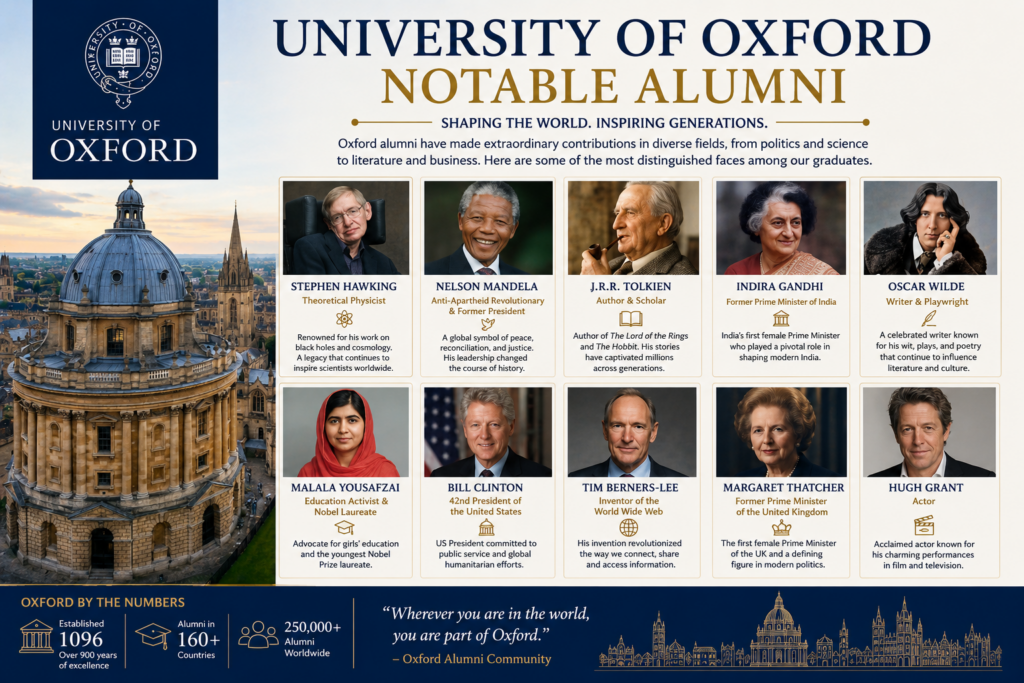
Oxford’s reach extends well beyond India. Below are images of the university’s alumni record, sorted by field, showing what it looks like for different types of fields.
| Field | Alumni | College | Degree / Subject | Notable Achievement |
|---|---|---|---|---|
| Politics | Margaret Thatcher | Somerville | Chemistry (BA) | First female UK Prime Minister |
| Politics | Tony Blair | St John's | Law (BA) | UK Prime Minister 1997-2007 |
| Politics | Bill Clinton | University College | Rhodes Scholar (PPE) | 42nd President of the United States |
| Politics | Benazir Bhutto | Lady Margaret Hall | PPE | First female Prime Minister of Pakistan |
| Science | Tim Berners-Lee | The Queen's College | Physics (BA, First Class) | Inventor of the World Wide Web |
| Science | Stephen Hawking | University College | Physics (BA) | Theoretical physicist; pioneered work on black holes |
| Science | Dorothy Hodgkin | Somerville | Chemistry | Nobel Prize in Chemistry, 1964 |
| Literature | J.R.R. Tolkien | Exeter College | English Language and Literature | Author of The Lord of the Rings |
| Literature | Oscar Wilde | Magdalen | Classics | Author, playwright |
| Literature | C.S. Lewis | University College | English | Author of the Narnia series |
| Law & Activism | Aung San Suu Kyi | St Hugh's | PPE | Nobel Peace Prize laureate, former State Counsellor of Myanmar |
A quick note about Stephen Hawking: He did his undergraduate work at University College, Oxford, and then went on to Cambridge for his graduate studies. He began his formal college education at Oxford but did his postgraduate work at Cambridge.
Sources: University of Oxford Famous Oxonians page, Rhodes Trust.
Can You Get Into Oxford from India? Eligibility and Requirements
Oxford is one of the world’s best schools and is very hard to get into. The Oxford admissions statistics page says the acceptance rate overall is about 17%. This total number is deceptively high for foreign applicants such as Indian students, as the competition is much stiffer. There are many international applicants, but only a limited number of places available for them.
Undergraduate requirements for Indian students:
- A1 in 4 relevant subjects and A2 in 1 more subject, overall 90% and above for CBSE. CISCE: 90% overall, with 95% and above in 4 relevant subjects for CISCE.
- No SAT or ACT scores needed
- For most courses, you have to take an admissions test (PAT for Physics, LNAT for Law, MAT for Math, TSA for PPE/Economics).
- Interviews were conducted online via Microsoft Teams in December; all 2026 interviews were online
- UCAS applications close on 15 October 2026.
Postgraduate requirements for Indian students:
- First-class bachelor’s degree (60–65%) from a Tier-1 Indian university or CGPA of 8.5 or above.
- IELTS score of a minimum of 7.0 overall, with no component less than 6.5 (some courses require 7.5+).
- TOEFL score of at least 100 for most courses.
- GMAT score of minimum 650 for MBA courses; GRE score of minimum 320 for STEM and social science courses.
- There is a graduate application portal (not UCAS), with deadlines differing by school, but most are in December or January.
- The application fee was £75 (Rs.9,719).
Sources: University of Oxford undergraduate admissions page, University of Oxford graduate admissions page
Documents Required for Indian Applicants Applying to Oxford
| Document | What Oxford Requires | India-Specific Note |
|---|---|---|
| Academic Transcripts | Official transcripts from all institutions attended | Class X and XII marksheets; undergraduate transcripts if applying for PG |
| Predicted or Final Grades | For UG: predicted grades from school; for PG: final degree result | CBSE/CISCE grade sheets accepted; percentage and grade format both acceptable |
| Proof of Degree | Final degree certificate for PG applicants | If the degree is not yet conferred, a provisional certificate with the university seal is acceptable |
| English Language Certificate | IELTS, TOEFL, or Cambridge English Advanced | British Council IELTS results accepted; test must be within two years of application |
| Personal Statement | For UG via UCAS: one 4,000-character personal statement | It must be written specifically for the subject; generic statements are identified immediately in Oxford interviews |
| Academic References | Two to three academic references (course-dependent) | References from Indian college professors are accepted; they must be in English |
| Admissions Test Results | Course-specific (PAT, LNAT, MAT, TSA, etc.) | Most tests are taken at authorised test centres in India; registration opens in September-October |
| Statement of Purpose | For most PG courses | Some courses also require a research proposal or a written work sample |
| CV/Resume | For PG courses | Include research experience; publications, if any; and any relevant extracurriculars |
| Passport Copy | Required for all international applicants | Must be valid for the duration of the study |
The Real Cost of an Oxford Education for Indian Families
| Cost Item | Annual Amount (GBP) | Annual Amount (INR approx.) |
|---|---|---|
| UG Tuition (most courses) | £35,260 – £59,260 | Rs. 45.7L – Rs. 76.8L |
| PG Tuition (most taught courses) | £37,380 – £62,820 | Rs. 48.4L – Rs. 81.4L |
| PG Tuition (clinical/specialist courses) | Up to £88,800 | Up to Rs. 1.15 Cr |
| Living Costs (per month) | £1,425 – £2,035 | Rs. 1.85L – Rs. 2.64L |
| Application Fee | £75 | Rs. 9,719 |
| UK Student Visa (Student route) | £490 | Rs. 63,494 |
| Immigration Health Surcharge (per year) | £776 | Rs. 1,00,554 |
Sources: University of Oxford fees pages, Oxford Living Cost
Your Oxford Application Timeline: A Calendar for Indian Students
| Month | Action |
|---|---|
| January 2026 | Begin subject research: identify 2-3 Oxford courses and their admissions tests |
| February - March 2026 | Research Oxford colleges, read about the tutorial system, and begin subject reading list |
| April - May 2026 | Class XII board exams (CBSE/CISCE); if currently in UG, semester exams |
| June 2026 | Class XII results out; assess whether scores meet the 90% benchmark |
| July - August 2026 | Register for admissions tests (PAT, LNAT, MAT, TSA registration opens in September); begin personal statement drafting; request LOR from school/college professors |
| September 2026 | Admissions test registration deadline (most tests); take IELTS or TOEFL if not already done |
| 15 October 2026 | UCAS application deadline for UG entry in October 2027 |
| October - November 2026 | Take admissions tests at an authorised Indian test centre |
| Mid-November to early December 2026 | Receive shortlisting notification for interviews (if applicable) |
| December 2026 | Online interviews via Microsoft Teams (UG candidates) |
| December 2026 / January 2027 | PG graduate application deadline (varies by course; check individual course pages); scholarship auto-consideration deadline |
| January 2027 | Receive UG offer decision |
| February - March 2027 | Meet offer conditions and arrange financial documentation for the visa |
| July - August 2027 | Apply for a UK Student Visa; the 28-day funds rule requires that funds must be in place by now |
| September - October 2027 | Arrive at Oxford; Michaelmas term begins |
When Things Go Wrong: Missed Deadlines, Low Scores, Visa Problems
Many things can go wrong when you are applying to Oxford from India. Here we talk about the most common ones.
- Not meeting the UCAS date (15 October for UG): It’s too late to apply to Oxford through UCAS. If you miss the deadline, the best options are to apply to other UK unis via UCAS Extra or clearing, then wait a year to boost your application and go to Oxford again the next cycle. You need to study harder for the admissions tests that year and speak to the teachers at the Oxford college you want to attend and retake the tests better prepared.
- (85-90% instead of 90%+) Class XII score on the border: Oxford states that Indian UG candidates need an overall score of 90% or higher. Even if you score in the high 80s, your application will still be considered if you perform better on the rest of the requirements, particularly on the entrance exam and interview. In real life, most Indians who get into UG programs have scores much above 90%. If your Class XII grade was below 90%, you may want to consider applying to other strong UK universities this cycle and then reapply to Oxford after another year of studying the subjects again.
- Provisional certificate or delayed marksheet: If you have not yet received your final degree, Oxford will accept a provisional certificate with the university's seal. Email the Oxford admissions office for your school to find out exactly what they will accept before sending in your materials.
- UK student visa refusal: Most Indian students say it’s the 28-day funds rule. Your bank statements should reflect that the necessary amount (around Rs.60L, which includes one year's tuition plus Rs.13.2L–Rs.17.3L for living expenses, totalling more than Rs.60L in verifiable funds for most programs) was held in an account accessible for 28 consecutive days before the visa application date. An alert will be triggered if UKVI sees money suddenly appearing in an account. Do this nine to twelve months ahead of time. You can appeal/reapply for a visa rejection; it's not forever, but it will push back your start date and cause problems with your CAS.
- Good profile, but turned down by Oxford: Oxford turns away good candidates every year. The tutorial interview is very unexpected, really. It tests not how well you can remember things but how well you can think under pressure. If you get knocked down one run, it doesn’t mean you’re never going to get looked at again. A lot of the students who got in applied twice. If you have an interview and get turned down, ask the admissions tutor for feedback (this procedure is possible for some classes), find out where your reasoning was weakest, and reapply with that problem fixed.
3 Takeaways
- The fact that Indian graduates from Oxford are so numerous is proof, not marketing. It is the alma mater of India’s first woman lawyer and two prime ministers. That’s the school you’re applying to.
- The requirements are clear, a minimum of 90% in Class XII for UG, a first-class equivalent for PG, and an IELTS score of at least 7.0. High, but achievable with a plan for the next 12 to 18 months.
- Most PG scholarships at Oxford don't mean you need to be a different applicant. For Clarendon, Felix, and most other college awards, you have to apply by the course date (December or January). The biggest mistake Indian applicants make is missing the date.
Verified by LeapScholar's UK counseling team. Have questions about Oxford University notable alumni? Book a free session with a LeapScholar counselor.
Frequently Asked Questions About Oxford University Notable Alumni
-
Who are the notable Indian alumni of Oxford?
Indira Gandhi (Somerville College, former Prime Minister of India); Dr. Manmohan Singh (Nuffield College, former Prime Minister and architect of India’s economic reforms in 1991); Cornelia Sorabji (Somerville College, India’s first female lawyer and the first woman to study law at Oxford); Vikram Seth (Corpus Christi College, author of A Suitable Boy); Amitav Ghosh (novelist); Mansur Ali Khan Pataudi (Balliol College, former Indian cricket captain); and Siddhartha Mukherjee (Magdalen College, Pulitzer Prize-winning author and oncologist).
-
What did Manmohan Singh study at Oxford?
Dr. Manmohan Singh took a DPhil in economics at Nuffield College, Oxford, in 1960. His doctoral thesis, supervised by the late Ian Little, was on India’s exports from 1951 to 1960. The study offered much of the economic thinking he drew upon as finance minister and prime minister of India. He had done Cambridge before.
-
What grades do Indian students need to get into Oxford?
In India, students studying under the CBSE board usually need to have A1 grades in four relevant subjects and an overall score of 90% or above to get into college. CISCE students are expected to score at least 90% in the aggregate and a minimum of 95% in four relevant subjects. You need a bachelor’s degree with a first-class equivalent for Master's programs, which is 60-65% in a Tier-1 Indian university, which is around 8.5+ on the CGPA scale. But usually those who are genuinely interested in the course score higher than these minimums.
-
What is the rate of Indian kids getting into Oxford?
The university's own admissions data shows that the overall acceptance rate for all applicants to Oxford is about 17%. Oxford restricts the number of foreign students in each course, so there is a lot more competition from people from other countries. Some education sites say the acceptance rate for India is 3.9%, but an official Oxford source has not confirmed this figure. The real bar is higher than what the overall acceptance rate says. It is a fact. Indian applicants have to compete with applicants from around the world.
-
What is the cost of Oxford University in Indian Rupees?
In 2026-27, most undergraduate courses will cost Indian students classified as overseas fee-payers between Rs 45.7 lakhs and Rs 76.8 lakhs (£35,260 and £59,260) a year, and most taught postgraduate studies will cost between Rs 48.4 lakhs and Rs 81.4 lakhs (£37,380 and £62,820) a year. Specialist and doctor courses are pricier. The cost of living adds another 1.85 to 2.64 lakh per month. The total cost of a 3-year UG degree usually ranges from Rs.2.04Cr to Rs.3.25Cr.
-
Would Indian kids be able to get a full scholarship to attend Oxford?
Indian students can apply for many fully funded scholarships. As a Rhodes Scholar, your course costs are covered, and you receive a monthly salary of about Rs.2.20 lakhs, which equates to about £1,700 in 2025–26. The Clarendon Fund covers all your tuition fees and gives you a living grant of around Rs.19.4 lakhs annually. No need to fill out a separate application; just finish it by the January course date. The Felix Scholarship covers the entire education of students from poorer regions of India, and they receive a stipend of about Rs. 23.2 lakhs per year.
-
Can Indian students apply for the Rhodes Scholarship? What's that?
The Rhodes Scholarship is the world’s oldest fully funded foreign graduate scholarship. Founded in 1902, the company has been based in Oxford since 1903. It offers to cover all tuition fees at Oxford and a living stipend of £20,400 a year, or about Rs. 26.4 lakhs, in 2025–26. Scholars are selected each year from the Indian community for students in India. To qualify, you must have a college degree, be under a certain age (usually 23 in India), and have demonstrated that you are academically and leadership and service oriented. You will have the opportunity to apply in 2026 for the 2027 cycle.
-
What happens if I miss the UCAS date for Oxford?
For Oxford UG applications, the UCAS date is October 15, the year before you want to start. This is the last limit. It cannot be avoided, and Oxford does not accept UCAS applications after the deadline. If you miss out, you can apply to other UK universities. For October 2026 applicants targeting 2027 entry, the main UCAS deadline for non-Oxford/Medicine courses is 29 January 2027. Prepare for the admissions test and learn more about the subject in the year before the next Oxford cycle, then reapply in October of the following year. If you miss the December or January deadline for graduate applications, you will not be automatically considered for most scholarships, such as the Clarendon Fund and Felix Scholarship. You may still be considered for a place with your application, but not for most scholarships.





Have Questions? Get Guidance to reach your Dream University
Connect with India's finest counsellors and biggest study abroad community.
Get Guidance