
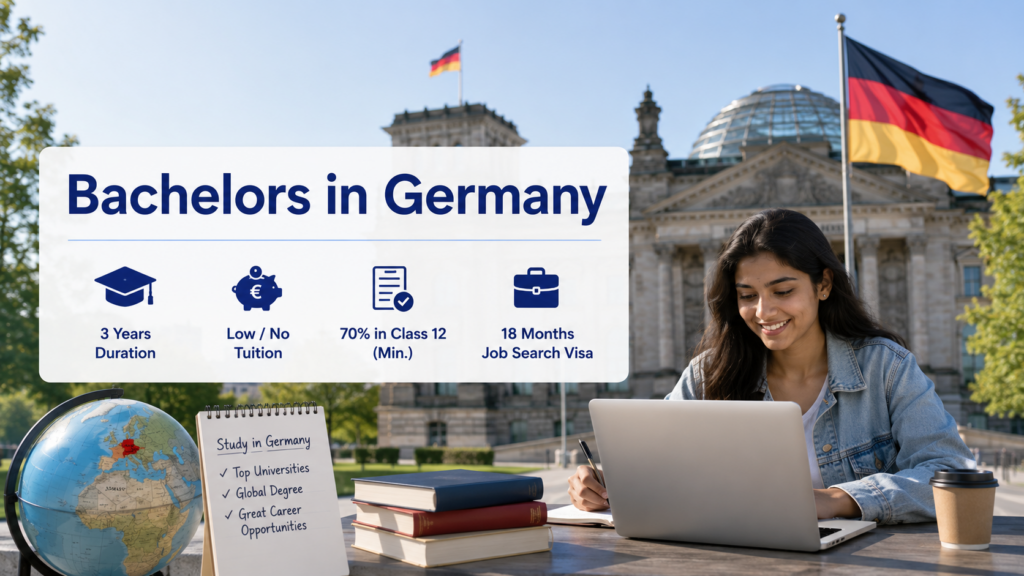
Quick Read
- Winter 2026/27 introduced a minimum 70% Class XII requirement for bachelors in Germany.
- Most public universities charge zero tuition; Baden-Württemberg and TUM don’t.
- A German bachelor’s degree runs 3 years at a Universität.
- Non-EU students may now work 140 full days a year, up from 120.
Bachelors in Germany: Highlights
| Particulars | Details |
| Course Duration | 3 years (Universität/TU); 3.5-4 years (Fachhochschule) |
| Intakes | Winter (October, primary); Summer (April, limited programs) |
| Class XII Eligibility | A minimum of 70% overall, effective Winter 2026/27 |
| Tuition at Public Universities | €0 in 14 of 16 states; fee-charging in Baden-Württemberg and at TUM |
| Semester Contribution | €100-€400 (₹10,927-₹43,708), all students |
| Blocked Account (2026 figure) | €11,904/year (₹13,00,750) |
| Language of Instruction | Primarily German; a minority of English-taught bachelor’s programs |
| Part-Time Work | 140 full days or 280 half days per year |
| Post-Study Visa | Up to 18 months on the Job Seeker Permit |
| Top-Ranked Bachelor’s University (QS 2027) | Technical University of Munich (Rank 25) |
Each figure above is sourced individually in its dedicated section below.

Choose your dream country
 UK
UK
 USA
USA
 Germany
 Australia
 Ireland
 Canada
 UAE
UAE
 France
 Sweden
 Italy
Italy
 Other
Other
When do you want to study abroad?
What's your highest level of education?
Have you completed Class 12th?
What was your Class 12 CGPA/percentage?
Are you a student or a parent/guardian?
What do you want to study?
Select your current city
How Leap will help you

Personalised University Shortlist

Express Applications with Quicker Admits

End-to-End Application Support
Top Universities for Bachelors in Germany
| University | QS World Rank 2027 | Popular Bachelor's Programs | Tuition status for non-EU students |
| Technical University of Munich (TUM) | 25 | Engineering, Computer Science, Management & Technology | Fee-charging (Bachelor's: €2,000-3,000/sem) |
| LMU Munich | 61 | Business Administration, Economics, Life Sciences | Tuition-free |
| Heidelberg University | 86 | Medicine, Life Sciences, Physics | Fee-charging (Baden-Württemberg) |
| Freie University of Berlin | 98 | International Relations, Psychology, Social Sciences | Tuition-free |
| RWTH Aachen University | 104 | Mechanical Engineering, Civil Engineering, Computer Science | Tuition-free |
| Karlsruhe Institute of Technology (KIT) | 110 | Mechanical Engineering, Physics, Data Science | Fee-charging (Baden-Württemberg) |
| Humboldt University of Berlin | 140 | Law, Political Science, Social Sciences | Tuition-free |
Source: QS World University Rankings 2027
Exchange rate used throughout: 1 Euro = ₹109.27 as of July 2026. Verify the live rate before finalizing your budget.
What Changed for Bachelors in Germany in 2026-27
If you researched about bachelors in Germany for Indian students even a year ago, the eligibility rules you read are already out of date. On 23 February 2026, APS India updated its evaluation criteria: from Winter Semester 2026/27 onward, Indian applicants need a minimum overall score of 70% in Class XII to qualify for either of the two established undergraduate pathways. The previous floor was effectively 50%.
| Requirement | Before March 2026 | From Winter 2026/27 |
| Class XII minimum | No universal floor; case-by-case | 70% overall, all boards |
| Studienkolleg route | Available below 70% | Requires 70%+ |
| Direct subject-restricted route | 70% + 1 India bachelor's year | Both conditions now strictly enforced together |
| APS certificate | Mandatory since Nov 2022 | Still mandatory, evaluated against new criteria |
Counselor insight: Students often assume completing one year of an Indian bachelor's automatically offsets a weak Class XII score. It doesn't. APS India's updated criteria require both the 70% threshold and the completed academic year: one no longer compensates for the other.
Source: APS India, Update on Higher Education Eligibility Requirements, 23 February 2026
Studienkolleg: What It Is, How Long It Takes, and How to Apply
Studienkolleg is the mandatory foundation course bridging India's 12-year schooling and Germany's 13-year Abitur-equivalent standard. It runs 2 semesters (about 1 year), and you qualify for admission by passing the Feststellungsprüfung (FSP) at the end, not by attendance alone.
| Track | Focus | Leads to |
| T-Kurs | Maths, Physics, Chemistry | Engineering, Computer Science, Natural Sciences |
| W-Kurs | Economics, Business Maths | Business Administration, Economics, Management |
| M-Kurs | Biology, Chemistry, Physics | Medicine, Pharmacy, Biology |
| G-Kurs | German, History, Social Studies | Humanities, Law, Social Sciences |
Source: Heidelberg University, Studienkolleg and Feststellungsprüfung
How to apply: Either your university conditionally admits you and routes you to its affiliated Studienkolleg, or you apply directly to a state Studienkolleg (deadlines typically mid-January/mid-July), followed by an Aufnahmetest in German and your subject track.
FSP pass rates: No single official national figure exists, but full-year Studienkolleg students consistently report 85-90% pass rates, against roughly 20% for external candidates who skip structured teaching.
Students who clear that B2/C1 bar comfortably tend to have started well before leaving India. Describing his own sequence, a Process Engineer in North Germany and TU Bergakademie Freiberg graduate who contributed to LeapScholar's Germany guide, Hemanth Kiran, says: "Recognised early on that the primary obstacle to studying in Germany is the language barrier. Started learning German (A1, A2) during undergraduate studies in India and continued through B1 and B2 levels after arriving in Germany."
Counselor insight: Most failures are linguistic, not academic. Students enter at B1 German, but the FSP is examined at B2/C1, and those who stop actively improving once enrolled struggle most.
Eligibility for Bachelors in Germany: Which Path Applies to You
There are two established routes to a bachelors in Germany for Indian students on a CBSE, ISC, or state board certificate, and both now sit on top of the same 70% floor.
- If you're a Class 12 graduate with 70%+ and no gap: You'll almost always need the Studienkolleg (foundation year), followed by the Feststellungsprüfung entrance exam, before starting your bachelor's proper. Studienkolleg courses are subject-specific: T-courses for engineering and computer science, W-courses for business and economics, and M-courses for medicine and biology.
- If you've completed one full academic year of an Indian bachelor's in a related field, with a Class XII score of 70%+: You may qualify for direct, subject-restricted admission, skipping the Studienkolleg entirely. This option is the route most searches for "bachelors in Germany without Studienkolleg" are really asking about.
- If you hold an IB Diploma or GCE A-Levels instead of a state board certificate: Some universities treat these as directly meeting the higher education entrance qualification, without Studienkolleg, depending on your subject combination and scores. Always confirm on the specific university's admission page, since this varies by institution.
- If your Class 12 score sits below 70%: Neither pathway is currently open to you at the standard undergraduate level (see the fallback section further down). In short, bachelors in Germany without Studienkolleg is only realistic if you already have that one India-based bachelor's year behind you, on top of the 70% mark.
Language proficiency runs alongside this: German-medium programs typically need TestDaF or a Goethe C1 certificate, while the smaller pool of bachelors in Germany in English usually asks for IELTS 6.0-6.5 or TOEFL 80-95.
Counselor insight: The direct subject-restricted route (skip Studienkolleg) is the one students ask about most, but it's also the route most people misqualify themselves for. 'Related field' is interpreted strictly; a Class 12 Commerce student's first-year BCom does not qualify as a 'related field' for Engineering or Computer Science at most German universities. Check the specific university's recognition criteria, not just the general rule.
How to Apply for a Bachelor’s Degree in Germany
- Shortlist your course and check the pathway. Confirm whether the program needs a Studienkolleg, accepts direct subject-restricted entry, or recognizes your IB/A-Level qualification.
- Start your APS certificate early. This is the single biggest bottleneck for Indian applicants; processing runs 6-12 weeks in peak season.
- Sit your language test. IELTS/TOEFL for English-taught programs, or TestDaF/Goethe for German-taught ones.
- Apply via Uni-Assist or the university's own portal, depending on which system the institution uses.
- Open your blocked account once you have an offer to prepare for the visa stage.
- Apply for your German student visa at VFS Global, with your admission letter, APS certificate, and blocked account confirmation.
For the exact document list this involves, our counselors have answered specific questions on APS and exam requirements for German bachelor's and master's applicants, which is worth a read before you start.
Applicants who filed before the system settled waited considerably longer. Recalling his own timeline, a Master's student in Operational Excellence at Hof University of Applied Sciences and a contributor to LeapScholar's Germany guide, Mahendra Wagh, says: "The student visa took about a month to process. The APS certificate took around 3 months, as the system was newly introduced at the time, though the timeline has since improved to a few weeks."
Documents and Blocked Account for Bachelors in Germany
| Document | Requirement | India-specific detail |
| APS Certificate | Mandatory since Nov 2022 | Fee: ₹18,000; apply with Class 12 admit card or provisional marksheet to start the queue early |
| Class 10 & 12 marksheets | Certified copies | Translation required if not in English/German; a separate credit-transfer certificate is not usually needed as long as original transcripts are submitted |
| Blocked account (Sperrkonto) | €11,904/year (2026 figure) | ₹13,00,750 at current rates; covers living costs, not tuition. Confirm the updated amount for the 2027-28 cycle closer to your application, since it is revised periodically |
| Language certificate | IELTS/TOEFL or TestDaF/Goethe | Match to your program's medium of instruction |
| Motivation letter (SOP) | Program-specific | Explain any gap year explicitly |
Source: Federal Foreign Office, Opening and closing a blocked bank account (Sperrkonto)
If you're unsure whether a credit transfer certificate applies to your case, our counselors have answered this exact question for the German student visa process.
On how the account behaves once funded: a Master's graduate in Management from SRH Heidelberg and contributor to LeapScholar's Germany guide, Pooja Kale, explains, "A blocked account is a mandatory account where incoming international students deposit one year's worth of living expenses prior to arriving in Germany. It serves as financial proof for visa approval, releasing a fixed monthly amount to cover living costs."
Is dMAT Required for Bachelors in Germany?
No, dMAT is not needed for this pathway, but it's worth understanding anyway if a Master's in Germany is somewhere in your longer-term plan.
| Question | Answer |
|---|---|
| What is it? | A standardised aptitude test developed by g.a.s.t. (the body behind TestAS and TestDaF), added to the APS documentation process in June 2026. |
| Does it apply to Bachelor's applicants? | No. dMAT applies only to Master's applicants, and only those whose undergraduate degree is in Engineering, Commerce, Accounting, Finance, Economics, Business, or Management. |
| When does it apply, for those it affects? | To APS applications submitted on or after 29 June 2026, effectively the Summer 2027 intake onward. |
| Why it's worth knowing now | If your plan is a Bachelor's now and a Master's in Engineering or Business later, you'll very likely fall inside this requirement when you apply again. It doesn't affect your current application at all. |
Universität vs. TU vs. Fachhochschule: Which Type Suits You
Before you shortlist a specific university, it helps to know what kind of institution you're actually choosing between. All three awards recognized bachelor's degrees; the difference is teaching style, not degree quality.
| Type | Focus | Best For | Can Award a PhD? |
| Universität | Theory-driven, research-oriented | Students likely to pursue a Master's or PhD, or fields like law and medicine | Yes |
| Technische Universität (TU) | Engineering, computer science, natural sciences are still research-led | Students aiming for R&D-heavy careers or further study in a technical field | Yes |
| Fachhochschule (FH/HAW) | Practice-oriented, mandatory internships, close industry ties | Students who want to enter the job market quickly after graduation | No, but FH graduates can enrol in a Master's at a Universität and pursue a PhD from there |
It is worth being blunt about this, because the assumption travels from India. There is no official German equivalent of an IIT-versus-state-college hierarchy — a degree from any accredited public university, Universität, TU or FH, is a state-recognised qualification with equal legal standing. Nor is there an informal prestige order between the two paths: the FH-plus-industry-cluster route regularly beats chasing a TU9 rejection, especially in engineering.
Counselor insight: Don't default to a Universität just because it sounds more prestigious. If your goal is a fast, well-paid first job rather than further research, an FH's mandatory internship structure often gets you there quicker, and German employers rate the two paths differently depending on the role, not by name alone.
Is a Bachelors Degree Free in Germany?
Mostly, yes, but two exceptions catch Indian applicants out every year.
| University / State | Tuition (per semester) | INR equivalent | Who pays |
| Most public universities (14 of 16 states) | €0 | ₹0 | Everyone, all nationalities |
| Baden-Württemberg (Heidelberg, KIT, Freiburg, Tübingen) | €1,500 | ₹1,63,905 | Non-EU/EEA students only |
| Technical University of Munich (TUM), Bachelor's | €2,000-€3,000 | ₹2,18,540-₹3,27,810 | Non-EU/EEA students newly enrolling from WS 2024/25 |
| All public universities | €100-€400 semester contribution | ₹10,927-₹43,708 | Every student, including EU/domestic |
Exchange rate used throughout: 1 Euro = ₹109.27 as of July 2026. Verify the live rate before finalizing your budget.
Sources: Ministry of Science, Research and Arts of Baden-Württemberg (MWK), Tuition Fees for International Students; TUM, Tuition Fees for Students from Non-EU Countries
Counselor insight: Don't budget assuming "Germany is free" and then get blindsided by a Baden-Württemberg or TUM offer letter. Check the state and the university before you fall in love with a specific program.
Scholarships for Bachelors in Germany: The Honest Picture
If you're hunting for a DAAD scholarship for bachelors in Germany, here's what most articles won't tell you plainly: it's genuinely hard to find. DAAD's own funding portal is overwhelmingly weighted toward Master's, PhD, and short-term exchange opportunities. Its flagship scholarships require an already-completed bachelor's degree plus, in many cases, professional work experience. Bachelor's-level funding mostly comes from smaller, university-specific sources, not a single flagship program.
| Scholarship | Amount | Who it's for | Notes |
| Deutschlandstipendium | €300/month (₹32,781) | Bachelor's and Master's students, all nationalities, merit-based | Not income-tested; half funded by the federal government, half by private sponsors; renewed each semester at university discretion |
| University-specific tuition waivers (e.g. TUM) | Covers part or all of a fee-charging university's semester fee | Students already paying non-EU tuition (Baden-Württemberg or TUM), hardship or merit-based | Only relevant if your university charges tuition in the first place; check your specific university's financial aid office |
| Foundation and state-level scholarships | Varies, typically €300-€1,000/month | Merit and social-engagement based, often require B2/C1 German | Fragmented across hundreds of small foundations rather than one central bachelor's scheme |
Exchange rate used throughout: 1 Euro = ₹109.27 as of July 2026. Verify the live rate before finalizing your budget.
Sources: DAAD, Scholarship Database: Deutschlandstipendium; DAAD, Undergraduate Funding Opportunities
Two numbers make that concrete. LeapScholar's survey found 47% of students in Germany spend between €800 and €1,200 a month, so a €300 Deutschlandstipendium is a buffer rather than a plan. Among respondents who took an education loan, ₹10–20 lakh was the most common amount, and Section 80E lets you deduct the interest paid for up to eight years.
Counselor insight: Don't build your first-year budget around winning a scholarship. Plan your blocked account and semester fees assuming zero scholarship funding, then treat any award as a bonus, not a lifeline. If a scholarship does come through partway into your course, see how our counselors explain the impact of scholarships on fees and applications.
Planning Calendar for Bachelors in Germany: Winter 2027-28 Intake
Winter Semester 2027-28 starts October 2027. Work backward from there:
| Timeframe | Action |
| By March 2027 | Confirm Class 12 percentage meets 70% threshold; start APS registration |
| April-May 2027 | Shortlist universities; confirm Studienkolleg or direct-entry eligibility per program |
| By 31 May 2027 | Submit complete file via Uni-Assist: the safe internal deadline, well ahead of the printed cutoff |
| 15 July 2027 | Official Uni-Assist deadline for most public universities (last-resort date, not a target) |
| August-September 2027 | Receive admission, open blocked account, book visa appointment |
| October 2027 | Winter Semester 2027-28 begins |
Source: Uni-Assist, Application Deadlines and Processing Time
Counselor insight: APS processing alone takes 6-12 weeks in peak season. Students who wait until June to start their APS file routinely miss the July 15 cutoff even though it looks like they have time on paper.
What to Do If Your Class XII Score Is Below 70%
This isn't the end of the road, but it does mean the standard bachelor's pathways are closed for now. Two realistic alternatives:
- Complete a full bachelor's degree in India first, then apply directly for a Master's in Germany. This is already the route the majority of Indian students in Germany use.
- Check private German universities, some of which weigh a strong TestAS (Test for Academic Studies) score alongside a lower Class XII percentage. Confirm this university-by-university, since it isn't a system-wide exception.
Counselor insight: Don't let a below-70% Class 12 score push you toward an unrecognized or unaccredited private institution just to "get to Germany." Verify accreditation on Anabin before you commit money.
Working Part-Time During Your Bachelors in Germany
Non-EU students can now work 140 full days or 280 half days per year, up from the older 120/240 limit still quoted in many outdated guides. That works out to roughly 20 hours a week during term, with more flexibility during semester breaks. Mandatory internships that are part of your degree don't count against this limit.
Source: DAAD, Side Jobs for International Students
For a side-by-side look at how this compares with other study destinations, our counselors have answered a related question on part-time work rules for students in Ireland and Germany.
Those hours are worth spending strategically. Our survey found 56% of LeapScholar respondents who held a Werkstudent or part-time role said it led directly to a full-time offer — the strongest single pattern in the whole survey. Describing how he used that window, a Mechanical Engineering graduate working in Germany since 2019 and contributor to LeapScholar's Germany guide, Mriganka Das, says he "leveraged Werkstudent positions during university and completed a Master's thesis within an industrial company rather than an academic lab, to gain practical engineering experience and build local professional connections."
Job Prospects and Salaries After Bachelors in Germany
Graduates of a German university don't need a job offer in hand at graduation. There are three distinct post-study pathways, and confusing them is one of the most common mistakes Indian students make when planning ahead.
| Pathway | Duration | Who it's for |
| Job Seeker Permit (§20 Residence Act) | Up to 18 months | Graduates of a German university, to find a qualifying job in their field |
| Opportunity Card (Chancenkarte) | Up to 12 months | Skilled workers or points-based applicants without a prior German degree and a broader job search |
| EU Blue Card | Renewable residence permit | Anyone with a qualifying job offer meeting the salary threshold; fastest route to permanent residency |
Source: Make it in Germany (Federal Ministry), Opportunity Card
For the Blue Card specifically, the salary bar is what decides eligibility, not the job title:
| Category | 2026 Threshold (gross/year) | INR equivalent |
| Standard occupations | €50,700 | ₹55,39,989 |
| Shortage occupations (engineering, IT, natural sciences) or graduates within 3 years of completing their degree | €45,934.20 | ₹50,19,230 |
Source: Make it in Germany (Federal Ministry), EU Blue Card
That threshold should drive the offer, not the other way round. Advising students on their first German job, a Group Product Manager at SAP and contributor to LeapScholar's Germany guide, Harit Bhasin, says: "Don't focus only on getting the highest salary. First, make sure your salary is enough to qualify for a Blue Card. That's your starting point, because it allows you to continue working in Germany and later leads to permanent residency and citizenship."
Counselor insight: As a fresh bachelor's graduate, you almost always qualify under the lower "graduate within 3 years" threshold, regardless of your field. Don't let a job posting that quotes the higher standard figure discourage you from applying; check which threshold actually applies to your situation before ruling out a role.
If software or IT is your target field, our Software Engineering in Germany guide breaks down real entry-level salary bands by city and employer type. And if long-term settlement is the goal rather than just a first job, the same guide also maps out the Blue Card-to-permanent residency timeline in detail.
3 Takeaways on Bachelors in Germany
Three things to act on before you go further with your bachelors in Germany plan:
- Confirm your Class XII percentage against the 70% floor first: this decides which pathway, if any, is open to you right now.
- Budget assuming Baden-Württemberg or TUM fees might apply, even though most public universities are tuition-free.
- Don't plan your finances around a DAAD scholarship: treat bachelor's-level funding as a bonus, not part of your core budget.
Verified by: LeapScholar's Germany counseling team, with hands-on experience guiding Indian students through the APS, Uni-Assist, and visa process.
Have questions about your bachelors in Germany eligibility? Book a free session with a LeapScholar counselor.
Frequently Asked Questions About Bachelors in Germany
-
Is a bachelors degree free in Germany?
Mostly. Public universities in 14 of 16 German states charge zero tuition, only a semester contribution of €100-€400 (₹10,927-₹43,708). Baden-Württemberg and TUM are the two exceptions that charge non-EU students separately.
-
Is Germany good for a bachelor's degree?
For engineering, computer science, and business, yes: German bachelor's degrees are internationally recognized and come with low or no tuition. The trade-off is that most programs are German-medium, and the new 70% Class XII rule has narrowed direct eligibility for some applicants.
-
How long is a bachelors degree in Germany?
A bachelor's at a Universität or TU takes 3 years (6 semesters). At a Fachhochschule, it typically runs 3.5-4 years because of a mandatory practical semester built into the program.
-
Can I study bachelors in Germany after 12th grade from India?
Yes, but from Winter Semester 2026/27, you'll need a minimum of 70% in Class XII, and you'll generally go through Studienkolleg first unless you've also completed one academic year of an Indian bachelor's in a related field.
-
Can I get a bachelors in Germany without Studienkolleg?
Yes, if you have a Class XII score of 70%+ and have completed one full academic year of a bachelor's program in India in a closely related subject, you may qualify for direct, subject-restricted admission.
-
Is there a DAAD scholarship for bachelors in Germany?
Realistically, very few. A DAAD scholarship for bachelors in Germany is the exception, not the rule, since DAAD's main funding lines are built for Master's and PhD applicants, several requiring professional work experience. Bachelor's-level funding mostly comes from the Deutschlandstipendium and individual university foundations.
-
Are there bachelors in Germany in English?
Yes, but they're a minority compared to German-medium programs and are concentrated in private universities and select public programs like TUM's Management & Technology.
-
Does the new dMAT rule affect my bachelors in Germany application?
No. The dMAT applies only to select Master's applicants in Engineering, Commerce, and Business fields from Summer 2027 onward. It has no bearing on bachelor's-level admission.
-
How many days can I work during my bachelors in Germany?
Non-EU students can work up to 140 full days or 280 half days per year, roughly 20 hours a week during term, with more flexibility during semester breaks.
-
What if my Class XII score is below 70%?
The standard bachelor's pathways are currently closed to you. Realistic alternatives are completing a bachelor's in India first and applying for a Master's in Germany later, or checking specific private universities that weigh TestAS scores.
-
How many years is a bachelors degree in Germany?
A standard bachelor's at a Universität or Technische Universität takes 3 years (6 semesters). At a Fachhochschule (University of Applied Sciences), expect 3.5-4 years, since these programs build in a mandatory practical semester and lean more toward direct industry entry than research. If you're specifically searching for bachelors in Germany in English, know that English-taught programs remain a minority of the total offering, concentrated in private universities and a handful of public programs like TUM's Management & Technology.





Have Questions? Get Guidance to reach your Dream University
Connect with India's finest counsellors and biggest study abroad community.
Get Guidance