
Quick Read
- Chevening covers full tuition and a stipend of £1,378 (₹1.77L).
- GREAT Scholarships provide £10,000 (₹12.82 lakh) off tuition only.
- Commonwealth Scholarships need no prior UK study or income.
- The Graduate Route visa will drop to 18 months from January 2027.
Understanding Fully Funded Scholarships in UK
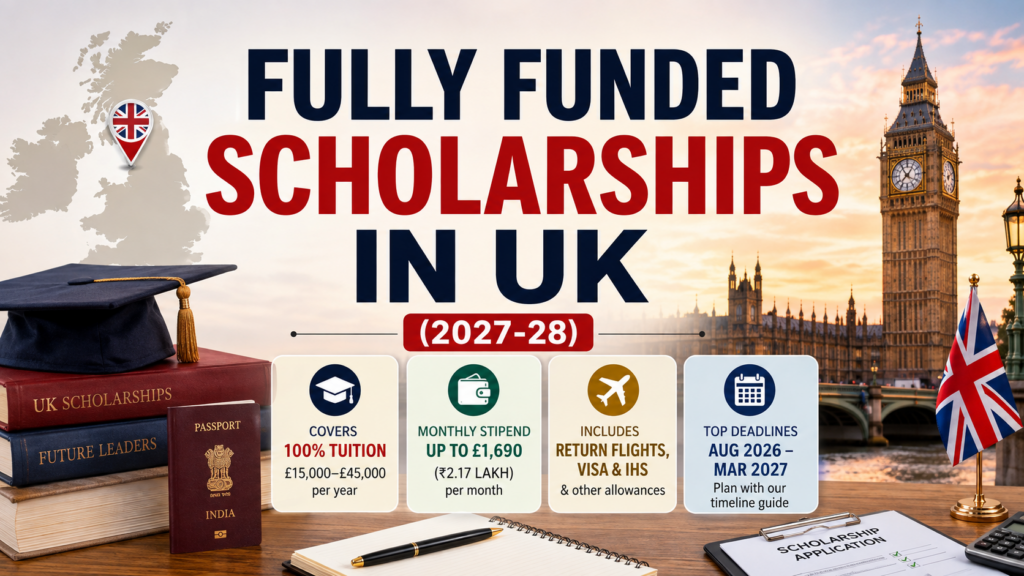
For UK scholarships, “fully funded” means three things together: full tuition fees, a monthly living stipend, and return travel plus visa-related costs. A scheme that covers only one of these, most commonly just tuition, is a partial scholarship regardless of how it’s marketed.
- Tuition fees: Genuinely fully funded schemes cover £15,000-£45,000 (₹19.22-57.67 lakh) per year, depending on the course and university.
- Monthly living stipend: Typically £1,100-£1,690 (₹1.41-2.17 lakh) per month, higher for London-based programs.
- Travel and visa: Return airfare, visa fees, and the Immigration Health Surcharge (IHS) are usually included.
- Additional allowances: Some schemes add arrival grants, warm-clothing allowances, or dependant and research support, though most exclude dependants entirely.
Fully Funded Scholarships in UK: 2027-28 Comparison
These ten schemes are the ones that genuinely meet the full-funding bar: tuition, a living stipend, and travel together, not just a tuition discount. Use this table to shortlist by level and deadline, then read the details on each below.
| Scholarship | Level | Coverage | Deadline (2027-28 cycle) | Work Experience Needed |
| Chevening | Master’s | Full tuition, stipend £1,378-1,690/month (₹1.77-2.17 lakh), return flights, visa | Opens 4 Aug 2026, closes 6 Oct 2026 | Yes, 2,800 hours (~2 years) |
| Commonwealth Master’s (FCDO/CSC) | Master’s | Full tuition, stipend ~£1,452/month (₹1.86 lakh), return airfare | Nov 2026-Feb 2027 window | No, but financial need required |
| Commonwealth Shared Scholarships | Master’s (course-specific) | Full tuition, stipend, return airfare, small allowances | Sept-Dec 2026 window | No, but financial need required |
| Rhodes Scholarship (Oxford) | Master’s/second degree | Full Oxford fees, stipend ~£19,800+/year (₹25.38 lakh), flights | Check India constituency page; typically mid-year | No |
| Gates Cambridge | Postgraduate | Full Cambridge fees, maintenance ~£21,000/year (₹26.91 lakh), flights, visa, IHS | Opens Sept 2026 | No |
| Clarendon Fund (Oxford) | Master’s/DPhil | Full course fees, UKRI-minimum living stipend | Automatic via Oxford application, January deadline | No |
| Felix Scholarships (Oxford, Reading, SOAS) | Master’s/PhD | 100% fees, living grant, one return flight from India | Nov 2026-Jan 2027, university-specific | No, but financial need and first-class degree required |
| Weidenfeld-Hoffmann (Oxford) | Master’s | 100% fees, living grant ~£19,237+ (₹24.65 lakh), leadership programme | Dec 2026-Jan 2027 | No |
| British Council Women in STEM | Master’s | Full tuition, stipend £1,300-1,600/month (₹1.67-2.05 lakh), flights, IELTS refund | Expected Feb-Mar 2027 | No |
| SeNSS / UKRI Doctoral Training Partnerships | PhD | Full fees, stipend ~£20,000+/year (₹25.63 lakh) | Varies by university, typically Jan | No |
Exchange rate used: £1 = ₹128.16, as of August 2026. Rates fluctuate; reverify before finalizing your budget.
Sources: Chevening official application timeline, Commonwealth Scholarship Commission, Rhodes Trust, Gates Cambridge, University of Oxford Clarendon Fund, Felix Scholarship
For the broader cost picture that a scholarship offsets, see Cost of Masters in UK.
GREAT Scholarships: Why It’s Not Actually Fully Funded
GREAT Scholarships are the single biggest source of confusion in “fully funded UK scholarship” searches.
- Who funds it: Jointly funded by the UK government’s GREAT Britain Campaign and the British Council.
- What it covers: A minimum of £10,000 (₹12.82 lakh) toward tuition for a one-year taught postgraduate course.
- 2026-27 availability: 12 scholarships for Indian students across universities, including Bristol, Surrey, and Queen’s University Belfast.
This is a genuinely useful award, but it is a tuition discount, not full funding:
- It does not cover living costs, travel, or visa fees.
- Most UK Master’s courses cost well above £10,000 (₹12.82 lakh), leaving a real gap to fund independently.
If a guide lists GREAT alongside Chevening and Commonwealth without flagging this difference, treat the rest of that guide’s “fully funded” claims with caution.
Counselor insight: Students often accept a GREAT-funded offer assuming the £10,000 covers “most” of the cost, then discover mid-application that their target course fee is £24,000 or more. Confirm the exact remaining balance directly with the university’s fees office before you commit, not after you’ve paid your deposit.
Source: British Council: GREAT Scholarships India
Which Fully Funded Scholarship Fits Your Profile
- If you are a fresh graduate with no work experience: Chevening is closed to you until you accumulate 2,800 hours (roughly two years) of work experience. Target Commonwealth Master’s Scholarships, Commonwealth Shared Scholarships, Gates Cambridge, or Clarendon instead, none of which require prior work experience.
- If you have 2+ years of work experience and strong leadership evidence: Chevening is built for this profile specifically. Apply alongside a Commonwealth Scholarship as a parallel track, since both open in a similar window and neither restricts you from applying to the other.
- If you are targeting a PhD: Look at SeNSS or other UKRI-funded Doctoral Training Partnerships, Clarendon (DPhil route), Rhodes, or Felix at Oxford specifically. Fully funded PhD scholarships in UK for international students typically pay a stronger stipend than Master’s-level schemes and run on department-specific deadlines rather than one national window.
- If you come from a financially disadvantaged background with a first-class undergraduate degree: Felix Scholarships at Oxford, Reading, or SOAS are built exactly for this profile and explicitly weigh financial need alongside academic merit, unlike Chevening or Commonwealth, which weigh leadership and development themes more heavily.
- If you are a woman pursuing a STEM Master’s: British Council Women in STEM sits alongside Chevening and CSC as a genuine full-funding option and is less saturated with applicants than either.
Counselor insight: Most rejected Chevening applications from fresher graduates aren’t rejected on essay quality. They’re rejected because the applicant didn’t have the 2,800 work-experience hours yet and applied anyway, wasting a cycle they can’t repeat until the following year.
Are There Fully Funded Undergraduate Scholarships in UK?
Genuinely fully funded undergraduate scholarships for international students are rare in the UK, and the truth is worth saying plainly rather than padding out a list that doesn’t really exist.
- If you’ve searched for fully funded scholarships in UK for undergraduate international students expecting a Chevening-style national scheme, none exist at that level.
- Chevening, Commonwealth Master’s, Gates Cambridge, and Clarendon are all postgraduate-only.
- The undergraduate funding landscape consists mostly of university-specific merit awards, typically partial fee waivers of £2,000-£10,000 (roughly ₹2.56-12.82 lakh) rather than full cost-of-study coverage.
If you’re set on undergraduate study in the UK without full government-level funding, plan around a combination of a partial university scholarship, an education loan, and family contribution, rather than searching for a Chevening equivalent at the undergraduate level. It does not currently exist.
Documents and Eligibility Checklist for Fully Funded Scholarships in UK
| Document | Applies To | India-Specific Detail |
| Valid passport | All applicants | Must be valid well beyond your intended course end date |
| Academic transcripts and degree certificates | All applicants | Provisional certificates accepted if final degree certificate isn’t yet issued |
| Proof of work experience (2,800 hours) | Chevening specifically | Full-time, part-time, voluntary, or unpaid work all count toward the total |
| Unconditional UK university offer | Chevening (at least one of three applications) | Not required at initial application; only required after shortlisting |
| Proof of financial need | Commonwealth Master’s, Commonwealth Shared, Felix | Commonwealth requires proof you cannot otherwise afford UK study |
| English proficiency (IELTS/equivalent) | All English-taught programs | Chevening itself does not mandate IELTS, but your university course usually does |
| Two to three references | Most schemes | Academic references for Oxford/Cambridge schemes; professional references for Chevening |
| First-class or upper-second (2:1) degree equivalent | Chevening, Commonwealth, Felix | Roughly 60-65% aggregate in the Indian system |
Counselor insight: The 2,800-hour work experience proof for Chevening confuses more applicants than the essays do. A generic HR letter stating only your start and end dates isn’t enough. You need documentation that confirms actual hours worked or full-time equivalence, which matters most for freelance, part-time, or internship experience.
Application Deadline Calendar for Fully Funded Scholarships in UK (2027-28 Cycle)
| Month | Action |
| Aug-Oct 2026 | Chevening opens (4 Aug) and closes (6 Oct); submit early, no extensions |
| Sept-Dec 2026 | Commonwealth Master’s and Shared Scholarships open; align course choice with CSC-listed programs |
| Dec 2026-Jan 2027 | Oxford funding deadlines: Clarendon, Felix, Weidenfeld-Hoffmann |
| Feb-Mar 2027 | British Council Women in STEM opens (university-specific) |
| Feb-Mar 2027 | Chevening results announced from mid-June; interviews run March-April |
| 8 Jul 2027 | Chevening unconditional-offer deadline |
| Sept/Oct 2027 | 2027-28 intake begins |
What to Do If Your Fully Funded Scholarship Application in UK Is Rejected
A Chevening rejection is not final. Most successful Chevening scholars applied two to three times before securing the award. Treat a rejection as a specific diagnostic:
- Identify whether your weak point was work experience, essay specificity, or reference quality.
- Fix that one thing.
- Reapply the following August.
If you miss the Chevening or Commonwealth window entirely for a given year, you still have fallback options within the same admission year:
- Oxford and Cambridge’s December-January deadlines for the Clarendon, Felix, and Gates Cambridge scholarships run on a separate cycle and remain open even after the Chevening deadline closes.
- GREAT Scholarships and university-specific awards open later, typically February-April, if your target intake hasn’t passed yet.
Does the UK Graduate Route Visa Change Affect Your Scholarship ROI?
A fully funded scholarship covers your study costs, but your post-study runway in the UK depends on a separate policy: the Graduate Route visa.
- Currently: Non-doctoral graduates get 2 years of unsponsored post-study work.
- From 1 January 2027: This drops to 18 months for anyone who applies for the Graduate Route on or after that date.
- PhD graduates: Keep the 3-year allowance regardless.
What this change means for your timeline:
- If your scholarship-funded Master’s runs September 2026-2027 and you graduate before the end of 2026, you can still apply before the cutoff and secure the full 2-year window.
- If you graduate in mid-2027, as most standard one-year Master’s students starting in September 2027 will, you’ll fall under the reduced 18-month window.
This doesn’t change whether the scholarship is worth pursuing, but it does change how long you have to convert a Chevening or Commonwealth year into a UK job before the visa clock runs out.
Source: UK Government: Graduate visa (Appendix Graduate, Immigration Rules)
3 Takeaways on Fully Funded Scholarships in UK
- Separate genuinely fully funded schemes (Chevening, Commonwealth, Gates Cambridge, Clarendon, and Felix) from partial awards marketed as fully funded (GREAT Scholarships, which cover only £10,000, or ₹12.82 lakh, of tuition).
- Match your profile to the right scheme: Chevening needs 2,800 hours of work experience, while Commonwealth, Gates Cambridge, and Clarendon don’t, making them the realistic route for fresh graduates.
- A scholarship funds your study, but the Graduate Route visa runway is separate: it drops from 2 years to 18 months for applications made on or after 1 January 2027, which matters for how long you have to convert your funded year into UK work experience.
Verified by: LeapScholar’s UK counseling team, with hands-on experience guiding Indian students through Chevening, Commonwealth, and university-specific scholarship applications.
Have questions about your fully funded scholarship application? Book a free session with a LeapScholar counselor.
Frequently Asked Questions About Fully Funded Scholarships in UK
-
What is a fully funded scholarship?
A fully funded scholarship covers full tuition fees, a monthly living stipend, and return travel or visa costs together, not just one of these. Schemes like Chevening, Commonwealth, Gates Cambridge, and Clarendon meet this definition. Schemes that cover only a portion of tuition, such as GREAT Scholarships, are partial funding regardless of how they’re described in marketing.
-
Which fully funded scholarships in UK are currently open for international students?
As of this writing, Chevening opened 4 August 2026 and closes 6 October 2026. Commonwealth Master’s and Shared Scholarships typically open between September and December. Oxford’s Clarendon, Felix, and Weidenfeld-Hoffmann schemes run on a December-January window tied to course application deadlines. Always verify live status on the official scheme page before applying.
-
Are there fully funded scholarships in UK for undergraduate international students?
Genuinely fully funded undergraduate scholarships are rare. Chevening, Commonwealth Master’s, Gates Cambridge, and Clarendon are all postgraduate-only. Undergraduate funding is mostly limited to partial, university-specific merit awards rather than full cost-of-study coverage.
-
Do I need work experience for fully funded scholarships in UK?
Chevening specifically requires 2,800 hours, roughly two years, of work experience after your undergraduate degree. Commonwealth Master’s, Commonwealth Shared, Gates Cambridge, Clarendon, and Felix do not require prior work experience, making them the realistic options for fresh graduates.
-
What is the difference between Chevening and Commonwealth Scholarships?
Chevening requires 2,800 hours of work experience and weighs leadership potential heavily; Commonwealth Scholarships require no prior work experience but require documented financial need and typically favor development-themed courses. Both cover full tuition, a stipend, and travel, and you can apply to both in the same cycle.
-
Are fully funded PhD scholarships available in UK for international students?
Yes. UKRI-funded Doctoral Training Partnerships such as SeNSS, along with Clarendon’s DPhil route, Rhodes, and Felix at Oxford, specifically, offer full funding for PhD study. These generally pay a higher stipend than Master’s-level schemes and run on university or department-specific deadlines rather than one national window.
-
Is GREAT Scholarship the same as a fully funded scholarship?
No. GREAT Scholarships provide a minimum of £10,000 (₹12.82 lakh) toward tuition for a one-year postgraduate course but do not cover living costs, travel, or visa fees. It is a valuable partial scholarship, not full funding, despite frequently being listed alongside genuinely fully funded schemes.
-
Can I apply for more than one fully funded scholarship in the same year?
Yes. Applying to Chevening, a Commonwealth Scholarship, and a university-specific award in the same cycle is standard practice and does not disqualify you from any of them, provided you meet each scheme’s individual eligibility rules.
-
What happens if my Chevening application is rejected?
A rejection does not close the door. Most successful Chevening scholars applied two to three times before winning the award. Diagnose the specific weak point in your application, whether work experience, essay quality, or references, fix it, and reapply the following August with a stronger profile.









Have Questions? Get Guidance to reach your Dream University
Connect with India's finest counsellors and biggest study abroad community.
Get Guidance