
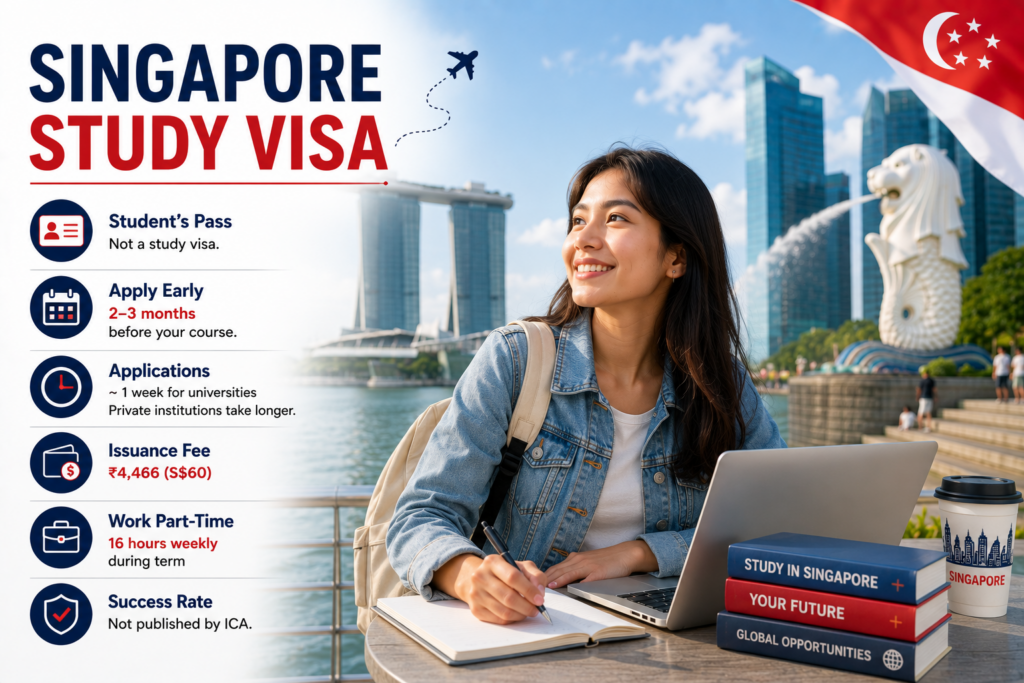
Quick Read
- ICA calls it a Student’s Pass, not a study visa.
- SOLAR or SOLAR+ applications go in 2 to 3 months before your course starts.
- University applications process in about a week; private institutions take longer.
- The Student’s Pass issuance fee is Rs. 4,466 (S$60) at today’s rate.
- Students can work 16 hours weekly during term, only at MOM-approved institutions.
- ICA does not publish the official success rate for Singapore study visas.
What a Singapore Study Visa Really Means for Indian Students
Singapore’s immigration authority, ICA, does not actually issue anything called a “study visa.” What you get is a Student’s Pass, a digital document tied to your course and institution, not a sticker in your passport. You’ll collect it through Singpass or FileSG once you’re in Singapore and have completed a short in-person step.
The one rule that causes the most confusion is: You cannot land on a tourist visa and switch to student status once there. Your Student’s Pass has to be approved, In-Principle Approval (IPA) letter in hand, before you board. That’s the whole logic behind a Singapore visa for Indian students: paperwork first, travel second.

Choose your dream country
 UK
UK
 USA
USA
 Germany
 Australia
 Ireland
 Canada
 UAE
UAE
 France
 Sweden
 Italy
Italy
 Other
Other
When do you want to study abroad?
What's your highest level of education?
Have you completed Class 12th?
What was your Class 12 CGPA/percentage?
Are you a student or a parent/guardian?
What do you want to study?
Select your current city
How Leap will help you

Personalised University Shortlist

Express Applications with Quicker Admits

End-to-End Application Support
My insight: Students who fly in "to sort things out in person" almost always end up flying straight back to India to restart the application from zero.
Singapore Visa for Indian Students: Eligibility for the 2027 Intake
There's no minimum percentage ICA asks for; that's your university's call, not immigration's. IELTS works the same way: a university requirement, not an ICA one. By the time you hold an offer letter, you've cleared both.
What ICA checks is funding, roughly Rs. 6 to 7.8 lakh (SGD 8,000 to 10,500) covering a year of tuition and living costs, whether from bank statements, a parent's income proof, or a scholarship letter.
| Program Level | Academic Requirement | Institutions |
|---|---|---|
| Undergraduate | Class 12 completion (CBSE, State Board, or ISC) | Government schools, IHLs, EduTrust PEIs |
| Postgraduate | Bachelor's degree from a recognised university | IHLs, EduTrust PEIs |
| Diploma | Class 10 or 12, depending on the course | Polytechnics, EduTrust PEIs |
| PhD or research | Master's degree or equivalent | NUS, NTU, SMU, SUTD, SIT |
Targeting a postgraduate research route? Cross-check your program against a Masters in Singapore breakdown before locking in your institution, since eligibility shifts slightly by department.
Documents You Need for Your Singapore Study Visa
This phase is where most Indian applicants lose time, not on the visa rules but on getting paperwork ready before their institution can open the SOLAR file.
| Document | What to know? |
|---|---|
| Indian passport | Valid at least 6 months past your course end date |
| Passport photo | 35mm x 45mm, white background, taken within 3 months |
| Letter of Acceptance | Triggers your SOLAR or SOLAR+ registration |
| eForm 16 | Filled online once your institution registers you, must match your passport exactly |
| Academic transcripts | CBSE marksheets as is; State Board marksheets need attestation, or an AIU equivalency certificate |
| Proof of funds | Last 6 months of bank statements, or a parent's ITR and salary slips if they're sponsoring you |
| Terms & Conditions acknowledgement | Signed off on SOLAR before your pass can be issued |
| Medical Examination Report | Only if your course runs 6 months or longer |
| SG Arrival Card | Filed online within 3 days of landing |
If you studied under a State Board other than CBSE or ICSE, start attestation now. It usually takes 2 to 4 weeks, and your institution cannot submit your SOLAR application without it.
My insight: The single most common delay isn't a missing document; it's a State Board marksheet stuck in an attestation queue nobody started early.
How the Singapore Study Visa Process Works: SOLAR and SOLAR+
SOLAR handles applications for universities, polytechnics, and government schools. SOLAR+ is built for private institutions, and which one applies depends on your offer letter.
Here's how the timeline shifts by situation:
Joining an IHL like NUS, NTU, or a polytechnic?
Your institution submits eForm 16 on SOLAR 2 to 3 months before your course starts, and your IPA letter should return within about a week. Most Indian students fall here.
Joining an EduTrust-certified private institution?
It's nearly identical, but budget closer to 2 weeks for your IPA. Confirm EduTrust status before applying, since non-certified PEIs can't sponsor a Student's Pass.
Are you above 21 and applying to a vocational, commercial, language, or fine arts course at a private institution?
ICA may call you in for an interview. Not a rejection signal, just the standard route for that category, but it can stretch things to 4 months.
Once your IPA letter arrives, pay the issuance fee, acknowledge the Terms & Conditions form, and submit your medical report if needed; then book your flight and file your SG Arrival Card. The IPA's validity is printed on the letter, usually around 2 months, and ICA does not extend it. Many universities run a group enrollment on campus once you land, so check before booking your ICA appointment.
My insight: Students on the interview track often assume they did something wrong. They didn't; it's simply the standard route for that course category.
Singapore Study Visa Fees in Indian Rupees
| Fee | In SGD | In INR | Paid When |
|---|---|---|---|
| SOLAR/SOLAR+ application fee | SGD 45 | Rs. 3,349 | At submission, non-refundable |
| Student's Pass issuance fee | SGD 60 | Rs. 4,466 | Once your IPA letter is issued |
| Multiple-journey visa (optional) | SGD 30 | Rs. 2,233 | With the issuance fee |
| Medical exam (if required) | N/A | Rs. 3,700 to 4,900 | At an approved clinic |
| Total, excluding medical exam | SGD 105 | Rs. 7,815 | N/A |
Sources: ICA, Approved Private Education Institutions; and ICA, Completion of Formalities and Issuance of Student's Pass.
This is the government side of Singapore study visa fees for settled Indian students. It's one of the cheaper visa processes among major study destinations, with no agent markup when you apply directly.
For the full cost picture, tuition and living costs together, the cost of studying in Singapore breakdown is worth reading alongside this guide.
Singapore Study Visa Processing Time and Success Rate for Indian Students
Processing time is not one number, and treating it like one is where many guides go wrong.
| Institution Type | Processing Time |
|---|---|
| University or polytechnic (IHL) | About 1 week, 2 weeks if a visa is also needed |
| EduTrust-certified private institution | About 2 weeks |
| Other approved private institution | Up to 1 month |
| Renewal or transfer application | About 1 week |
| Interview track (21+, vocational/language/fine arts courses) | Up to 4 months |
What's the Actual Success Rate for Indian Students?
ICA simply doesn't publish the success rate for Singapore study visas for Indian students, so if you see a specific percentage quoted anywhere online, it isn't from an official source; don't treat it as fact. What we do know from actual rejection cases: they cluster around a few avoidable causes, unattested marksheets, thin financial proof, or a passport that expires before the course ends. Fix those, and there's no real reason your application should struggle.
My insight: We've seen immaculate IHL applications clear in under a week, and equally clean PEI applications take the full month, purely because of the portal. Institution type sets the minimum speed.
Working in Singapore on Your Student’s Pass
- Up to 16 hours a week during term time, full-time during vacations, only at institutions on MOM's approved list. Confirm with your international office rather than assuming it.
- No separate work permit needed if you qualify, and your employer doesn't file anything extra either.
- Holding a PhD offer? SINGA covers tuition, stipend, and airfare, and the award letter can replace most of your financial proof on SOLAR+.
- Final-year undergrad exploring research? SIPGA is the closer fit.
- Neither applies? Look into other scholarships open to Indian students in Singapore before finalizing your funding plan.
- Once you've landed, check what part-time and post-study job opportunities actually look like for Indian students.
- Course ending? You get a week to surrender your pass, unless you convert to a Visit Pass to job hunt, valid for a year.
For more detailed information on the Singapore employment pass, check our blog on Singapore work visa for Indian professionals.
My insight: Not every EduTrust-certified institution sits on MOM's work-pass-exemption list. Students assume EduTrust status alone covers this; it doesn't.
What to Do If Your Singapore Study Visa Application Goes Wrong?
Rejected application: ICA tells your institution why, usually thin financial proof, unattested documents, or a passport that doesn't clear the 6-month buffer. Institutions can appeal with corrected paperwork, and most document issues resolve within 2 to 3 weeks.
Delayed board results: get a provisional certificate from your school and ask your institution to open the application with that, without assuming they'll act unprompted.
Expired IPA letter: no extension exists. Your institution submits a fresh application, and the entire clock restarts, which is why booking travel promptly after approval matters.
Missed the 2 to 3 month window: contact your international office immediately. Since ICA fixes that window, a late submission risks pushing your IPA past your start date, and a semester deferral may be your only option.
My insight: Students who recover fastest from a rejection call their institution's international office that same day, not a week later hoping ICA clarifies things unprompted.
Your Singapore Study Visa Timeline for the January 2027 Intake
Singapore universities and polytechnics generally run two intake windows a year: a bigger August intake (applications open around December) and a smaller January intake (applications open around July). Some PEIs add a February or May start too.
If you're reading this in the second half of 2026, the August 2026 window has already closed for most institutions, which makes January 2027 the next realistic intake to plan around.
| Period | What happens? |
|---|---|
| July to August 2026 | Apply to your chosen university, polytechnic, or PEI |
| September 2026 | Accept your offer and pay the deposit (typically Rs. 22,000 to 1,12,000) |
| October to November 2026 | Your institution submits your SOLAR/SOLAR+ application |
| November 2026 | ICA processes your application, 1 week to 1 month depending on institution type |
| Late November to December 2026 | Your IPA letter arrives |
| December 2026 | Medical exam, fee payments, and booking your ICA appointment |
| Late December 2026 | Travel to Singapore |
| Early January 2027 | Complete formalities, collect your digital Student's Pass |
Once January 2027 passes, the next window is August 2027, shift every row forward by about seven months. Either way, the anchor stays the same: your course start date minus that 2 to 3 month SOLAR window.
My insight: The riskiest month here is the SOLAR submission window itself, October to November for a January intake. Everything before it can slip a little; that one can't.
3 Key Takeaways on Singapore Study Visa
- Stop treating processing time as a single number. Confirm your institution's exact bracket, IHL, EduTrust PEI, or interview track, and plan around that figure.
- Attest your marksheets early if you're not on CBSE or ICSE. Get this done weeks before your institution needs to submit.
- Check your IPA letter's validity the day it arrives. Book your travel well inside that window, since there's no second chance once it lapses.
Verified by: LeapScholar's Singapore counseling team, with hands-on experience guiding Indian students through the SOLAR and SOLAR+ Student's Pass process.
Have questions about your own Singapore study visa timeline? Book a free session with a LeapScholar counselor.
Frequently Asked Questions About Singapore Study Visa for Indian Students
-
Do I need IELTS for the Singapore student visa itself?
No. IELTS is a university admissions requirement, not something ICA checks. Once you hold an offer letter, that requirement is already satisfied.
-
How long does the Singapore study visa actually take?
It depends on your institution type. University and polytechnic applications usually clear within a week, EduTrust private institutions within two weeks, other private institutions within a month, and interview-track applicants can wait up to four months.
-
What's the real Singapore study visa price if my first application fails and I need to reapply?
You'd pay the SGD 45 application fee again, since it's non-refundable the first time too. The issuance fee only kicks in once approved, so a clean application the first time saves you from paying that Singapore study visa price for Indian applicants twice over. That's the real reason the Singapore study visa price for Indian students can end up higher than the table above suggests.
-
Can my parents stay with me on my Student's Pass?
No, a Student's Pass doesn't extend to family. Parents or spouses need their own Short-Term Visit Pass, capped at 30 days and extendable once through ICA.
-
What happens if I defer my course after getting my pass?
Your Student's Pass gets cancelled the moment you're no longer actively enrolled. Your institution notifies ICA, you surrender the pass, and re-enrolling later means a fresh SOLAR application from scratch.
-
Is the Singapore study visa fee the same no matter how long my course is?
Yes, government fees don't scale with course length. The only exception is the medical exam, which applies if your course runs six months or longer.
-
Can I work part-time while holding a Singapore study visa?
Yes, up to 16 hours a week during term time, but only if your specific institution is on MOM's approved list. Full-time work during vacations has no such restriction.
-
Is there an official Singapore study visa success rate for Indian students?
No, ICA doesn't release one. Numbers quoted elsewhere aren't from an official source. What actually predicts approval is document quality: attested marksheets, solid financial proof, and a passport with enough runway left.






Have Questions? Get Guidance to reach your Dream University
Connect with India's finest counsellors and biggest study abroad community.
Get Guidance