
Quick Read
- NUS ranks 10th, NTU 12th in QS World Rankings 2027.
- Tuition: SGD 17,000–50,000 (INR 12.53L–36.86L) per year.
- MOE Tuition Grant cuts fees 40–60%, with a 3-year bond.
- EP salary rises to SGD 6,000 (INR 4.42L) in 2027.
Why Study in Singapore for Indian Students in 2026-27?
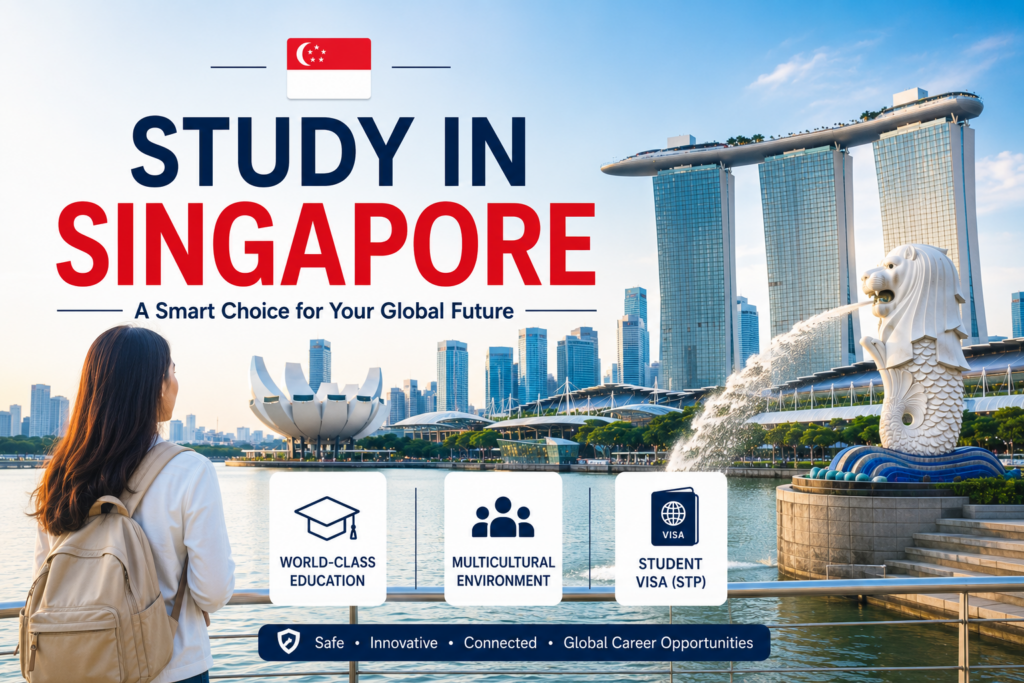
Here’s what makes Singapore worth your shortlist. The National University of Singapore (NUS) ranks 10th globally and Nanyang Technological University (NTU) ranks 12th in the QS World University Rankings 2027, putting two of Asia’s top-ranked universities within reach. Singapore Management University (SMU) sits at joint 411th, still a strong name in business and law.
Three things matter to you as an Indian applicant:

Choose your dream country
 UK
UK
 USA
USA
 Germany
 Australia
 Ireland
 Canada
 UAE
UAE
 France
 Sweden
 Italy
Italy
 Other
Other
When do you want to study abroad?
What's your highest level of education?
Have you completed Class 12th?
What was your Class 12 CGPA/percentage?
Are you a student or a parent/guardian?
What do you want to study?
Select your current city
How Leap will help you

Personalised University Shortlist

Express Applications with Quicker Admits

End-to-End Application Support
- English-medium instruction: If your schooling was fully in English, you likely skip a separate test as a CBSE or ISC student.
- Short flight time: under six hours from any major Indian metro.
- Cultural familiarity: Tamil is one of Singapore's four official languages, easing the move for South Indian students.
Counselor insight: Families often compare study in Singapore against the UK, US, or Australia purely on tuition. What decides the case is total cost over the full program, including the 3-year bond if you take the MOE Tuition Grant.
Top Universities to Study in Singapore: Rankings, Fees and Courses
| University | QS Rank 2027 | Known For | Approx. Annual Tuition (International) |
| National University of Singapore (NUS) | 10 | Engineering, Computing, Medicine, Law | SGD 17,000–40,000+ (INR 12.53L–29.49L+) |
| Nanyang Technological University (NTU) | 12 | Engineering, Business, AI/Data Science | SGD 20,000–40,000 (INR 14.74L–29.49L) |
| Singapore Management University (SMU) | 411 | Business, Accountancy, Law | SGD 25,000–45,000 (INR 18.43L–33.17L) |
| Singapore University of Technology and Design (SUTD) | Not separately QS-ranked | Design, Engineering (MIT collaboration) | SGD 20,000–35,000 (INR 14.74L–25.80L) |
| Singapore Institute of Technology (SIT) | Not separately QS-ranked | Applied degrees, industry placements | SGD 18,000–30,000 (INR 13.27L–22.12L) |
Fees at universities in Singapore for international students vary by program, GST, and whether the MOE Tuition Grant applies and shift by intake year.
For a full university-by-university breakdown, see top universities in Singapore.
Counselor insight: Students fixate on NUS and NTU because they're the names they've heard of. But SMU's accountancy program and SIT's industry-placement model produce strong outcomes for students who wouldn't clear NUS's or NTU's 90%+ cutoff. Match the university to your profile, not the name recognition.
Cost to Study in Singapore: Tuition and Living Expenses
The study in Singapore cost breaks down into tuition and living expenses, summarized below.
| Cost Category | SGD (per year, unless noted) | INR Equivalent | Notes |
| UG Tuition (Public university) | 17,000–40,000 | 12.53L–29.49L | Varies by university and program |
| PG/Professional Tuition (Medicine, Law, MBA) | 40,000–50,000+ | 29.49L–36.86L+ | Highest for Medicine, Law, MBA |
| Living Expenses | 9,600–18,000 (SGD 800–1,500/month) | 7.08L–13.27L (58,976–1,10,580/month) | Accommodation, food, transport, personal expenses |
| Part-time Work Offset | Up to 16 hrs/week during term | N/A | Can offset a meaningful part of living costs |
Exchange rate used throughout this article: 1 Singapore Dollar (SGD) equals INR 73.72. Verify the current rate before finalizing your budget.
Sources: NUS Official Fee Schedule
For a full monthly living-cost breakdown by category and city area, see our cost of living in Singapore guide.
Counselor insight: Students budget tuition carefully and then underestimate the deposit structure. Most universities require the first semester's fee upfront before you've even received your Student Pass. Keep that amount in a transferable account, not a fixed deposit, by the time you accept your offer.
Is Singapore Free? Scholarships and the MOE Tuition Grant
Study in Singapore is not free, but it is heavily subsidized for eligible students. The study in the Singapore scholarship landscape is split into the MOE Tuition Grant (a subsidy with a bond) and merit-based awards (mostly bond-free).
| Scholarship/Grant | Offered By | Level | Key Benefit | Bond |
| MOE Tuition Grant | Ministry of Education (MOE) | UG (selected PG) | Reduces tuition by 40–60% at NUS, NTU, SMU, SUTD, SIT | Yes, 3-year work bond |
| Singapore International Graduate Award (SINGA) | A*STAR, NUS, NTU, SMU, SUTD | PhD | Full tuition + monthly stipend ~SGD 2,700 (INR 1.99L) | No |
| Nanyang Scholarship | NTU | UG | Full tuition + living allowance: SGD 6,500/year (INR 4.79L) | No (beyond MOE Tuition Grant bond, if applicable) |
| Lee Kong Chian Scholars' program | SMU | UG | Full 4-year tuition waiver + notebook grant + overseas exposure | No (beyond MOE Tuition Grant bond, if applicable) |
Breaking the MOE Tuition Grant bond means repaying the subsidized amount as liquidated damages, so weigh the exit plan before accepting it.
For the complete scholarship list, see our scholarships in Singapore guide.
Sources: MOE Tuition Grant Scheme | A*STAR SINGA Scholarships | NTU Nanyang Scholarship | SMU Lee Kong Chian Scholars' program
Counselor insight: Students often accept the MOE Tuition Grant without weighing the exit plan. If your goal after graduating is a master's in the US or a job back in India, the 3-year bond becomes a constraint. Decide your post-graduation plan before you sign.
Documents Checklist to Study in Singapore
| Document | India-Specific Detail |
| Class 10 and 12 marksheets | CBSE, ICSE, or state board originals plus notarized English translation if not in English |
| Medium of Instruction (MOI) letter | Issued by your Indian university/school registrar; can waive IELTS/TOEFL for NUS and NTU if your prior education was fully in English |
| English proficiency scores | IELTS (typically 6.0–7.0) or TOEFL, unless waived via MOI letter |
| Passport | Valid for at least 6 months beyond your intended study period |
| Passport-size photograph | Digital, colour, taken within the last 3 months, per ICA specifications |
| Financial proof | Bank statements or education loan sanction letter covering tuition and living costs |
| Offer letter / Registration Acknowledgement | Issued by your Singapore university after admission, required to start the Student Pass application |
Counselor insight: The MOI letter is the most underused document among Indian applicants. It can save the cost and scheduling hassle of a fresh IELTS attempt, but most Indian registrars take 2 to 4 weeks to issue it. Request it the same week you decide to apply.
Student Pass: Singapore Visa Requirements for Indian Students
Every international student studying full-time in Singapore for more than 30 days needs a Student's Pass, issued by the Immigration and Checkpoints Authority (ICA). Your university initiates the application; students cannot apply to ICA directly.
- University registers you on the SOLAR (Student's Pass Online Application & Registration) system after you accept your offer.
- Complete the eForm16 with personal and academic details; pay a non-refundable SGD 45 (INR 3,317) processing fee.
- ICA reviews and issues an In-Principle Approval (IPA) letter, your entry document into Singapore.
- After arrival, attend an in-person ICA appointment for biometrics and collect your physical Student's Pass, paying a SGD 60 (INR 4,423) issuance fee.
Processing typically takes 1 to 4 weeks, longer during the June to August peak season.
Counselor insight: The most common cause of delay isn't a rejected application; it's a mismatched detail between your offer letter and passport, like a shortened or missing middle name. Check every field before your university submits SOLAR on your behalf.
Which Path Are You On? A Decision Framework for Studying in Singapore
- If you are a Class 12 CBSE or ISC student targeting the August 2027 intake: You need 90%+ overall, including English, for NUS or NTU. Below that, SMU, SIT, or James Cook University Singapore are genuinely viable, not fallbacks. Start IELTS or SAT prep in Class 11, since applications for August 2027 open around October 2026. Check whether your board results, typically declared in May, will be ready before the deadline or whether you'll apply with predicted grades.
- If you are a final-year graduate comparing study in Singapore against a master's in the UK, Canada, or the US: Students who study masters in Singapore at NUS or NTU often pay less in total than a 2-year Canadian or US program, purely due to the shorter 12 to 18-month duration. The trade-off: Singapore has no dedicated post-study work visa, so you need a job clearing the Employment Pass or S Pass threshold within your post-study window.
- If you are a working professional considering an MBA or part-time master's at NTU or SMU: SMU's MBA is generally the more India-friendly option on cost; NTU's Nanyang MBA and INSEAD's Singapore campus sit at the premium end. Below a 650 GMAT, SMU is realistic; 700+ with leadership experience makes NTU or INSEAD worth it.
See our top courses in Singapore guide for a full ROI comparison.
Counselor insight: Indian applicants often decide "Singapore or not" before deciding which of these three profiles they actually are. The right question isn't whether Singapore is good; it's whether Singapore is good for your specific stage and goal.
Planning Calendar: Singapore Intakes Mapped to the Indian Academic Year
| Month (2026-27 Cycle) | What to Do |
| June–July 2026 | Class 12 board results declared; shortlist universities and confirm English proficiency requirement |
| August–October 2026 | NUS, NTU, and SMU open applications for the August 2027 intake |
| October 2026 | January 2027 intake applications open at select private and graduate programs |
| December 2026–February 2027 | NUS and NTU application deadlines for August 2027 intake (varies by program; confirm on each university's admissions page) |
| February–March 2027 | Offer letters released; accept offer and pay initial deposit within 2–4 weeks |
| March–April 2027 | University initiates Student's Pass application via SOLAR |
| May–July 2027 | ICA processes Student's Pass; arrange accommodation and pre-departure formalities |
| August 2027 | Classes begin for the main intake |
For program-specific deadlines and the full list of intakes across public and private institutions, see our intakes in Singapore guide.
Counselor insight: Students who wait for board results before shortlisting universities lose 6 to 8 weeks they don't have. Shortlist against your predicted Class 12 percentage in April, and adjust only if your actual result changes your options.
Working in Singapore After You Graduate: EP, S Pass and the 2027 Salary Change
Most students are unaware that Singapore has no dedicated post-study work visa. After your Student's Pass expires, you need a job clearing either the Employment Pass (EP) or S Pass salary floor.
| Work Pass | Current Minimum (Most Sectors) | Current Minimum (Financial Services) | From 1 January 2027 (Most Sectors) | From 1 January 2027 (Financial Services) |
| Employment Pass | SGD 5,600 (INR 4.13L) | SGD 6,200 (INR 4.57L) | SGD 6,000 (INR 4.42L) | SGD 6,600 (INR 4.87L) |
| S Pass | SGD 3,300 (INR 2.43L) | SGD 3,800 (INR 2.80L) | SGD 3,600 (INR 2.65L) | SGD 4,000 (INR 2.95L) |
Sources: MOM Employment Pass Eligibility | MOM S Pass Eligibility
Both floors rise further with age, and the 2027 rates apply to new applications from 1 January 2027 and renewals expiring from 1 January 2028. EP applicants must also clear COMPASS, a points-based framework requiring at least 40 points across salary, qualifications, and workforce diversity.
Students on the MOE Tuition Grant bond need this job regardless; those without a bond have more flexibility to return to India if they can't clear the new threshold.
See our permanent residency in Singapore guide for the EP-to-PR pathway and our job opportunities and average salary guides for realistic starting pay by sector.
Counselor insight: Computer Science and Data Science graduates from NUS or NTU are least affected by this change, since tech starting salaries already clear the new SGD 6,000 floor. Students in humanities, hospitality, or general business should model their expected salary against the 2027 threshold before committing to a bonded Tuition Grant.
What to Do If Your Application Doesn't Go to Plan
- Your IELTS score comes back below the requirement. Book a retest immediately; results are typically available within 13 days. Most universities accept a retest score submitted after the deadline with prior notice.
- You miss the August intake deadline. Check whether your program also runs a January intake; NUS Business School, SMU, and select NTU graduate programs do. If not, the next opportunity is usually August the following year.
- Your Student's Pass application is rejected. ICA doesn't always state a reason. Your university's international office can submit an appeal, typically resolved within about 4 weeks. Common causes are mismatched details between your offer letter and passport or incomplete financial documentation.
Counselor insight: A rejected Student's Pass is not the same as a rejected admission. Students sometimes assume the worst and start exploring other countries when the actual fix is a document correction and a straightforward reapplication.
3 Takeaways on Study in Singapore for Indian Students
Study in Singapore works best for Indian students who match their profile honestly, budget for the full bond commitment, and plan their post-graduation work pass eligibility in advance. Three takeaways:
- Match your profile to the right university. Confirm whether your Class 12 or graduate profile realistically clears NUS/NTU (QS 2027: #10, #12) or fits better at SMU, SIT, or a private university.
- Decide on the MOE Tuition Grant bond before signing. The 40–60% fee reduction comes with a 3-year work bond; weigh it against your actual career plan first.
- Check the 2027 Employment Pass floor before committing. If you plan to work in Singapore after graduating, benchmark your target salary against the SGD 6,000 (INR 4.42L) EP minimum effective 1 January 2027.
Verified by: LeapScholar's Singapore counseling team, with hands-on experience guiding Indian students through university admissions, Student Pass applications, and post-study planning in Singapore.
Have questions about studying in Singapore? Book a free session with a LeapScholar counselor.
Frequently Asked Questions About Study in Singapore for Indian Students
-
Can Indian students study in Singapore after 12th?
You have more options than just NUS and NTU. Apply to NUS, NTU, SMU, or private institutions right after Class 12 from CBSE, ICSE, or a recognized state board. NUS and NTU expect 90%+ overall, including English, while SMU, SIT, and private universities give a broader window.
-
What is the total cost to study in Singapore for Indian students?
Budget SGD 17,000 to 50,000 (INR 12.53L to 36.86L) a year in tuition, plus SGD 800 to 1,500 (INR 58,976 to 1,10,580) a month in living costs. The MOE Tuition Grant cuts tuition by 40 to 60 percent, but you'll owe a 3-year bond in return
-
Is study in Singapore free for Indian students?
Not free, but genuinely subsidized if you qualify. The MOE Tuition Grant brings fees down 40 to 60 percent, with a 3-year bond attached. Want to skip the bond? Fully-funded routes like SINGA exist for PhD students.
-
How many intakes do universities in Singapore for international students offer?
Usually two a year: a main intake in August and a smaller one in January. Private institutions like PSB Academy sometimes add February and September intakes too.
-
What English test score do I need to study in Singapore?
Most universities ask for IELTS 6.0 to 7.0 or an equivalent TOEFL score. If your entire education was in English, ask your registrar for a Medium of Instruction (MOI) letter; it can waive the test.
-
Can I work part-time while I study in Singapore?
You can work up to 16 hours a week during term and full-time during vacations without a separate work permit.
-
What happens if I can't clear the Employment Pass salary after graduating?
You still have options: a Long-Term Visit Pass where eligible, further studies, or returning to India. From 1 January 2027, the EP minimum rises to SGD 6,000 (INR 4.42L), so model your target salary against this before graduation, especially on an MOE Tuition Grant bond.
-
Is a Singapore degree valued the same as a UK or US degree by Indian employers?
It holds up well. NUS and NTU degrees, both ranked in the global top 15 in the QS World University Rankings 2027, carry strong recognition with Indian and multinational employers, particularly in engineering, computing, and finance.
-
Do I need an education loan to study in Singapore, and will Indian banks fund it?
Most students do, and Indian banks, including SBI, HDFC Credila, and Axis Bank, offer loans covering tuition, living costs, and airfare. You'll need Indian citizenship, an admission offer, and a co-applicant with stable income.







Have Questions? Get Guidance to reach your Dream University
Connect with India's finest counsellors and biggest study abroad community.
Get Guidance