
Quick Read
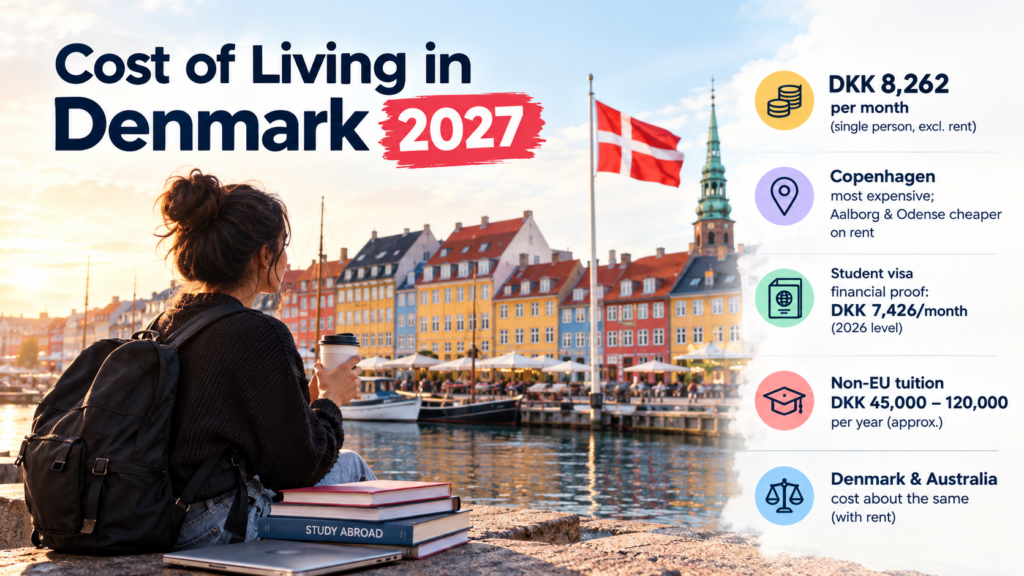
- Average cost of living in Denmark is DKK 8,262 a month for a single person, excluding rent (Numbeo, Sep 2026).
- Copenhagen is the most expensive city; Aalborg and Odense run noticeably cheaper on rent.
- The official Danish student visa financial proof requirement is DKK 7,426 a month (2026 level).
- Non-EU tuition ranges from roughly DKK 45,000 to DKK 120,000 a year, depending on the programme.
- Denmark and Australia end up costing about the same once rent is part of the picture, even though Denmark looks pricier at first glance.
Cost of Living in Denmark: Monthly Overview
Numbeo’s latest numbers for Denmark, updated this September, put a single person’s monthly costs at DKK 8,262 excluding rent. A family of four is looking at DKK 30,162. Add typical rent and a single student renting a one-bedroom flat is looking at roughly DKK 15,700 a month all-in.
| Category | Monthly Cost (DKK) | Approx. INR |
|---|---|---|
| Living costs, single person, excl. rent | 8,262 | Rs.1.21L |
| Living costs, family of four, excl. rent | 30,162 | Rs.4.43L |
| 1-bedroom apartment, city centre | 7,422 | Rs.1.09L |
| 1-bedroom apartment, outside centre | 5,858 | Rs.0.86L |
Source: Numbeo, Cost of Living in Denmark, Sep 2026

Choose your dream country
 UK
UK
 USA
USA
 Germany
 Australia
 Ireland
 Canada
 UAE
UAE
 France
 Sweden
 Italy
Italy
 Other
Other
When do you want to study abroad?
What's your highest level of education?
Have you completed Class 12th?
What was your Class 12 CGPA/percentage?
Are you a student or a parent/guardian?
What do you want to study?
Select your current city
How Leap will help you

Personalised University Shortlist

Express Applications with Quicker Admits

End-to-End Application Support
These national figures are a starting point. If you search separately for the cost of living in Aalborg Denmark or Copenhagen specifically, expect the real numbers to sit noticeably above or below this average, which is exactly what the next section breaks down.
My insight: These are national averages, not what you'll actually pay. Denmark's cost of living varies more by city than most European countries, which is why the next section matters more than this one for your actual budget.
Cost of Living in Copenhagen vs Aarhus vs Aalborg
Since "cost of living in Denmark" really means a different number depending on which city you land in, Numbeo's own city indices are the cleanest way to compare cost of living in Denmark Aarhus, Aalborg, and the capital side by side. Copenhagen sets the ceiling; Aalborg and Odense sit meaningfully lower, mainly on rent.
| City | Cost of Living Index | Rent Index | How It Compares to Copenhagen |
|---|---|---|---|
| Copenhagen | 90.1 | 41.6 | Baseline, most expensive |
| Aarhus | 82.2 | 29.4 | 9% cheaper day-to-day, 29% cheaper rent |
| Aalborg | 80.9 | 20.9 | 10% cheaper day-to-day, 50% cheaper rent |
| Odense | 76.5 | 20.9 | 15% cheaper day-to-day, 50% cheaper rent |
If you're specifically weighing the cost of living in Aalborg Denmark against Copenhagen, the rent gap is the number that matters most: Aalborg rent runs at roughly half of Copenhagen's index. Aarhus cost of living sits closer to the capital, but still comes in meaningfully cheaper on rent. The average cost of living Copenhagen carries is driven almost entirely by that rent premium, not by groceries or transport, which stay fairly close across all four cities.
A Realistic Student Budget in Denmark
This is the cost of living in Denmark as a student in a smaller city like Aarhus or Horsens. Copenhagen students should expect the rent line to roughly double, pushing the total closer to DKK 10,000-12,000 a month. If your city search is really about Aarhus cost of living specifically, this VIA breakdown is the closest thing to an official number available.
| Expense | Monthly Cost (DKK) | Approx. INR |
|---|---|---|
| Rent incl. utilities | 3,000-4,000 | Rs.44K-59K |
| Food | 1,900 | Rs.28K |
| Transport | 200 | Rs.3K |
| Phone and internet | 300 | Rs.4.4K |
| Insurance | 200 | Rs.3K |
| Books and supplies | 200 | Rs.3K |
| Other personal expenses | 1,000 | Rs.15K |
| Total | 6,500-7,500 | Rs.95K-1.10L |
Source: VIA University College, Living Costs in Denmark
Cost of Living in Denmark vs Australia and the USA
Two comparisons come up constantly when students are choosing between destinations, so here's what Numbeo's own comparison tool actually shows, not a rounded guess.
| Comparison | What Numbeo Shows |
|---|---|
| Cost of living in Denmark vs Australia (excl. rent) | Australia is 5.4% cheaper |
| Cost of living in Denmark vs Australia (incl. rent) | Australia is 2.9% more expensive, since Australian rent runs 32.7% higher |
| Cost of living in Denmark vs America | Denmark is 14.6% higher overall |
| Rent, Denmark vs America | Denmark is 28.6% lower |
The pattern is consistent across both comparisons: Denmark's rent is actually lower than you'd expect for a Nordic country, and day-to-day costs (restaurants, groceries) are what push the overall number up. If the cost of living in Denmark vs America is your specific concern, factor in that the gap narrows considerably once you account for Denmark's free healthcare and free tuition for EU students.
My insight: Students comparing Denmark to Australia often only look at the headline cost of living number and miss that Australian rent is the actual deciding factor, not groceries or transport. If your budget is rent-sensitive, run the comparison with rent included, not excluding it.
Financial Proof Requirement for a Danish Student Visa
Every non-EU student must show they can support themselves to obtain a residence permit from Denmark's immigration authority (SIRI). This figure is set annually and is not negotiable.
- Monthly requirement: DKK 7,426 (2026 level)
- Maximum documentation required: DKK 89,112, capped at 12 months even for longer programs
- Accepted proof: bank statement, scholarship award letter, or evidence that your first semester's tuition is already paid
Source: New to Denmark (nyidanmark.dk), Higher Educational Programmes
If your program runs longer than a year, you only need to document 12 months at a time, not the full length of your degree. Our Denmark student visa guide walks through the rest of the application checklist.
Tuition Fees at Danish Universities
EU, EEA, and Swiss citizens pay no tuition at Danish public universities. Non-EU students pay per program, and the range is wide enough that it's worth checking your specific course rather than assuming a flat number.
| University | Tuition (Non-EU, per year) | Approx. INR |
|---|---|---|
| Technical University of Denmark (DTU) | EUR 15,000 | Rs.16.46L |
| Aalborg University | DKK 79,100-115,700 (program-dependent) | Rs.11.6L-17.0L |
| University of Copenhagen | DKK 75,000 | Rs.11.0L |
| Aarhus University | EUR 8,000-15,300 | Rs.8.8L-16.8L |
Sources: DTU, Fees and Funding, Aalborg University, Finance and Fees
Our guide to top universities in Denmark breaks down program-specific fees if you've already shortlisted a course.
Scholarships and the SU Grant
The SU (Statens Uddannelsesstøtte) is Denmark's own state education grant, but it's built for Danish and EU students working part-time in Denmark, not a general international scholarship. Non-EU students should look at university-specific routes instead.
- Danish Government Scholarships: tuition waiver plus, in some cases, a living stipend, allocated directly by each university to strong non-EU applicants
- Aalborg University merit scholarships: a monthly stipend of DKK 11,225 (2026 rate) alongside a tuition waiver, paid for the standard four-semester master's duration
- Erasmus Mundus Joint Masters: fully funded joint programs that include Danish universities as partners
For a complete scholarship landscape before applying, our Danish Government Scholarship guide lists eligibility windows for each university.
Source: Aalborg University, Finance and Fees
How to Reduce Your Cost of Living in Denmark?
A few things can really help a Danish student budget, beyond the generic "cook at home" advice.
- If you're eligible to work: non-EU students can work 20 hours a week during the term and full-time in June, July, and August. At typical Danish student wages, that alone can cover a third of your monthly budget.
- If groceries are eating your budget: Netto, Rema 1000, and Fakta run noticeably cheaper than the premium chains. The price gap on staples is real, not marketing.
- If you want to cut food costs further: the "Too Good To Go" app connects you with bakeries and restaurants selling unsold food at a fraction of the price.
- If you're deciding between a bike and a car: a decent used bike costs DKK 500-1,500 once; petrol and car ownership in Denmark are heavily taxed, so most students skip owning a car entirely.
- If you haven't locked in housing yet: applying for a dorm room before a private rental usually pays off, since dorm rent typically includes utilities and removes a variable that catches most first-year students off guard.
For the work side of the equation, our guide to jobs in Denmark for international workers covers what's actually available to students on a study permit.
3 Key Takeaways on Cost of Living in Denmark
- Price your specific city, not the national average. The gap between Copenhagen and Aalborg on rent alone is close to 50%. Anyone researching the cost of living in Denmark as a student should start with their actual city, not a countrywide number.
- Confirm your visa financial proof figure directly on nyidanmark.dk before you apply, since it updates every year and the number you find elsewhere may already be outdated.
- Factor in your 20-hour work allowance as real income, not a nice-to-have. It's often the difference between a tight budget and a comfortable one.
Verified by: LeapScholar's Europe team, who work with Indian students on Denmark budgets and visa applications every intake cycle.
Have questions about the cost of living in Denmark? Book a free session with a LeapScholar counselor and get personalized advice.
Frequently Asked Questions About Cost of Living in Denmark
-
What is the average cost of living in Denmark per month?
For a single person, the budget is DKK 8,000 to 8,300 a month, excluding rent, based on Numbeo's current data. Add rent and a realistic all-in figure for a student, which sits between DKK 6,500 in a smaller city and DKK 12,000 in Copenhagen. The average cost of living in Copenhagen specifically pulls toward the higher end of that range because of rent, not day-to-day spending.
-
Is the cost of living in Copenhagen much higher than the rest of Denmark?
Yes, mainly because of rent. Copenhagen's rent index runs close to double Aalborg's and Odense's, while everyday costs like groceries and transport stay fairly similar across Danish cities.
-
How does the cost of living in Denmark compare to Australia?
It depends on whether you include rent. Day-to-day costs are actually a bit cheaper in Australia, but Australian rent runs over 30% higher than Denmark's, so the two end up close once you add housing into the comparison.
-
Is Denmark pricier than the USA?
Overall, yes, Denmark is about 15% more expensive on day-to-day costs. Rent works the other way, though, since Danish rent is nearly 29% lower than typical US rent, which softens the gap considerably if housing is a big chunk of your budget.
-
What proof of funds do I need for a Danish student visa?
You need to show DKK 7,426 per month of study (2026 level), capped at DKK 89,112 for any 12-month period, even if your program runs longer. A bank statement, scholarship letter, or proof of paid tuition all count as valid documentation.
-
Do I have to pay tuition to study in Denmark?
Not if you're an EU, EEA, or Swiss citizen; tuition is free at all Danish public universities for you. Non-EU students pay per program, typically DKK 45,000 to 120,000 a year depending on the subject and institution.
-
Can international students work while studying in Denmark?
Yes. Non-EU students on a study residence permit can work 20 hours a week during term time and full-time in June, July, and August, which meaningfully offsets the cost of living in Denmark for students who plan ahead and treat that income as part of the budget rather than a bonus.
-
Is Aarhus cheaper than Copenhagen for students?
Yes, noticeably. The cost of living in Aarhus runs about 9% cheaper on everyday costs and close to 30% cheaper on rent, based on Numbeo's city-level index. It's the most commonly cited budget-friendly alternative to Copenhagen among students who still want a large-city experience, and it's a fair answer whether you're checking the cost of living in Denmark, Aarhus specifically, or just comparing the two biggest cities generally.











Have Questions? Get Guidance to reach your Dream University
Connect with India's finest counsellors and biggest study abroad community.
Get Guidance