
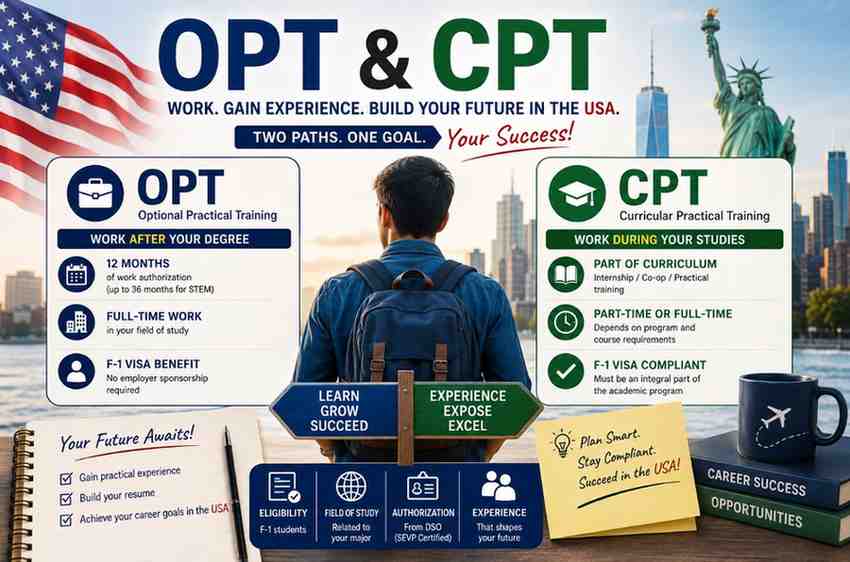
Quick Read
- CPT is authorised by your DSO during your degree program.
- OPT gives 12 months, or 36 months for STEM graduates.
- Twelve months of full-time CPT eliminates your OPT eligibility.
- The OPT application fee is Rs.44,932 filed online.
- Indian OPT participants crossed 97,000 in the 2023-24 year.
- From September 2026, OPT requires an extension of stay filing.
What OPT and CPT Actually Are
OPT and CPT are the two work authorisations available on an F-1 visa. They differ on who signs off, when you can use them, and what happens to your degree timeline.
OPT: Optional Practical Training

Choose your dream country
 UK
UK
 USA
USA
 Germany
 Australia
 Ireland
 Canada
 UAE
UAE
 France
 Sweden
 Italy
Italy
 Other
Other
When do you want to study abroad?
What's your highest level of education?
Have you completed Class 12th?
What was your Class 12 CGPA/percentage?
Are you a student or a parent/guardian?
What do you want to study?
Select your current city
How Leap will help you

Personalised University Shortlist

Express Applications with Quicker Admits

End-to-End Application Support
- Who authorises it: USCIS, through Form I-765. Your DSO recommends it, but the federal government decides.
- What you get: an Employment Authorization Document (EAD) card. Work before the start date on that card is a status violation.
- How long: 12 months for non-STEM graduates. STEM graduates can add 24 months, reaching 36 in total.
- Job link: the role must relate directly to your major. You do not need an offer in hand to apply.
Pre-completion OPT is used while you are still studying.
- Requires one full academic year completed at an SEVP-certified institution.
- 20 hours a week maximum while classes are in session, full-time during official breaks.
- Every month used here is subtracted from your post-completion OPT. This is the part students miss.
Post-completion OPT is used after you finish your degree.
- Minimum 20 hours a week to count as employed.
- The 90-day unemployment clock starts on your EAD start date, not on graduation day.
- STEM-tagged degrees can file for the 24-month extension before this period ends.
Cap-gap bridges the gap between OPT expiry and an H-1B start date, provided your employer filed a cap-subject petition requesting an October 1 start while you were still in valid status.
CPT: Curricular Practical Training
- Who authorises it: your Designated School Official (DSO), who endorses it on your Form I-20. No federal filing, no fee, usually about a week.
- What it covers: internships, co-ops and projects with employers your institution has an arrangement with.
- The condition: the work must be integral to your curriculum, not merely related to it. Most programs require it to carry academic credit.
- Eligibility: valid F-1 status plus one full academic year of enrolment.
- The limit that matters: 12 months or more of full-time CPT at one degree level removes your post-completion OPT at that level entirely. Full-time means more than 20 hours a week. Part-time CPT does not count.
Counselor insight: Students treat CPT as the easy option because the DSO turns it around in a week. The cost is invisible until final semester, when someone adds up three full-time co-op semesters and realises OPT is gone. Track your cumulative full-time months from the first authorisation, not the third.
OPT and CPT Compared: The Differences That Decide Your Timeline
| Point of difference | CPT | OPT |
|---|---|---|
| Full form | Curricular Practical Training | Optional Practical Training |
| Who authorises | Your Designated School Official | USCIS |
| Document produced | I-20 with CPT endorsement | Employment Authorization Document |
| When it applies | During your programme | Mainly after completion |
| Federal fee | None | Rs.44,932 ($470) online |
| Processing time | About 5 to 7 working days | Typically 2 to 4 months |
| Hours permitted | Part-time or full-time | Full-time after completion |
| Employer constraint | Specific employer named in advance | Any employer in your field |
| Curriculum link | Must be integral to your program | Must relate to your field of study |
| Effect on the other | 12 months full-time ends OPT at that level | Does not affect CPT |
Counselor insight: The difference students underestimate is processing time. CPT turns around in about a week through your DSO, so it feels routine. OPT is a federal filing that can take two to four months, which means the decision to apply happens a full semester before you need the authorisation.
How CPT Works and the 12-Month Rule That Ends OPT Eligibility
To be eligible for CPT you need valid F-1 status, one full academic year of enrolment, employment that is integral to your curriculum, and DSO authorisation issued before your start date. Starting work one day early is a status violation, not a technicality.
The rule that matters most sits at 12 months. Under 8 CFR 214.2(f)(10)(i), if you accumulate 12 months or more of full-time CPT at one educational level, you become ineligible for post-completion OPT at that level. Full-time means more than 20 hours a week. Part-time CPT does not count toward the total at all.
The consequence is absolute rather than proportional. You do not get a shortened OPT period. You get none at that degree level, and the loss is permanent.
CPT itself has no lifetime cap. Authorisation is granted in increments, usually semester by semester, and you must stay enrolled full-time throughout. If you lose the job or drop below a full course load, the authorisation ends.
Counselor insight: The students who lose OPT this way are almost never reckless. They accept a full-time co-op because the money is good, then accept a second one, and nobody adds up the months across the degree. Count your cumulative full-time CPT total before you say yes to the second offer, not after.
How to Apply for OPT and What It Costs in 2026-27
- Request the OPT recommendation from your DSO, who enters it in SEVIS and issues a new I-20.
- File Form I-765 within 60 days of that recommendation and inside the window running from 90 days before your program completion to 60 days after it.
- Receive your EAD and do not begin work before the start date printed on it.
| Cost | Amount | Note |
|---|---|---|
| Form I-765, filed online | Rs.44,932 ($470) | Cheaper and trackable |
| Form I-765, filed on paper | Rs.49,712 ($520) | No cheques accepted |
| Premium processing, optional | Rs.1,70,168 ($1,780) | 30-business-day response |
Exchange rate used: Rs.95.60 per USD. Verify the current rate before finalising your budget.
Two fee traps are worth naming. The $410 figure was retired on April 1, 2024, and paying it now gets your application rejected outright. There is no separate biometrics fee. Personal and business cheques are no longer accepted for paper filings.
You do not need a job offer to apply for OPT. You may also work for multiple employers, provided every role relates to your field of study. Set against the cost of studying in the USA for Indian students, the filing fee is small, but the timing is not forgiving.
Counselor insight: Filing online saves Rs.4,780 and gives you receipt notices and status tracking immediately, which matters when you are counting days against a job start date. There is rarely a good reason to file OPT on paper.
Documents You Need for OPT and CPT Applications
| Document | Needed for | India-specific detail |
|---|---|---|
| I-20 with CPT endorsement or OPT recommendation | Both | Check name spelling and order matches your passport exactly |
| Form I-765 | OPT | Name must match the I-20 and passport, not your marksheet order |
| Passport biographical page | OPT | Carry old passports too if your current one was reissued |
| Current F-1 visa stamp | OPT | A copy is sufficient; the stamp may be expired without issue |
| Most recent Form I-94 | OPT | Download it from i94.cbp.dhs.gov. Do not rely on memory |
| Two photographs | OPT | US 2x2 inch specification, not Indian passport size |
| Employer offer letter | CPT | Must state hours per week so full-time or part-time is unambiguous |
| Transcript or enrolment verification | CPT | Your US institution issues this, not your Indian university |
| Previous EADs | OPT | Keep every card issued to you, including expired ones |
| Form I-983 training plan | STEM OPT | Employer completes it with specific learning objectives |
| Form I-539 | Some cases from Sept 2026 | See the rule change section below |
Counselor insight: Keep every I-20 you have ever been issued, including superseded versions from earlier degree levels. STEM OPT and later H-1B filings ask for the full history, and reconstructing it from a university that has since changed record systems takes weeks you will not have.
STEM OPT Extension: 24 More Months on Top of Your OPT
Eligible STEM graduates can add 24 months to their initial 12 months of post-completion OPT, reaching 36 months of work authorisation in total. This 24-month extension replaced the earlier 17-month version on May 10, 2016.
The conditions are specific:
- Your degree must appear on the DHS STEM Designated Degree Program List.
- Your employer must be enrolled in E-Verify and remain enrolled throughout.
- You must work at least 20 hours a week for each employer.
- You and your employer must complete Form I-983, a training plan with defined learning objectives. Generic descriptions such as "software developer" now draw Requests for Evidence.
Two extensions are possible across successive higher degree levels. You cannot apply during the 60-day grace period after initial OPT ends. If you file on time while your OPT is still valid, your existing EAD is automatically extended for up to 180 days while the application is pending.
The 24 months change your economics, not just your paperwork. Three years of authorisation gives you three H-1B attempts instead of one, and it materially affects the salary trajectory covered in the guide to average salary in the USA for Indian graduates and the routes set out in post study work visa options in the USA.
Counselor insight: Whether your degree is STEM-tagged depends on the CIP code on your I-20, not on the program title. Two masters with near-identical curricula can differ on this, and the difference is 24 months of work authorisation. Check the CIP code before you accept an admit, not after you graduate.
The Unemployment Limits That Apply During OPT and CPT
During your initial 12 months of post-completion OPT you may accrue a maximum of 90 days of aggregate unemployment. During the STEM extension you get 60 additional days, for 150 across the full 36-month period. Exceeding the limit is a status violation.
Two mechanics catch people out. The clock starts on the OPT start date printed on your EAD, not on the day you begin applying for jobs. And paid work of at least 20 hours a week in your field counts as employed, so a part-time role in your area stops the clock even if it is not the job you wanted.
CPT has no unemployment clock, but the authorisation is tied to a specific employer. Lose the job and the authorisation ends with it.
Because the 90 days are counted from a date you choose, the job search itself becomes an immigration issue. Work through high-demand jobs in the USA for Indians before your final semester rather than after graduation.
Counselor insight: The most expensive mistake here is requesting the earliest possible OPT start date to look decisive. The clock runs from that date whether you have an offer or not. Choose a start date you can realistically be employed by.
When Your OPT and CPT Plans Go Wrong
Your EAD has not arrived by your intended start date. You cannot work in the interim, and no employer letter changes that. Tell the employer early and ask them to move the start date. Premium processing is available if the delay is threatening the offer.
Your job offer is withdrawn after the EAD is issued. The 90-day unemployment clock is already running from the start date on the card. Start applying immediately and count from that date, not from the day the offer fell through.
You have already used 12 months of full-time CPT. Post-completion OPT is gone at that degree level. What remains is progressing to a higher degree level, which carries its own OPT allowance, or moving to a work category you independently qualify for. Note that after September 15, 2026, a second degree at the same level is no longer available as a route.
You receive a Request for Evidence on Form I-983. This is usually the job description. Rewrite it with specific technical duties and learning objectives tied to your degree field, and respond inside the deadline on the notice.
You want to travel to India with an I-765 pending. Avoid it if you can. Guidance on the job search side is covered in how to get a job in the USA as an Indian student, but the filing risk is separate and real.
Counselor insight: USCIS correspondence goes to your US address, and response windows are short. A request for evidence that arrives while you are in Bengaluru can expire before you see it, and a lapsed response is treated as no response.
3 Takeaways on OPT and CPT
- Add up your cumulative full-time CPT months across the whole degree before you accept the next offer, because 12 months ends post-completion OPT at that level permanently.
- File Form I-765 online for Rs.44,932 in the December to February window before your final semester, not in April when the window has already been open for weeks.
- If you graduate before early 2027, file on or before March 18, 2027 to stay inside the transition carve-out and avoid a separate Form I-539 with its own fee and processing time.
Verified by: LeapScholar's USA counselling team, with hands-on experience guiding Indian students through CPT authorisation, Form I-765 filings, STEM OPT extensions and the transition to H-1B sponsorship.
Have questions about your OPT and CPT timeline? Book a free session with a LeapScholar counsellor.
Frequently Asked Questions About OPT and CPT
Do I need to file anything extra for OPT after September 2026?
From September 15, 2026, students needing time for post-completion OPT or STEM OPT must apply for an extension of stay with USCIS or depart and seek readmission. Students already in duration of status who timely file Form I-765 on or before March 18, 2027 are exempt from filing a separate Form I-539 for that period.
What happens if I do not find a job during OPT?
You may accrue up to 90 days of aggregate unemployment during initial post-completion OPT, counted from your EAD start date. Exceeding that is a status violation. Paid work of at least 20 hours a week in your field stops the clock, so a related part-time role protects your status while you keep searching for the role you want.
Can I apply for H-1B while on CPT?
You cannot hold H-1B status while using CPT, since the two are different statuses. An employer can, however, file a cap-subject H-1B petition on your behalf while you are still an F-1 student. Most Indian students move to H-1B during OPT or STEM OPT instead, using cap-gap to bridge the period until the October 1 start date.
What is CPT in USA and who is eligible for CPT?
CPT, or Curricular Practical Training, is work authorisation that lets F-1 students take an internship, co-op or project that is integral to their curriculum. Your designated school official authorizes it and endorses your Form I-20, so there is no USCIS filing and no fee. To be eligible, you need to have valid F-1 status, one full academic year of enrolment, and DSO approval before your first day of work.
Can I work on OPT without a job offer?
You can apply for and receive OPT with no job offer in hand, because the authorisation is tied to your field of study rather than a specific employer. Once your EAD start date passes, however, the 90-day unemployment clock begins running whether you are employed or not, so applying early and starting the search early both matter.
How much does the OPT application cost in 2026?
Form I-765 costs Rs.44,932 ($470) filed online or Rs.49,712 ($520) on paper, with no separate biometrics fee. Premium processing is an optional Rs.1,70,168 ($1,780) for a 30-business-day response. The older $410 figure was retired on April 1, 2024 and paying it now triggers rejection. Rate used: Rs.95.60 per USD.
How long is OPT for Indian students?
Post-completion OPT gives 12 months of work authorisation per degree level. If your degree appears on the DHS STEM Designated Degree Program List, you may apply for a 24-month extension, reaching 36 months in total. That extension requires an employer enrolled in E-Verify, a minimum of 20 hours a week, and a completed Form I-983 training plan.
Does CPT affect my OPT eligibility?
Twelve months or more of full-time CPT at one educational level makes you ineligible for post-completion OPT at that level. Full-time means more than 20 hours a week. Part-time CPT does not count toward the total at all. The consequence is complete loss of OPT at that level rather than a shortened period, and it cannot be reversed.
What is the difference between OPT and CPT?
CPT is Curricular Practical Training, authorised by your Designated School Official and endorsed on your Form I-20, used during your program for work that is integral to your curriculum. OPT is Optional Practical Training, authorised by USCIS through Form I-765, producing an Employment Authorization Document, and used mainly after completion. CPT costs nothing and takes about a week. OPT costs Rs.44,932 ($470) and takes two to four months.





Have Questions? Get Guidance to reach your Dream University
Connect with India's finest counsellors and biggest study abroad community.
Get Guidance