
Quick Read
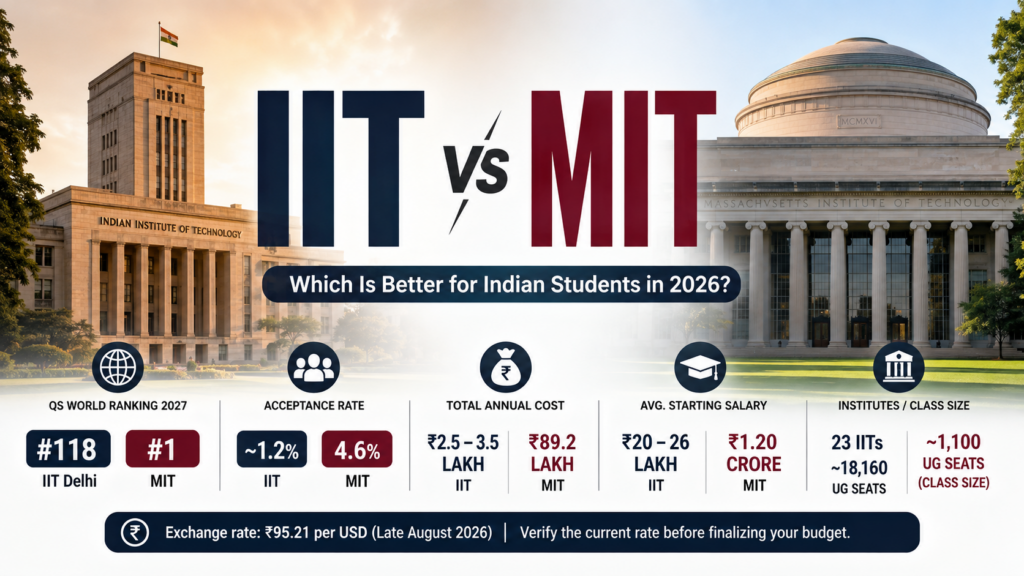
- MIT ranks #1 globally; IIT Delhi is India’s highest at #118.
- Roughly 18,160 IIT seats exist against 56,880 JEE Advanced qualifiers.
- MIT’s 2026-27 cost of attendance is $93,730 (Rs.89.2 lakh).
- Families earning under $200,000 a year attend MIT tuition-free.
IIT vs MIT: Quick Comparison
| Parameter | IIT (all 23 institutes) | MIT |
| Type | Government, autonomous | Private, research university |
| Entrance route | JEE Main → JEE Advanced | SAT/ACT + holistic application |
| QS World Ranking 2027 | #118 (IIT Delhi, India’s highest) | #1 |
| Seats/class size | ~18,160 UG seats across 23 IITs | ~1,100 UG seats (Class of 2030: 1,299 admitted) |
| Acceptance rate | ~1.2% of JEE Main aspirants get an IIT seat | 4.6% (Class of 2030) |
| Annual tuition | Rs.2 lakh (general category, income above Rs.5L) | Rs.63.5 lakh ($66,720) |
| Total annual cost | Rs.2.5-3.5 lakh (tuition + hostel + mess) | Rs.89.2 lakh ($93,730) |
| Avg. starting salary | Rs.20-26 lakh (median/average, IIT Bombay) | Rs.1.20 crore ($126,438), all majors |
Exchange rate used: Rs.95.21 per USD, as of late August 2026. Verify the current rate before finalizing your budget.

Choose your dream country
 UK
UK
 USA
USA
 Germany
 Australia
 Ireland
 Canada
 UAE
UAE
 France
 Sweden
 Italy
Italy
 Other
Other
When do you want to study abroad?
What's your highest level of education?
Have you completed Class 12th?
What was your Class 12 CGPA/percentage?
Are you a student or a parent/guardian?
What do you want to study?
Select your current city
How Leap will help you

Personalised University Shortlist

Express Applications with Quicker Admits

End-to-End Application Support
Source: QS World University Rankings 2027; JoSAA 2026 seat data; MIT Admissions Class of 2030 data; MIT Cost of Attendance 2026-27; IIT Bombay placement data 2025-26
IIT vs MIT Ranking: Where Each Stands in QS 2027
The QS World University Rankings 2027, released 18 June 2026, is the most current edition and settles the "IIT vs MIT ranking" question clearly at the global level:
- MIT: #1, holding the top spot for the 15th consecutive year.
- IIT Delhi: #118, India's highest-ranked institution, up from #123 the previous year.
- IIT Bombay: #134, IIT Madras: #170, IIT Kharagpur: #205.
- IIT Kanpur and IISc Bangalore: tied at #221.
So when the question is specifically "IIT Bombay vs MIT" or "IIT Bombay vs MIT USA," the honest answer on pure global ranking is that MIT sits well over 100 places ahead. But QS rankings weigh international faculty ratio, citations, and global reputation heavily, factors that structurally favor a US research university over an India-focused public institute; they say little about your actual outcomes if you study at either.
Counselor insight: Students fixate on the ranking gap without asking what QS is actually measuring. If your goal is placement into the Indian industry or a government-linked career, IIT's domestic reputation and alumni network matter more than a global rank number.
IIT vs MIT Acceptance Rate: The Real Numbers for 2026
MIT calculates its rate from applicants who submit an undergraduate application, while an IIT comparison can look very different depending on whether you use the full JEE Main pool or only students who qualify for JEE Advanced.
- MIT, Class of 2030: 1,299 admitted from 28,349 applicants, for an acceptance rate of 4.6%. Early Action was 5.5%; Regular Action was 3.9%.
- IIT, 2026 cycle: around 15 to 16 lakh unique students registered for JEE Main. Of those, 56,880 qualified for JEE Advanced, and only about 18,160 received B. Tech seats across all 23 IITs.
- That means the real IIT "acceptance rate," measured against the full JEE Main aspirant pool, works out to roughly 1.2%, less than a third of MIT's rate. Even measured only against JEE Advanced qualifiers, barely 1 in 3 gets an IIT seat.
Which is tougher, IIT or MIT? By pure selectivity, IIT is tougher. MIT rejects more applicants in absolute terms, but a far higher share of a much smaller, self-selected pool.
Counselor insight: Don't let this number alone drive your decision. JEE Advanced tests a narrow band of Physics, Chemistry, and Math at extreme speed and depth. MIT's process weighs essays, extracurriculars, and a track record of independent projects far more heavily. Being "hard" means different things at each.
IIT vs MIT Fees: What Each Actually Costs
| Cost component | IIT (general category) | MIT |
| Annual tuition | Rs.2 lakh (income above Rs.5 lakh) | $66,720 (Rs. 63.5 lakh) |
| Tuition waiver | Full waiver for SC/ST/PwD (any income) and general/OBC-NCL/EWS under Rs.1 lakh income | Full tuition-free for family income under $200,000/year |
| Expected family contribution | Based on category/income slab | Rs.0 for family income under $100,000/year |
| Total annual cost (incl. living) | Rs.2.5-3.5 lakh | $93,730 (Rs. 89.2 lakh) |
| Total 4-year cost | Rs.8-13.5 lakh | Roughly $375,000 (Rs.3.57 crore) at sticker price, before aid |
| Financial aid policy | Category and income-based fee remission | Need-blind for all applicants, including international; meets 100% of demonstrated need |
The genuinely under-covered fact in this IIT vs MIT USA comparison is that starting with the 2025-26 academic year, MIT guarantees free tuition for admitted students whose family income is under $200,000 a year, and families earning under $100,000 pay nothing toward the total cost at all.
Counselor insight: We still see families eliminate MIT from consideration purely on the $93,730 headline figure without ever checking the net price calculator. That's the single most expensive assumption a family can make in this decision.
Source: MIT Cost of Attendance 2026-27; MIT Cost & Affordability, tuition-free policy; IIT fee structure, official circulars.
Exchange rate used: Rs.95.21 per USD, as of late August 2026. Verify the current rate before finalizing your budget.
IIT vs MIT Scholarships: Financial Aid Options Compared
For a middle-income Indian family, MIT's sticker price is irrelevant; what matters is the actual aid package, which can bring the real cost close to IIT's. For scholarships and financial planning for a US degree, it's worth budgeting both scenarios before ruling either out.
IIT Scholarships and Fee Concessions
| Scholarship/scheme | Coverage | Eligibility |
| Merit-cum-Means (MCM) Scholarship | 100% tuition waiver + Rs.1,000-4,000/month stipend | Family income up to Rs.4.5-5 lakh (varies by IIT); up to 25% of admitted students |
| SC/ST fee waiver | 100% tuition waiver + mess/hostel concessions | Automatic for SC/ST students, regardless of family income |
| Income-based fee remission | Full tuition waiver | General/OBC-NCL/EWS with family income under Rs.1 lakh |
| Partial fee remission | Pay Rs.33,333/semester instead of Rs.1 lakh | General/OBC-NCL/EWS with family income of Rs.1-5 lakh |
| Central Sector Scholarship | Fee reimbursement + stipend | SC/ST/minority students, via National Scholarship Portal |
MIT Scholarships and Financial Aid
| Aid type | Coverage | Eligibility |
| MIT need-based Scholarship | Covers 100% of demonstrated financial need; no loans in the package | All admitted students, including international ones, who apply for aid |
| Tuition-free policy | Full tuition covered | Family income under $200,000/year (Rs.1.90 crore), from 2025-26 |
| Zero-contribution policy | No family contribution expected toward any cost | Family income under $100,000/year (Rs.95.2 lakh) |
| Merit scholarships | None offered | MIT awards aid purely on demonstrated need, not academic merit |
| External options for Indian students | Partial to full funding for graduate study | Fulbright-Nehru Fellowship, Inlaks Shivdasani Scholarship (mainly for master's/PhD applicants, not undergraduate) |
Source: IIT Bombay Merit-cum-Means Scholarship details; IIT Kharagpur Scholarships, official; MIT Cost & Affordability, need-based aid policy
MIT's process is worth underlining since it trips up most Indian applicants: there is no separate "merit scholarship" to apply for. Every admitted student who submits the CSS Profile is automatically considered for need-based aid, and the amount is based entirely on demonstrated financial need, not JEE-style rank or GPA cutoffs.
Counselor insight: We tell families to run MIT's net price calculator before their SAT prep even starts. Knowing the realistic aid outcome early changes how a family plans the rest of the application list, rather than discovering it only after an admit letter arrives.
IIT vs MIT: Curriculum and Teaching Style
- IIT leans theory-first, with a rigorous, exam-driven structure across 250+ B. Tech specializations spread over 23 institutes.
- MIT emphasizes hands-on, project-based learning, with 56 undergraduate majors and a 3:1 student-faculty ratio that allows closer research involvement even at the undergraduate level.
- Both maintain strong research output and actively push students toward entrepreneurship and startups, so this difference is about style of learning, not quality.
Counselor insight: Students who thrive under strict, structured deadlines with less ambiguity tend to prefer the IIT format. Students who want to define their research question early and iterate on it tend to prefer MIT's structure.
Source: MIT Admissions, career and academic program data; IIT curriculum structure, JoSAA/IIT institute pages
IIT vs MIT Salary and Career Outcomes
| Metric | IIT Bombay (2025-26) | MIT |
| Average package | Rs.26.45 lakh | $126,438 (Rs.1.20 crore), all majors |
| Median package | Rs.20 lakh | Not separately published; average skews close to median across majors |
| Highest domestic package | Rs.1.48 crore | N/A (US-based hiring) |
| Highest international package | Rs.1.5 crore+ (reported, varies by cycle) | N/A (most graduates work domestically in the US) |
| Primary post-study route | Direct campus placement in India | OPT (12 months, extendable to 36 for STEM), then H-1B |
Source: IIT Bombay placement data 2025-26; MIT Admissions, Graduating Student Survey
On a pure IIT vs MIT highest package and IIT vs MIT salary comparison, MIT undergraduates entering the US job market start, on average, at a level that only IIT's top outlier offers reach. This is the core of the MIT vs IIT salary gap that most comparison articles cite, but it's an incomplete picture on its own.
The gap narrows considerably once you factor in the cost of living, taxes, and the fact that most IIT graduates work in India while most MIT graduates work in the US. What happens after graduation matters as much as the number itself:
- IIT graduates enter campus placements directly into Indian and multinational companies.
- MIT graduates on an F-1 visa can work in the US for 12 months on Optional Practical Training (OPT), extendable to 36 months for STEM degrees, before needing H-1B sponsorship to stay longer.
Counselor insight: An IIT graduate aiming for a US career doesn't have to make a final choice. A strong IIT undergraduate record is one of the more common paths into an MIT master's program, and it comes with a lower acceptance bar than undergraduate admission.
Can You Get Into MIT After an IIT? Decision Framework
- If you're a Class 12 student still deciding between JEE prep and a US application: you don't have to pick exclusively. JEE Main and SAT preparation timelines overlap enough that many strong students prepare for both, then decide based on results.
Start SAT preparation by mid-Class 11 if MIT stays on your list.
- If you're a B.Tech student at an IIT considering an MIT master's: this is a well-worn path. MIT's graduate admission looks for a strong GPA, GRE (where required), a clear research statement, and letters from faculty who know your work closely, not just your JEE rank.
See How Indian Students Can Get Into MIT for what MIT's admissions office specifically looks for.
- If you're a parent weighing cost against prestige: run MIT's net price calculator before eliminating it on sticker price alone, and compare that real number against the full four-year IIT cost, not just tuition.
IIT vs MIT: Application Timeline for 2027-28
| Stage | IIT (JEE cycle) | MIT |
| 8-10 months before intake | Begin JEE Main preparation / finalize SAT plan | Build an MIT-specific project portfolio, request recommendations |
| 6-7 months before | JEE Main Session 1 (January) | MIT Early Action deadline (early November) |
| 4-5 months before | JEE Main Session 2 (April), JEE Advanced (May-June) | Early Action decisions (mid-December); Regular Action deadline (early January) |
| 2-3 months before | JoSAA counselling and seat allotment (June-July) | Regular Action decisions (mid-March) |
| 1 month before | Reporting and fee payment at allotted IIT | Enrollment confirmation and visa (F-1) processing begins |
What If You Don’t Get Into Either?
- Missed an IIT seat: JEE Advanced qualifiers who don't get an IIT seat can still use their JEE Main rank for NITs, IIITs, and Government Funded Technical Institutes (GFTIs) through the same JoSAA counselling process, without a separate application.
- Didn't get into MIT: MIT's acceptance rate is low enough that even strong applicants are frequently rejected. A well-prepared SAT score keeps other SAT-accepting universities in the UK, Canada, and elsewhere in the US genuinely open, and applying to a realistic spread of 8-10 universities alongside MIT is standard advice, not a backup plan.
3 Takeaways on IIT vs MIT
- Check the QS 2027 ranking and your actual target outcome (India-based career vs. global/US career) before assuming either institute is the "better" choice.
- Don't eliminate MIT on sticker price alone; run the net price calculator, since families earning under $200,000 a year attend tuition-free.
- If MIT undergraduate admission doesn't work out, a strong IIT B.Tech followed by an MIT or other US master's remains a realistic, well-travelled path.
Verified by: LeapScholar's USA counseling team, with hands-on experience guiding Indian students through MIT and other top US applications, financial aid planning, and F-1 visa processes.
Have questions about whether MIT or an IIT-to-US path fits your profile? Book a free session with a LeapScholar counselor.
Frequently Asked Questions About IIT vs MIT
-
IIT vs MIT: which is better?
Neither is objectively better. IIT wins on cost and India-based career outcomes; MIT wins on global ranking, research exposure, and US career access. The right answer depends on where you want to build your career and what you can realistically afford after financial aid. For students specifically comparing IIT Bombay vs MIT or IIT Delhi vs MIT, the same factors, career goals, cost, research opportunities, and location should guide the decision.
-
IIT vs MIT: which is best for a global tech career?
If the goal is a global tech career, especially one based in the US, MIT gives more direct access through campus recruiting and OPT/H-1B pathways. If the goal is a strong, India-based career with lower financial risk, IIT is the stronger direct route. This is also why IIT India vs MIT USA can have different answers depending on where you ultimately want to work.
-
Is MIT better than IIT?
On global ranking, yes, MIT is better (#1 vs. #118). On cost predictability, campus placement guarantees, and lower financial risk for most Indian families, IIT is often the safer, more direct choice. For IIT Bombay vs MIT USA, for example, MIT has the stronger global ranking and US career access, while IIT Bombay offers a significantly lower cost and strong Indian placement outcomes.
-
IIT vs MIT USA: Can you study at both?
Yes. A common and well-supported path is a B.Tech at an IIT followed by an MS at MIT. This route typically has a higher graduate admission rate than applying to MIT directly out of Class 12.
-
What is the IIT vs MIT acceptance rate difference?
IIT's effective acceptance rate against the full JEE Main aspirant pool is roughly 1.2%. MIT's Class of 2030 acceptance rate was 4.6%. IIT is significantly more selective when measured this way. The acceptance rate of IIT vs MIT is not a perfect like-for-like comparison because the two institutions use very different admission systems.
-
Is IIT harder than MIT to get into?
By raw selectivity, yes. IIT admits a smaller share of its full aspirant pool than MIT does. The type of difficulty differs, though. JEE Advanced is a single high-stakes exam, while MIT evaluates a full profile over months. So when asking which is tougher, IIT or MIT, the answer depends partly on whether you mean exam difficulty or overall admission difficulty.
-
What is the IIT vs MIT salary difference for graduates?
IIT Bombay's average package for 2025-26 was around Rs.26.45 lakh; MIT's average starting salary across all majors is Rs.1.20 crore. The comparison narrows once cost of living, taxes, and currency are factored in, since most IIT graduates work in India and most MIT graduates work in the US. This is why you should view the MIT vs IIT salary comparison alongside location and living costs rather than salary alone.
-
What is the main difference between IIT and MIT in teaching style?
IIT leans theory-first with a rigorous, exam-driven structure; MIT emphasizes hands-on, project-based learning with a lower student-faculty ratio. Both maintain strong research output. This distinction is one of the biggest IIT and MIT differences for students deciding between the two systems.
-
Do IIT vs MIT students have different day-to-day experiences?
Yes. IIT students typically follow a more structured, cohort-based schedule tied to semester exams. MIT students have more flexibility to build individualized course loads and join research labs from their first year.
-
Are IIT and MIT the same?
No. IIT and MIT are different institutions with different admissions systems, academic structures, costs, and career pathways. IIT refers to India's network of 23 Indian Institutes of Technology, while MIT refers to the Massachusetts Institute of Technology in the US.









Have Questions? Get Guidance to reach your Dream University
Connect with India's finest counsellors and biggest study abroad community.
Get Guidance