
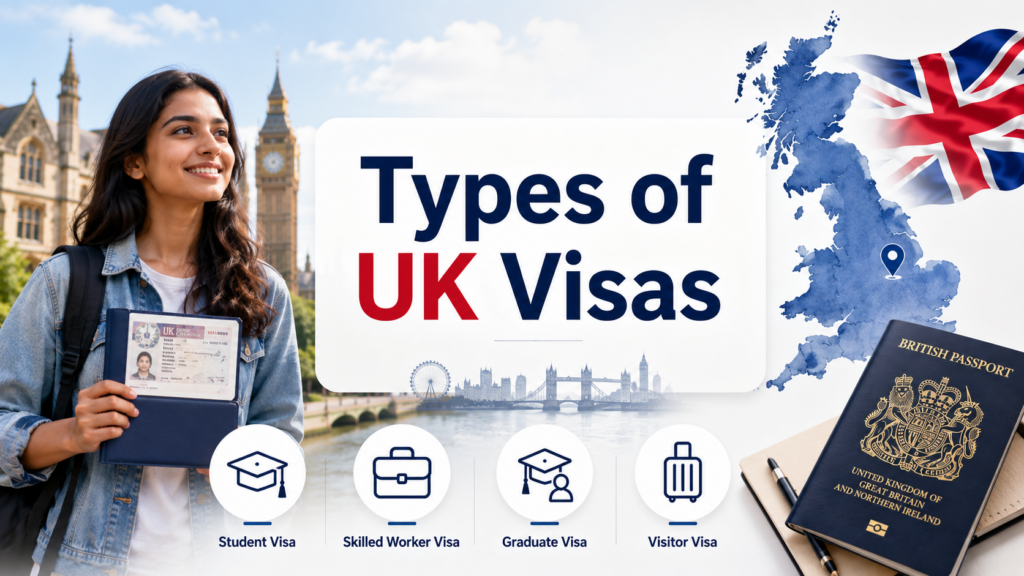
Quick Read
- Indian passport holders are not eligible for the UK ETA and must apply for a visa for every trip.
- The UK has 6 main visa categories: Visitor, Student, Work, Family, Transit, and Settlement.
- UK Student Visa fee is £558 (Rs.71,885) from 8 April 2026; Graduate Route fee is £937 (Rs.120,713).
- The Graduate Route post-study work period will reduce to 18 months for most students applying from January 2027.
How Many Types of UK Visas Are There? The Full List for Indians in 2026
Indian passport holders cannot use the UK ETA and must apply for a visa for every trip; here is the complete picture of what is available in 2026.
| Types of UK Visas | Purpose | Stay Duration | Fee from 8 April 2026 | India-Specific Note |
| Standard Visitor Visa | Tourism, family visits, business, short study | Up to 6 months | £135 (Rs.17,392) | No ETA available for Indians |
| Standard Visitor (Long-term) | Multiple visits over 2, 5, or 10 years | 6 months per visit | £506 / £903 / £1,128 (Rs.65,187 / Rs.116,313 / Rs.145,319) | The same 6-month per-visit rule applies |
| UK Student Visa | Full-time degree, master’s, MBA, PhD | Duration of course + 4 months | £558 (Rs.71,885) | TB test from UKVI-approved clinic in India mandatory |
| Short-term Student Visa | English language courses (6-11 months) | Up to 11 months | £228 (Rs.29,373) | Cannot work; no Graduate Route access |
| Child Student Visa | School-level study for ages 4-17 | Duration of course | £558 (Rs.71,885) | The sponsor must be a licensed UK school |
| Skilled Worker Visa | Employment with a licensed UK sponsor | Up to 5 years | £819 (Rs.105,534) for up to 3 years | B2 English required from 8 January 2026 |
| Health and Care Worker Visa | NHS or social care roles | Up to 5 years | £284 (Rs.36,588) for up to 3 years | IHS exemption applies |
| Global Talent Visa | Leaders in science, tech, arts, research | Up to 5 years | £766 (Rs.98,683) | No job offer required; endorsement needed |
| Innovator Founder Visa | Business founders with endorsement | 3 years | £1,357 (Rs.174,820) | Requires endorsement from approved UK body |
| Temporary Worker Visa | Seasonal, creative, religious, charity roles | Role-specific | £298 (Rs.38,391) | Includes Seasonal Worker sub-route |
| India Young Professionals Scheme (YPS) | Work and travel in the UK | 2 years | £319 (Rs.41,097) | India-exclusive ballot; 3,000 places per year |
| Graduate Route Visa | Post-study work after UK degree | 18 months (2 years for PhD) | £937 (Rs.120,713) | Must apply from inside UK before Student Visa expires |
| Spouse / Partner Visa | Join a partner settled in the UK | 2.5 years (renewable) | £2,064 (Rs.265,871) | A minimum income threshold applies |
| Parent / Child Dependant Visa | Join a parent or child in the UK | Route-dependent | £2,064 (Rs.265,871) | Students on taught master’s cannot bring dependents. |
| Transit Visa (Airside) | Airside layover only, no border crossing | Duration of transit | £41.50 (Rs.5,346) | Required for most Indian passport holders |
| Transit Visa (Landside) | Layover requiring entry through border control | Duration of transit | £74.50 (Rs.9,598) | Needed if leaving the international zone |
| Indefinite Leave to Remain (ILR) | Permanent settlement | Indefinite | £3,226 (Rs.415,573) | Requires 5 years of continuous qualifying residence |
Source: Home Office Immigration and Nationality Fees, 8 April 2026

Choose your dream country
 UK
UK
 USA
USA
 Germany
 Australia
 Ireland
 Canada
 UAE
UAE
 France
 Sweden
 Italy
Italy
 Other
Other
When do you want to study abroad?
What's your highest level of education?
Have you completed Class 12th?
What was your Class 12 CGPA/percentage?
Are you a student or a parent/guardian?
What do you want to study?
Select your current city
How Leap will help you

Personalised University Shortlist

Express Applications with Quicker Admits

End-to-End Application Support
Exchange rate used: £1 = Rs.128.83 as of June 2026. Verify the current rate before finalizing your budget.
Which of the Types of UK Visas Do You Need? Decision Guide for Indians in 2026
The different types of UK visas are built around the purpose of travel. Use the scenarios below to identify yours.
1. If you are a final-year BTech or BSc student with an offer from a UK university for September 2026: You need a UK Student Visa. You should apply after your university issues the Confirmation of Acceptance for Studies (CAS) number, which is issued after you have received an unconditional offer and paid your deposit. Apply no earlier than 6 months before your course start date and no later than the first week of August for a September start. After completing your degree, you can apply for the Graduate Route visa from within the UK.
2. If you are an experienced software engineer or finance professional with a job offer from a UK employer paying more than £41,700 a year, You need a Skilled Worker Visa. Your employer must be a licensed UK sponsor and will issue you a Certificate of Sponsorship (CoS). From 8 January 2026, you must demonstrate English proficiency at the B2 level. Apply online through GOV.UK after receiving your CoS. Processing from India typically takes 3 weeks.
3. If you are a parent planning to visit your child during their graduation ceremony in the UK: You need a Standard Visitor Visa. You can stay for up to 6 months. You cannot work, study for more than 6 months, or receive public funds on this visa. If your child is on a taught master's or undergraduate degree, you cannot travel on their Student Visa as a dependant under current rules; a separate Visitor Visa is your correct route.
Counselor insight: The most common mistake we see is families applying for a Standard Visitor Visa when the actual purpose falls outside its permitted activities, for instance, attending a course that lasts longer than 6 months. UKVI does check. If you are uncertain which UK visa type from India applies to your situation, use the official GOV.UK visa checker before submitting any application.
Types of UK Student Visas in 2026: Fees, Rules and the Graduate Route Change
The types of UK student visas fall into three categories:
- Student Visa (main route): For full-time degree-level study at a licensed UK university. You must be 16 or older, hold a CAS number, and meet the English language requirement (typically IELTS 6.0-6.5 overall). Fee: £558 (Rs.71,885) from 8 April 2026.
- Short-term Student Visa: For English language courses lasting 6 to 11 months at an accredited institution. Fee: £228 (Rs.29,373) from 8 April 2026. You cannot work and you cannot access the Graduate Route after this visa.
- Child Student Visa: For students aged 4 to 17 attending a licensed UK school. Fee: £558 (Rs.71,885) from 8 April 2026.
Maintenance funds required (from 11 November 2025):
- London: £1,529 per month, up to 9 months = £13,761 (Rs.17,73,044) to show in your bank account for 28 consecutive days
- Outside London: £1,171 per month, up to 9 months = £10,539 (Rs.13,57,783)
This amount is in addition to your first year's tuition fees.
Source: UKCISA: Changes to the Student and Graduate Rules, October 2025
The Graduate Route change that affects 2026 starters is:
Students who apply for the Graduate Route on or after 1 January 2027 will receive 18 months of post-study work permission instead of the previous 2 years. PhD graduates retain 3 years. This change affects anyone starting a taught master's or undergraduate degree in September 2026, since they will graduate and apply for the Graduate Route in late 2027, after the cutoff.
Graduate Route visa fee (from 8 April 2026): £937 (Rs.120,713) plus Immigration Health Surcharge of £1,035 (Rs.133,339) per year.
(IHS is paid upfront in full at application; for an 18-month Graduate Route visa, the fee is approximately £1,553 total).
Source: UKCISA: Graduate Route Visa
Counselor insight: The 28-day rule for maintenance funds is strict. The money needs to have been in the account for 28 uninterrupted days before you apply. Document review consistently flags fixed deposits that need breaking or large transfers that arrive a week before the application. Prepare the application at least a month in advance.
India-specific requirements for UK Student Visa applications:
- A TB test from a UKVI-approved clinic in India is mandatory, no exceptions. Book early; most clinics in Delhi, Mumbai, and Bengaluru fill up weeks in advance during July and August.
- IELTS for UKVI scores are what UKVI accepts. Standard IELTS is fine for your university offer, but for the visa application itself, the UKVI-specific test is the safer option.
- For academic evidence, marksheets and provisional certificates work. You do not need a final degree certificate if it has not been issued yet.
Types of UK Work Visas for Indians in 2026: Skilled Worker, Global Talent and YPS Lottery
The types of UK work visas for Indian nationals in 2026 are limited to four real options.
- Skilled Worker Visa: This is the main route. You need a job offer from a licensed UK sponsor, a role at RQF Level 6 or above, and a salary of at least £41,700 (Rs.53,762) or £33,400 (Rs.43,029) if you qualify as a new entrant. Fee: £819 (Rs.105,534) for up to 3 years, or £1,618 (Rs.208,527) for over 3 years. From 8 January 2026, B2-level English is required. You can apply for ILR after 5 years of continuous residence.
- Health and Care Worker Visa: A Skilled Worker sub-route for NHS and social care roles. The fee drops to £284 (Rs.36,588) for up to 3 years, and you are exempt from the Immigration Health Surcharge. Salary thresholds vary by role.
- Global Talent Visa: No job offer needed. This visa is for people already recognized, or with strong potential, as leaders in academia, research, tech, arts, or culture. It runs as a two-step process: pay the endorsement application fee of £561 (Rs.72,273) to the endorsing body first, then the visa fee of £205 (Rs.26,410) after endorsement is granted. You can sponsor yourself once endorsed.
- India Young Professionals Scheme (YPS) Lottery: This is India-exclusive. 3,000 places are available each year for Indian nationals aged 18 to 30 who hold a bachelor's degree and have at least £2,530 (Rs.325,939) in savings. The ballot opens on GOV.UK in February and July. Entering the ballot is free. The visa fee of £319 (Rs.41,097) is only paid after you are selected, and you then have 90 days to complete the application.
- High Potential Individual (HPI) Visa: For recent graduates (within 5 years) from globally top-ranked universities. No job offer required. IIT graduates and graduates of other QS/THE top-50 universities qualify. Grants 2 years of unrestricted work. Fee: £822 (Rs.105,889). Does not lead directly to ILR but can be followed by a Skilled Worker visa.
Counselor insight: The YPS ballot is genuinely random. In 2025, thousands of eligible applicants entered and were not selected. If the UK is a serious career goal, pursue the Skilled Worker route in parallel and treat the YPS as a bonus opportunity, not a primary plan.
One critical caveat: time spent in the UK on the YPS does not count toward Indefinite Leave to Remain. If long-term settlement is your goal, the Skilled Worker visa is the only route that builds toward ILR; the YPS is a 2-year window, not a pathway.
Types of UK Family Visas for Indians in 2026
The types of UK family visas cover reunion, joining a partner, or bringing children:
- Spouse / Partner Visa: This visa is for Indian nationals who are joining a partner with UK settled status or British citizenship. Fee: £2,064 (Rs.265,871) from 8 April 2026. The UK-based partner must earn at least £29,000 per year (this threshold is increasing in stages). Grants 2.5 years of leave, renewable, with a path to ILR.
- Child Dependant Visa: For children under 18 who are joining a parent in the UK. Fee: £2,064 (Rs.265,871), matching the Spouse Visa route.
- Student Dependant Visa: From January 2024, only PhD students and those on government-funded scholarships can bring a spouse or children to the UK. If you are on a taught master's, MBA, or undergraduate degree, your family cannot join you as dependents.
- Indefinite Leave to Remain (ILR): After 5 years of continuous qualifying residence on a Skilled Worker, Student, or Family visa, you can apply for permanent settlement. Fee: £3,226 (Rs.415,573) from 8 April 2026.
- eVisa: The physical Biometric Residence Permit (BRP) is fully replaced by a digital e-visa linked to your UKVI account. All grants, extensions, and settlements from July 2025 are issued as digital immigration status only.
Types of UK Transit Visas for Indians
Most Indian passport holders do. Even a layover at Heathrow or Gatwick can require a transit visa.
- Direct Airside Transit Visa (DATV): For airside-only layovers where you stay within the international zone. Fee: £41.50 (Rs.5,346) from 8 April 2026.
- Visitor in Transit Visa (Landside): For layovers where you pass through border control, for example, to re-check bags or travel between terminals at a different airport. Fee: £74.50 (Rs.9,598).
You may be exempt if you hold a valid visa for the US, Canada, Australia, or New Zealand. Check your specific situation on GOV.UK before booking flights.
Types of UK Visas Applications from India: Step-by-Step Process in 2026
Applying for any of the different types of UK visas follows the same core steps:
- Use the GOV.UK visa checker to confirm your correct visa category.
- Create a UKVI account at GOV.UK and complete the online application form.
- Pay the visa application fee and the Immigration Health Surcharge (IHS) online. Both are non-refundable once submitted.
- Upload supporting documents. India is on the UK's low-risk differentiation list, which means documents may not always be required upfront, but UKVI can request them at any time. Always prepare a complete document file.
- Book a biometric appointment at a VFS Global Visa Application Centre in India (Delhi, Mumbai, Chennai, Bengaluru, Hyderabad, Kolkata, Chandigarh, Jalandhar, Ahmedabad, Cochin, or Pune).
- Attend your appointment, submit biometrics, and wait for a decision.
Processing times from India:
- Standard: 15 working days (3 weeks) from the date of biometric submission
- June to August is peak season; allow 5 to 6 weeks during this period
- Priority service: £500 (Rs.64,415), decision within 5 working days
- Super Priority service: £1,000 (Rs.128,830), decision within 1 working day
Source: GOV.UK: UK visa fees
How early can you apply?
- Student Visa: Up to 6 months before your course start date (earliest) and after receiving your CAS
- Visitor Visa: Up to 3 months before your travel date
- Skilled Worker Visa: After receiving your Certificate of Sponsorship (CoS) from your employer
Counselor insight: UKVI explicitly advises against booking non-refundable flights or accommodation until a visa decision has been received. From June to August, processing regularly takes longer than the standard 3-week window. Students with September start dates should apply by the first week of August at the latest.
Documents Required for Types of UK Visas from India: Full Checklist
| Document | What to Prepare | Visa Types |
| Valid passport | At least 6 months' validity beyond your intended stay | All visa types |
| Previous UK visas | Physical or digital copies of past grants or refusals | All visa types |
| Bank statements | 28 consecutive days, ending within 31 days of application; funds must not dip below required amounts on any single day | Student, Work, Family |
| TB test certificate | From a UKVI-approved clinic in India, allow 2-3 weeks for an appointment | Student, Work (most categories) |
| IELTS for UKVI score | B1 or B2 depending on visa type; standard IELTS scores are also accepted by most universities but IELTS for UKVI is the safe choice for visa purposes | Student, Skilled Worker |
| CAS number | Issued by your university after unconditional offer and deposit payment | Student Visa only |
| Certificate of Sponsorship (CoS) | Issued by your UK employer before you apply | Skilled Worker Visa |
| Academic marksheets | Class 10, Class 12, and undergraduate degree marksheets and provisional certificates | Student Visa |
| Proof of accommodation | Hotel booking, family address, or university accommodation confirmation | Visitor, Student |
| Travel history | Previous passports if your travel history spans multiple documents | All visa types |
Source: GOV.UK: Student Visa | GOV.UK: TB test for a UK visa (India)
Month-by-Month Planning Timeline for Types of UK Visas: September 2026 Start
| Month | Action | Notes |
| January 2026 | Shortlist universities; prepare for IELTS for UKVI | Book IELTS at least 4-6 weeks before score needed |
| February - March | Submit UCAS or direct applications | Rolling admissions: apply early |
| April - May | Receive offers; negotiate conditions | Accept unconditional offer when received |
| June | Pay university deposit and receive the CAS. | CAS issued 1-3 weeks after deposit and conditions met |
| Early July | Book TB test appointment | UKVI-approved clinics book out fast; do not delay |
| Late July | Submit visa application | Apply online; pay fees; upload documents |
| August 1-7 | Complete biometrics at VFS | Allow standard 3-week processing plus buffer for peak season |
| September | Travel to UK; begin the course. | Do not book non-refundable travel before receiving your visa decision |
What to Do When Your UK Visa Application Goes Wrong
- Visa refusal: Read the refusal notice carefully. UKVI states the reason for refusal in the decision letter. The most common refusal reasons for Indian applicants are insufficient financial evidence, missing TB test, wrong visa category applied for, and failure to disclose previous refusals or immigration history. Do not reapply immediately without fixing the root cause.
- Administrative Review vs. Appeal: Most UK visa refusals from outside the UK have no appeal right. The option available is an administrative review, which costs £80 (Rs.10,306) and asks UKVI to reconsider the decision. Administrative Review checks for caseworker error only; it does not allow you to submit new evidence.
- Prior UK visa refusal: Every future visa application, for any country, asks whether you have ever been refused a UK visa. You must disclose your history honestly. Failure to do so triggers a separate refusal on grounds of deception and can result in a long-term ban.
- Delayed TB test results: UKVI-approved TB test clinics in India typically take 3 to 10 working days to issue results. Book your appointment at least 4 weeks before you plan to submit your visa application to avoid delays.
- Missed CAS deadline: If your university has not issued a CAS by mid-July, contact the international admissions office immediately. Most universities can expedite for genuine cases. If the CAS cannot be issued in time for your intended start date, ask about a January intake deferral before withdrawing your application.
Counselor insight: A prior refusal is recoverable. We regularly assist students who were refused the first time, usually due to weak financial evidence or an incomplete application. The key is addressing the exact refusal reason, not just resubmitting the same documents.
3 Takeaways on Types of UK Visas for Indian Applicants
- Identify your correct UK visa type using the GOV.UK visa checker before you apply. Applying in the wrong category leads to a refusal, which you must disclose on every future application, for any country, not just the UK.
- Book your TB test appointment at a UKVI-approved clinic in India before you begin your online application. Appointments fill up weeks in advance, especially in July and August. A missing TB certificate is a straightforward reason for refusal that costs you the entire application fee.
- Budget the Immigration Health Surcharge (IHS) separately from the visa fee. For a 1-year master's on a Student Visa, the IHS alone is £776 (Rs.99,972). For a Graduate Route Visa of 18 months, it is £1,553 (Rs.200,024). The total cost is significantly higher than the visa application fee by itself.
Verified by: LeapScholar's UK counselling team, with hands-on experience guiding Indian students through Student Visa applications, Graduate Route transitions, and Skilled Worker Visa planning.
Have questions about UK visa types? Book a free session with a LeapScholar counselor.
Frequently Asked Questions About Types of UK Visas for Indians
-
Which UK visa type should I apply for as an Indian student?
The right UK visa type depends on your course. If you have an offer for a full-time degree, Masters, MBA, or PhD at a UK university, the Student Visa is the correct UK visa type to apply for. For a short English language course of 6 to 11 months, the Short-term Student Visa is the right route. Unsure which UK visa type applies to your situation? Use the GOV.UK visa checker before applying.
-
What are the different types of UK visas available for Indian nationals?
There are six main types of UK visas: Visitor, Student, Work, Family, Transit, and Settlement. Within each of these types of UK visas are sub-categories. The most commonly used types of UK visas from India are the student visa, Standard Visitor Visa, Skilled Worker Visa, Graduate Route Visa, Spouse Visa, and the India-exclusive YPS Lottery Visa. The full list of types of UK visas with fees is in the comparison table above.
-
What is the UK visa fee in Indian rupees in 2026?
Fees vary by UK visa type. From 8 April 2026, using the fixed rate of £1 = Rs.128.83: Student Visa: £558 (Rs.71,885). Visitor Visa (6 months): £135 (Rs.17,392). Skilled Worker Visa (up to 3 years): £819 (Rs.105,534). Graduate Route Visa: £937 (Rs.120,713). ILR: £3,226 (Rs.415,573). All fees are non-refundable once the application is submitted, regardless of which UK visa type you apply for.
-
How long does a UK visa take to process from India?
Processing time is the same across most types of UK visas. Standard processing from India is 15 working days from the date of biometrics at VFS Global. Between June and August, allow 5 to 6 weeks regardless of your UK visa type. Priority service cuts this to 5 working days for £500 (Rs.64,415). Super Priority gives a next-working-day decision for £1,000 (Rs.128,830).
-
What is the difference between a UK Student Visa and a Short-term Student Visa?
These are two separate types of UK visas with different conditions. The Student Visa covers full-time degree-level courses, allows part-time work during term (up to 20 hours per week), and leads to the Graduate Route after graduation. The Short-term Student Visa is for English language courses of 6 to 11 months only. It does not permit work, and it does not lead to the Graduate Route. Applying for the wrong UK visa type in this case means losing your right to work and your post-study options entirely.
-
Can I work in the UK on a Student Visa?
Yes, with limits. The Student Visa is one of the UK visa types that permits part-time work: up to 20 hours per week during term time and full-time during official university vacations. Self-employment is not permitted on this UK visa type. If you hold a Short-term Student Visa, you cannot work at all. The right to work does not carry over between UK visa types unless you apply to switch.
-
What is the Graduate Route visa and how long does it last in 2026?
The Graduate Route is one of the types of UK visas you apply for from inside the UK after completing a UK degree. It is one of the most used types of UK visas for Indian students who want to stay and work after graduation. Applications submitted before 1 January 2027 receive 2 years of permission (3 years for PhD graduates). Applications made on or after 1 January 2027 receive 18 months for taught degrees; PhD graduates retain 3 years. Fee: £937 (Rs.120,713) from 8 April 2026, plus IHS of £1,035 (Rs.133,339) per year.
-
What is the India Young Professionals Scheme (YPS) and who can apply?
The YPS is one of the types of UK visas available exclusively to Indian nationals. It offers 3,000 places per year to Indian citizens aged 18 to 30 with a bachelor's degree and at least £2,530 (Rs.325,939) in savings. Unlike most other UK visa types, this one is allocated by random ballot on GOV.UK, which opens in February and July. The ballot is free to enter. The visa fee of £319 (Rs.41,097) is paid only after selection. The visa allows 2 years of unrestricted work in the UK.
-
What happens if my UK visa application is refused?
A refusal of any UK visa type must be disclosed on all future visa applications, including applications to other countries. You will receive a refusal letter stating the specific reason. Most refusals of UK visa types made from outside the UK do not carry a right of appeal. You can request an Administrative Review for £80 (Rs.10,306), which asks UKVI to check for caseworker error only. You cannot submit new evidence at this stage. Fix the root cause of the refusal before reapplying for any UK visa type.








Have Questions? Get Guidance to reach your Dream University
Connect with India's finest counsellors and biggest study abroad community.
Get Guidance