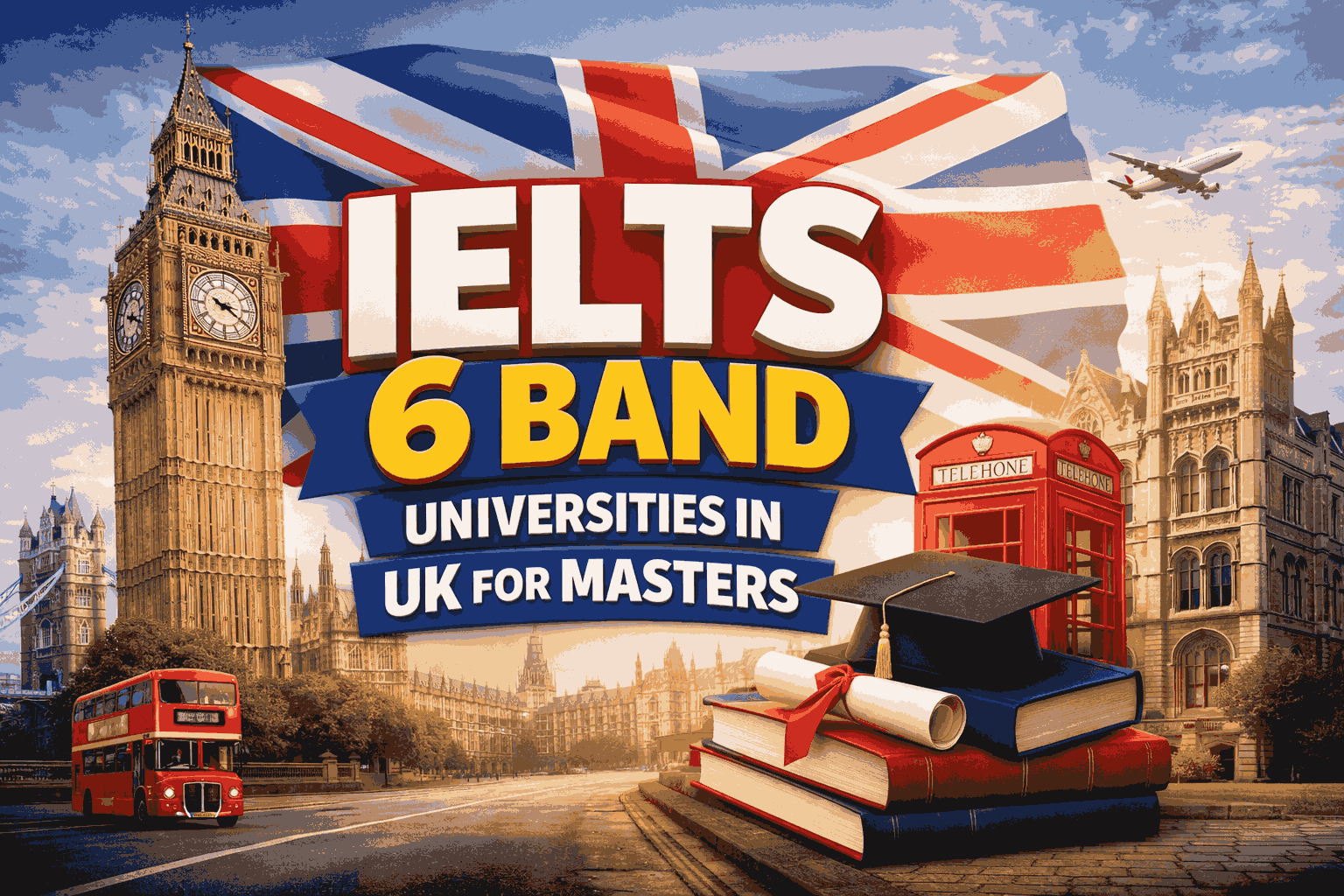
If you’re planning to study abroad in 2026-27, a 1 year master’s program in UK could be one of the smartest choices you make. Unlike two-year master’s degrees in countries like the US or Canada, UK universities pack the same academic value into a shorter, more intensive format saving you both time and money.
From business and data science to law, engineering, and healthcare, there’s a wide range of courses designed to fast-track your career. On top of that, the Graduate Route visa lets you stay back for two years after graduation to gain international work experience, making the UK an even more attractive option for Indian students.In this guide, we’ll walk you through everything you need to know top universities, tuition fees in INR, scholarships, eligibility, visa steps, and post-study opportunities so you can decide if a one-year UK master’s is the right move for your future.
Popular 1-Year Master’s Programs in the UK
One of the best things about the UK is the wide variety of one-year Master’s programs available. Almost every subject you can think of is offered in this accelerated format. The one year master in uk degrees typically fall under titles like Master of Science (MSc), Master of Arts (MA), Master of Laws (LLM), or Master of Engineering (MEng).
Here’s a glimpse into the broad subject areas you can explore:
Choose your dream country
When do you want to study abroad?
What's your highest level of education?
Select you current city
How Leap will help you
Personalised University Shortlist
Express Applications with Quicker Admits
End-to-End Application Support
- Business and Management: Finance, Marketing, Business Analytics, International Business, Human Resource Management, Supply Chain, and Logistics.
- STEM (Science, Technology, Engineering, and Mathematics): Computer Science, Data Science, Artificial Intelligence, Civil Engineering, Mechanical Engineering, Biotechnology.
- Arts and Humanities: English Literature, History, Philosophy, Film Studies, Digital Media.
- Social Sciences: International Relations, Economics, Psychology, Sociology, Public Policy.
- Law: Corporate Law, International Law, Human Rights Law (LLM).
- Medicine and Healthcare: Public Health, Pharmacy, Nursing, Physiotherapy.
While you can study almost anything, some fields are particularly popular among Indian students because they offer a fantastic return on investment and lead to high-demand careers both in the UK and back home.
Here's a look at some of the most sought-after programs, along with their estimated costs and potential earning power.
| Master's Field | Average Annual Tuition Fee (GBP & INR) | Potential Average Salary (UK) (GBP & INR) | Top Universities |
|---|---|---|---|
| Data Science & Analytics | £25,000 - £38,000 (₹29.4L - ₹44.7L) | £55,000 (approx. ₹64.7L) | Imperial, Edinburgh, UCL, Warwick |
| Computer Science & AI | £26,000 - £40,000 (₹30.6L - ₹47.0L) | £58,000 (approx. ₹68.2L) | Oxford, Cambridge, Imperial, UCL |
| Finance & Accounting | £28,000 - £45,000 (₹32.9L - ₹52.9L) | £60,000 (approx. ₹70.6L) | LSE, Warwick, Imperial, Manchester |
| Marketing | £22,000 - £35,000 (₹25.9L - ₹41.2L) | £45,000 (approx. ₹52.9L) | Warwick, Manchester, Cranfield, Bath |
| Management (MiM) | £27,000 - £42,000 (₹31.8L - ₹49.4L) | £50,000 (approx. ₹58.8L) | LBS, LSE, Imperial, Warwick |
(Sources: Fee data is indicative from official university websites. Salary data is estimated from sources like Payscale UK and Glassdoor UK for early-career professionals.)
Note: Conversion Rate used is 1 GBP = ₹117.69 as of August 19, 2025.
This table makes it clear why STEM and Business courses are such a big draw. Fields like Data Science, AI, and Finance command high salaries in the UK, allowing you to get a strong return on your investment quickly, especially with the two-year Post-Study Work visa. When choosing your program, consider not just your interest but also the career opportunities it opens up. A Master's in a high-growth area from a top university is a powerful combination for long-term success.
Top Universities in the UK Offering 1 Year Master’s Programs
The "best university" for you will heavily depend on what you want to study. A university that's a world-leader in Engineering might not be the top choice for Law. To give you a clearer picture, we've broken down the top UK universities offering 1-year master's degrees from business powerhouses like the London School of Economics (LSE) to tech giants like Imperial College London and historic institutions like the University of Oxford, based on the most popular subject areas for Indian students. We're using the latest QS World University Rankings by Subject (2026) to guide this list, but remember to always check the specific course modules to find the perfect fit for your career goals.
1. London Business School (LBS)
As one of the world's most elite business schools, LBS is not a traditional university but a graduate institution dedicated entirely to business and finance. Its brand is a global powerhouse, and its London location provides direct access to the world's top financial and consulting firms. An LBS degree is an investment in a world-class network.
| Master's Program | Indicative Annual Fee (GBP & INR) | Key Highlights / Ideal For |
|---|---|---|
| Masters in Management (MiM) | £47,500 (approx. ₹55.9L) | A top-ranked program for recent graduates, focused on building a strong foundation in global business practices. |
| Masters in Financial Analysis (MFA) | £50,900 (approx. ₹59.9L) | Designed for pre-experience finance professionals aiming for careers in investment banking and asset management. |
| Masters in Analytics and Management | £47,500 (approx. ₹55.9L) | Blends data analytics with strategic management, perfect for future leaders in tech and data-driven industries. |
This selection of programs highlights LBS's focus on shaping the next generation of global business leaders. The Masters in Management (MiM) provides a comprehensive business foundation for early-career professionals, while the Masters in Financial Analysis (MFA) offers a specialized, technical route into high-finance. The addition of the Masters in Analytics and Management shows LBS's commitment to the future of data-driven strategy, making it the premier choice for Indian students targeting elite roles in consulting or finance.
2. London School of Economics and Political Science (LSE)
LSE is a world-leading social sciences university with immense global prestige in economics, finance, law, and politics. Its central London location and influential alumni network make it a hub for students aiming for high-impact careers in international finance, corporate law, and global business.
| Master's Program | Indicative Annual Fee (GBP & INR) | Key Highlights / Ideal For |
|---|---|---|
| MSc Finance | £44,064 (approx. ₹51.9L) | A highly rigorous and theoretical program that is a primary target for investment banks and financial institutions. |
| LLM (Master of Laws) | £35,256 (approx. ₹41.5L) | A powerhouse for corporate and commercial law, with deep connections to London's "Magic Circle" law firms. |
| MSc Data Science | £36,168 (approx. ₹42.6L) | Unique focus on applying data science methods to solve complex social, economic, and political challenges. |
The programs listed for LSE underscore its core identity: applying rigorous, theoretical analysis to professional fields. The demanding MSc Finance is a direct pathway to investment banking, the LLM is a top choice for aspiring corporate lawyers, and the unique MSc Data Science equips students to solve societal problems. This makes LSE the ideal institution for an Indian student who wants to build a career based on deep subject matter expertise and a prestigious academic brand.
3. University of Warwick (Warwick Business School - WBS)
Located on a large, modern campus, the University of Warwick is a Russell Group powerhouse, and its Warwick Business School (WBS) is consistently ranked among the UK's elite. It offers a perfect balance of academic prestige and a vibrant campus experience, with a strong reputation among global employers.
| Master's Program | Indicative Annual Fee (GBP & INR) | Key Highlights / Ideal For |
|---|---|---|
| MSc Business Analytics | £39,500 (approx. ₹46.5L) | A top-ranked program known for its blend of technical data skills and practical business application. |
| MSc Finance | £43,950 (approx. ₹51.7L) | One of the most respected finance master's in Europe, with strong ties to financial firms in London. |
| MSc Management | £35,750 (approx. ₹42.1L) | An excellent all-around management course, ideal for graduates looking to enter a wide range of business careers. |
This trio of programs demonstrates why WBS is considered a complete and elite business school. 1 year msc in uk covers the three essential pillars of modern business: the technical side with its MSc Business Analytics, the quantitative core with its prestigious MSc Finance, and the strategic overview with its versatile MSc Management. For an Indian student seeking a top-tier business degree from a campus-based university with a stellar corporate reputation, this combination is hard to beat.
4. Imperial College London
Imperial is a global top 10 university focused exclusively on science, engineering, medicine, and business. It's a hub of innovation in London, known for its practical, research-driven approach and its graduates who are highly sought after in technical and quantitative fields.
| Master's Program | Indicative Annual Fee (GBP & INR) | Key Highlights / Ideal For |
|---|---|---|
| MSc Business Analytics | £41,300 (approx. ₹48.6L) | A world-leading program for careers in data science, FinTech, and consulting. Strong quantitative focus. |
| MSc Computing (AI & ML) | £39,400 (approx. ₹46.4L) | Cutting-edge curriculum in Artificial Intelligence. Ideal for aspiring AI specialists and researchers. |
| MSc Advanced Mechanical Engineering | £40,900 (approx. ₹48.1L) | For engineers wanting deep technical expertise, with a strong emphasis on research and advanced principles. |
Imperial’s premier Master's programs clearly demonstrate its identity as a world-leader at the intersection of data, technology, and business. Whether it’s the highly sought-after MSc in Business Analytics that bridges data science and corporate strategy, the cutting-edge MSc in Computing (AI & ML) for aspiring tech pioneers, or the deeply technical MSc in Advanced Mechanical Engineering, each program offers unparalleled depth. This makes Imperial the ideal choice for an Indian student with a strong quantitative background aiming for a specialist role in a high-growth, technical industry.
5. The University of Manchester (Alliance Manchester Business School)
A massive, modern Russell Group university with a proud history of innovation, Manchester is known for its practical, industry-linked teaching. Its Alliance Manchester Business School is a top-tier institution famous for its "Manchester Method" of learning by doing, which involves solving real-world challenges for real clients.
| Master's Program | Indicative Annual Fee (GBP & INR) | Key Highlights / Ideal For |
|---|---|---|
| MSc Management | £33,000 (approx. ₹38.8L) | A flagship course known for its hands-on projects and high employability in diverse sectors. |
| MSc Advanced Computer Science | £34,000 (approx. ₹40.0L) | Offers a huge range of specialisms and benefits from Manchester's thriving tech and digital media scene. |
| MSc Structural Engineering | £34,500 (approx. ₹40.6L) | A highly respected program from a massive engineering department with extensive links to UK industry. |
This selection of programs reflects Manchester's core strength: providing a practical, large-scale, and industry-focused education. The hands-on MSc Management prepares students for real-world business challenges, while the comprehensive MSc Advanced Computer Science and industry-linked MSc Structural Engineering are designed to produce highly employable graduates. For Indian students who value practical experience and want a degree respected for its real-world relevance, Manchester is an excellent choice.
6. University of Oxford
As one of the world's oldest and most prestigious universities, Oxford offers an education defined by academic rigor and its unique tutorial-based teaching system. An Oxford degree is a mark of intellectual excellence, opening doors to the highest levels of academia, industry, and public service.
| Master's Program | Indicative Annual Fee (GBP & INR) | Key Highlights / Ideal For |
|---|---|---|
| MSc in Financial Economics | £54,490 (approx. ₹64.1L) | Extremely competitive, quantitative finance program taught by the Saïd Business School and Economics department. |
| MSc in Computer Science | £35,000 (approx. ₹41.2L) | Focuses on the deep theoretical foundations of computing, with cutting-edge research in AI and quantum computing. |
| BCL (Bachelor of Civil Law) | £45,770 (approx. ₹53.8L) | Oxford's world-renowned Master's in Law, considered more prestigious than a standard LLM in the common law world. |
The Master's programs at Oxford are a testament to its focus on deep theoretical knowledge and academic prestige. The highly quantitative MSc in Financial Economics, the theory-intensive MSc in Computer Science, and the world-renowned BCL are not just vocational courses; they are designed to create intellectual leaders. This makes Oxford the perfect destination for high-achieving Indian students aiming for top-tier careers in academia or roles that require profound subject matter expertise.
7. University of Cambridge
A pillar of academic excellence, Cambridge is at the heart of the "Silicon Fen," one of Europe's most important technology hubs. A Cambridge Master's is synonymous with pioneering research, intellectual prestige, and exceptional career opportunities, especially in technology and finance.
| Master's Program | Indicative Annual Fee (GBP & INR) | Key Highlights / Ideal For |
|---|---|---|
| MPhil in Finance | £51,500 (approx. ₹60.6L) | A top-tier, research-focused finance program from the Judge Business School, ideal for careers in asset management. |
| MPhil in Advanced Computer Science | £40,140 (approx. ₹47.2L) | An intensive program focused on algorithms and machine learning, with strong ties to the Silicon Fen tech cluster. |
| LLM (Master of Laws) | £37,521 (approx. ₹44.1L) | An elite law program with exceptional strength in international law and corporate governance. |
The MPhil programs at Cambridge highlight its identity as a research-intensive powerhouse with strong links to innovation. The quantitative MPhil in Finance, the tech-focused MPhil in Advanced Computer Science, and the future-facing MPhil in Engineering for Sustainable Development are all designed for students who want to be at the forefront of their fields. For an Indian student aiming for a career in R&D, specialized finance, or technology, Cambridge provides an unparalleled environment for deep learning.
8.University of Edinburgh
Located in Scotland's stunning capital, the University of Edinburgh is a historic institution and a Russell Group member with a world-class reputation for research. It is a European leader in the fields of informatics, artificial intelligence, and data science, making it a top destination for tech-focused students.
| Master's Program | Indicative Annual Fee (GBP & INR) | Key Highlights / Ideal For |
|---|---|---|
| MSc Artificial Intelligence | £40,900 (approx. ₹48.1L) | A pioneering AI program from one of Europe's largest informatics research centers. Ideal for future AI leaders. |
| MSc Data Science | £38,500 (approx. ₹45.3L) | Covers the entire data science pipeline, from data collection to machine learning, with a strong research focus. |
| MSc Finance | £39,500 (approx. ₹46.5L) | A well-regarded program with strong industry links, especially in the asset management sector. |
This selection of programs confirms Edinburgh's status as a UK leader in technology and data. The highly-ranked MSc in Artificial Intelligence and MSc in Data Science represent the core of its modern reputation, making it a magnet for top tech talent. These are complemented by a strong MSc in Finance, creating a powerful portfolio for Indian students looking to build careers in the rapidly growing fields of FinTech, AI, and data analytics.
9.UCL (University College London)
As "London's Global University," UCL is a massive, multi-disciplinary institution known for its progressive ethos and research excellence across a vast range of subjects. It is consistently ranked among the world's top universities and offers an incredible variety of Master's programs.
| Master's Program | Indicative Annual Fee (GBP & INR) | Key Highlights / Ideal For |
|---|---|---|
| MSc Machine Learning | £35,000 (approx. ₹41.2L) | A highly selective program with a strong focus on the mathematical and statistical foundations of ML. |
| MSc Management | £39,000 (approx. ₹45.9L) | A popular and practical program designed for students from non-business backgrounds seeking a career in management. |
| MSc Financial Risk Management | £38,000 (approx. ₹44.7L) | A highly quantitative program ideal for careers as a 'quant' in banking, hedge funds, and financial regulation. |
The programs at UCL showcase its key strengths: specialization and variety at the highest level. The deeply technical MSc Machine Learning is perfect for future AI researchers, the versatile MSc Management is ideal for career-changers, and the quantitative MSc Financial Risk Management is a direct path to specialized roles in finance. This variety makes UCL an excellent choice for Indian students who want to pursue a niche specialization at a world-class university in the heart of London.
Scholarship and Financial Aid for Indian Students
While studying in the UK is a significant investment, numerous scholarships can help reduce the financial burden for Indian students.
Here are some of the most prominent ones you should look into.
| Scholarship | Benefit (Approximate) | Key Eligibility for Indians |
|---|---|---|
| Chevening Scholarship | Fully funded: covers tuition fees, living expenses, and flights. | 2+ years of work experience, strong leadership potential. |
| Commonwealth Master's Scholarship | Fully funded: covers fees, living allowance, and travel costs. | Excellent academic record from a Commonwealth nation. |
| GREAT Scholarships | Minimum of £10,000 (approx. ₹11.7L) towards tuition fees. | Be an Indian citizen applying to a partner UK university. |
| University-Specific Scholarships | Varies from £3,000 - £15,000 (₹3.5L - ₹17.6L) or 25-50% of tuition fees. | Merit-based, often assessed automatically with your course application. |
(Sources: Information is from official scholarship websites like Chevening, Commonwealth, and the British Council.)
Note: Conversion Rate used is 1 GBP = ₹117.69 as of August 19, 2025.
Eligibility & Documents Required for 1 Year Master’s in UK
Getting into 1 year masters in uk is straightforward if you meet the academic criteria. The UK education system is very welcoming to Indian students and their qualifications.
Here are the typical eligibility requirements:
- Bachelor's Degree: You'll need a bachelor's degree from a recognized university. The great news is that most UK universities accept the three-year Indian bachelor's degree (like a B.Com, BSc, or BA). You will typically need a First Class or high Upper Second-Class degree, which usually translates to 60% or higher in your undergraduate studies.
- English Language Proficiency: Since you'll be studying in English, you need to prove your proficiency.
- IELTS: An overall score of 6.5 to 7.5, with no band less than 6.0.
- TOEFL iBT: An overall score of 90 to 100.
- Exemption: Some universities may waive this if you scored above 70-75% in English in your 12th-grade board exams (CBSE/ISC) or if your entire bachelor's degree was taught in English.
Documents Required Checklist
When you apply, you'll need a set of documents to support your application. Get these ready in advance!
- Official transcripts and mark sheets from your undergraduate degree.
- Your final degree certificate.
- Statement of Purpose (SOP): A crucial essay explaining why you want to study this specific course at that university.
- Letters of Recommendation (LORs): Usually two, from professors or employers who know you well.
- Your updated CV or resume.
- Your official IELTS or TOEFL score report.
- A scanned copy of your passport.
UK 1 Year Masters vs. 2-Year Master’s: A Strategic Comparison
For many Indian students, the biggest decision is choosing between the UK's intensive one-year model and the traditional two-year Master's found in countries like the US, Canada, or Australia. The following table provides a clear, at-a-glance summary of the core differences.
| Feature | UK 1-Year Master's | US/Canada 2-Year Master's |
|---|---|---|
| Duration | A concentrated 12-month program for rapid career advancement. | A comprehensive 24-month program with a structured, steady pace. |
| Total Cost | Lower overall investment with only one year of fees and living costs. | A higher investment covering two full years of tuition and living expenses. |
| Curriculum | Highly specialised from day one, focusing on deep subject expertise. | Flexible and broad, allowing for exploration before committing to a specialty. |
| Internships | Focuses on in-built industry projects integrated within the curriculum. | Features a dedicated long summer break designed for a traditional internship. |
| ROI | A faster return on investment due to lower cost and earlier career entry. | A slower, more long-term return on a larger initial investment. |
| Post-Study Visa | A flexible 2-year visa that can be applied for without a job offer. | A 1-3 year visa where your stay is often linked to active employment. |
Duration & Intensity
The masters in uk duration is defined by its high-paced and focused nature. The curriculum is condensed into a 12-month period, which requires consistent effort and excellent time management. This accelerated model is ideal for students who are ready to immerse themselves fully in their subject to achieve their career goals quickly. In contrast, the two-year Master's follows a more traditional and evenly-paced approach. The workload is spread out over two academic years with a long summer break, which allows for a more gradual adaptation to postgraduate study and a less demanding weekly schedule.
Total Cost & Return on Investment (ROI)
This is arguably the most significant advantage of the UK model. By only paying for one year of tuition and living expenses, you could be saving upwards of ₹40-50 lakhs compared to a two-year program in the US. This translates to a smaller education loan and significantly less financial pressure. Consequently, your Return on Investment (ROI) is much faster. You start earning a full year earlier, allowing you to pay back your loan sooner and begin building your career and savings.
Curriculum & Specialisation
The academic philosophies are distinct. The UK model turns you into a specialist. From the moment you begin your MSc in Finance, you are studying advanced finance. This is excellent for students who have a clear career goal and want to graduate with deep, marketable expertise. The two-year model allows you to be an explorer. The first year often includes foundational courses and electives, giving you the chance to discover your niche before diving deep. This is a better fit for career-changers or those who want a broader, more interdisciplinary education.
Internship Opportunities
The structure of the program dictates the type of work experience you can gain. The two-year model's long summer break is purpose-built for a traditional 3-4 month internship, which is a powerful addition to your CV. While the UK model's intensity doesn't allow for this, leading universities have integrated practical, real-world industry projects and consulting modules directly into the course. This provides you with direct, relevant experience and talking points for job interviews, even without a formal internship.
Post-Study Work Visas
This is a crucial strategic point. The UK's 2-year Graduate Route visa has a game-changing feature: you can apply for it without needing a job offer. This provides an incredible safety net and unparalleled flexibility. It gives you the freedom to find the right role without the pressure of a ticking clock. Visas in other countries, while often longer (like the US OPT or Canadian PGWP), are typically dependent on you securing and maintaining employment, adding an extra layer of pressure right after graduation.
ersities have already opened their application portals. A well-prepared application not only increases your chances of acceptance but also streamlines the subsequent visa and pre-departure preparations.
Below is a comprehensive guide to help you through your journey for the 2026 intake.
Step 1: Research and Shortlist Universities and Courses (August - October 2025)
- Identify Your Niche: Pinpoint the specific master's program that aligns with your career aspirations and academic background.
- University Selection: Research universities are renowned for their chosen field. Consider factors such as faculty expertise, course curriculum, industry connections, and location.
- Check Eligibility: Carefully review the entry requirements for each shortlisted program, paying close attention to academic grades, undergraduate degree relevance, and any work experience prerequisites.
Step 2: Prepare for and Take Standardised Tests (September - November 2025)
- English Language Proficiency: If English is not your first language, you will need to take an approved test like the IELTS, TOEFL, or PTE Academic. Aim to achieve the minimum score specified by your target universities.
- Other Tests: Some programs, particularly in business and management, may require a GMAT or GRE score. Ensure you prepare adequately and book your test well in advance.
Step 3: Collate Your Application Documents (October - December 2025)
- Gather Essential Paperwork: This is a crucial phase that requires careful organisation. Refer to the detailed list of required documents below.
- Statement of Purpose (SOP): Craft a compelling SOP that highlights your motivations, academic and professional background, and future goals.
- Letters of Recommendation (LORs): Request LORs from academic referees or professional supervisors who can attest to your capabilities.
Step 4: Submit Your Application (December 2025 - March 2026)
- Application Portals: Most UK universities accept direct applications through their online portals. Some may use the centralised Universities and Colleges Admissions Service (UCAS).
- Meet Deadlines: Be mindful of application deadlines, which can vary significantly between universities and courses. Early applications are often encouraged.
- Application Fee: Pay the required application fee for each university.
Step 5: Await and Accept Your Offer (January - May 2026)
- Types of Offers: You may receive a conditional offer (requiring you to meet certain criteria) or an unconditional offer.
- Decision Time: Carefully evaluate your offers and accept the one that best fits your aspirations. Pay the deposit to secure your place.
Step 6: Apply for Your Student Visa (June - August 2026)
- Confirmation of Acceptance for Studies (CAS): Once you have an unconditional offer and have paid the deposit, your university will issue a CAS number.
- Visa Application: The CAS is essential for your UK Student Visa application. Gather all necessary financial and supporting documents.
- Biometrics and Interview: You will need to provide biometric information (fingerprints and a photograph) at a visa application centre, and may be required to attend a credibility interview.
What is the UK Student Visa Process for Indian students?
Once you have your offer and the Confirmation of Acceptance for Studies (CAS) from your university, you can begin the visa process. It's a clear, points-based system.
Here is the step-by-step process:
- Receive Your CAS: Your university will issue a CAS number once you've accepted their offer and met all conditions. This is the most important document for your visa.
- Prepare Your Documents: Gather all required documents, including your passport, CAS details, financial proof, and TB test certificate.
- Complete the Online Application: Fill out the Student Route visa application form on the official UK Visas and Immigration (UKVI) website. You'll need to pay the visa application fee of £490 (approx. ₹57,700).
- Pay the Immigration Health Surcharge (IHS): This is a mandatory fee that gives you access to the UK's National Health Service (NHS). It costs £776 (approx. ₹91,300) for students for one year master degree in uk for international students.
- Book Your Biometrics Appointment: After submitting the online form and paying the fees, you'll be directed to book an appointment at a VFS Global centre in India.
- Attend the Appointment: At the VFS centre, you will submit your fingerprints and have your photograph taken. You will also submit your passport and any other required physical documents.
- Wait for the Decision: Your application is then processed by UKVI.
- Receive Your Passport: You will be notified when your passport is ready for collection. If approved, it will contain a vignette (sticker) that allows you to travel to the UK. You will collect your Biometric Residence Permit (BRP) after you arrive in the UK.
How Long Does it Take to Get a UK Student Visa from India?
Planning your timing is key! The processing times can vary, so it's best to apply as soon as you have your CAS.
- Standard Processing Time: The standard time for a decision on a UK student visa from India is 3 weeks (15 working days) from the date of your biometrics appointment (Source: UKVI).
- Priority Visa Service: If you're short on time, you can opt for the Priority Visa service, which aims for a decision within 5 working days. This service costs an additional fee.
- Super Priority Visa Service: For urgent applications, the Super Priority service aims for a decision by the end of the next working day. This is the most expensive option.
It's always recommended to apply at least 2-3 months before your course start date to avoid any last-minute stress.
Post-Study Work Opportunities After 1 Year Master’s in UK
The UK offers a fantastic and straightforward opportunity for Indian students to gain international work experience after their studies through the Graduate Route visa.
Here's what it means for you:
- Stay and Work for 2 Years: After you successfully complete your one-year Master's degree, you can apply for this visa to stay in the UK for two years.
- No Job Offer Needed: You don't need to have a job offer to apply. This gives you the freedom and time to search for the perfect role after you graduate.
- Flexible Work: You can work in almost any job at any skill level during these two years. The goal is to find a long-term role in a skilled profession.
- A Pathway to a Skilled Worker Visa: The Graduate Route acts as a bridge. It allows you to find an employer who can then sponsor you for a Skilled Worker visa, which can lead to long-term settlement in the UK if you choose.
This visa makes the UK one of the most attractive destinations for Indian students right now.
Cost of Living: London vs. The Rest of the UK
Your living expenses are a major part of your budget and a key requirement for your UK student visa. The most significant factor determining this cost is your university's location. Life in London is considerably more expensive than in any other UK city.
Here is a realistic breakdown of the average monthly expenses you can expect.
| Expense Category | Average Monthly Cost (London) | Average Monthly Cost (Outside London) |
|---|---|---|
| Accommodation | £800 - £1,200 (₹94k - ₹1.41L) | £500 - £750 (₹58k - ₹88k) |
| Food & Groceries | £250 - £350 (₹29k - ₹41k) | £200 - £300 (₹23k - ₹35k) |
| Transport (Public) | £120 - £160 (₹14k - ₹19k) | £50 - £80 (₹6k - ₹9k) |
| Utilities & Mobile Bill | £70 - £100 (₹8k - ₹12k) | £60 - £90 (₹7k - ₹11k) |
| Personal & Social | £200 - £300 (₹23k - ₹35k) | £150 - £250 (₹18k - ₹29k) |
| Total Monthly Est. | £1,440 - £2,110 (₹1.69L - ₹2.48L) | £960 - £1,470 (₹1.13L - ₹1.73L) |
For your visa application, you must show proof of funds to cover 9 months of living expenses. The UK Visas and Immigration (UKVI) has set a minimum amount for this:
- Inside London: £1,334 per month (£12,006 or approx. ₹14.09 Lakhs total)
- Outside London: £1,023 per month (£9,207 or approx. ₹10.81 Lakhs total)
Key Takeaway: Choosing a university outside London can save you over ₹3Lakhs in living costs alone for the year, making your UK education significantly more affordable without compromising on quality.
Conclusion
A one-year Masters in uk for international students is more than just a degree; it's a strategic career accelerator. It's an intensive, challenging, and incredibly rewarding experience that equips you with a globally respected qualification in half the time of a traditional two-year program. For Indian students, it represents a perfect balance of quality education, manageable duration, and excellent post-study work opportunities. It allows you to learn from the best, build a global network, gain valuable international experience, and then re-enter the workforce with a significant advantage. It is a smart, efficient, and powerful investment in your future.
Ready to fast-track your education with a 1 year masters programs in UK for international students? Leap Scholar is here to guide you through the entire process. From choosing the right university to handling visa applications and SOP reviews, we’ve got you covered. Get started with us today!
FAQs on 1 Year Master’s Programs in the UK
Q. Why are Master's programs in the UK only one year long?
Ans. The one year Masters in uk is the standard and is designed for efficiency. UK universities achieve this by creating a highly focused curriculum with less emphasis on elective modules outside the core subject and by having shorter vacation periods (e.g., a 3-4 week winter break instead of a 2-month summer break). It's an intense and rigorous academic year that covers the same amount of core content as a traditional two-year program elsewhere.
Q. Why do Indian students prefer one-year Master’s degrees in the UK?
Ans. Indian students prefer the one year courses in uk for three main strategic reasons:
Time Savings: You're back in the workforce a full year earlier, accelerating your career path.
Lower Overall Cost: You only have to pay for one year of tuition fees and one year of living expenses, making the total investment significantly lower than in countries with two-year programs.
Faster Return on Investment (ROI): Because the cost is lower and you start earning sooner, you can pay back your education loan and start seeing a return on your investment much faster.
Q. Is a 1-year UK Master's degree recognized globally (in Europe, the US, India, Canada, Australia)?
Ans. Yes, absolutely. A Master's degree from an accredited and recognized UK university is fully respected by employers and academic institutions worldwide. It is considered a valid and complete postgraduate qualification for jobs and for applying to PhD programs in all the countries you mentioned, including India.
Q. Will I get rejected for jobs or PhDs because my Master's was only one year long?
Ans. This is a common fear, but it's unfounded. Rejections for jobs or PhD programs are based on the overall strength of your profile, your grades, research, interview performance, and relevant experience, not the duration of your Master's degree. Global recruiters and top universities are very familiar with the UK's one-year Master's system and view it as a complete and rigorous qualification.
Q. Is the one-year course too intense or difficult?
Ans. It is intensive. However, the curriculum is specifically designed for a 12-month duration. It requires good time management and consistent effort, but millions of international students successfully complete it every year. The structure is built to support you through the fast-paced learning environment.
Q. Can I work part-time during my studies?
Ans. Yes, on a Student Route visa, you are generally allowed to work up to 20 hours per week during term time and full-time during official vacations. This is a great way to gain experience and help with living expenses.
Q. Do I need work experience for a one-year Master's?
Ans. For most academic Master's degrees, like an MSc (Master of Science) or MA (Master of Arts), you do not need work experience. They are designed for recent graduates. The main exception is an MBA, which is a professional degree that requires several years of work experience.
Q. How much money do I need to show for the UK student visa?
Ans. You need to show enough funds to cover your full first-year tuition fee PLUS a fixed amount for living expenses for 9 months. This is £12,006 (approx. ₹14,13,000) if your university is in London or £9,207 (approx. ₹10,83,500) if it's outside London.
Q. Is an education loan from an Indian bank accepted as proof of funds?
Ans. Yes, a loan sanction letter from a nationalized or approved private bank in India is a valid and commonly used proof of funds for the UK visa application.
Q. Are there any 1 year Masters programs UK that don't require work experience?
Ans. Yes, absolutely! This is one of the biggest advantages of the UK system for recent graduates. The vast majority of one-year Master's programs, such as the MSc (Master of Science), MA (Master of Arts), and LLM (Master of Laws), do not require any professional work experience. They are designed as academic progression routes for students who have just completed their bachelor's degree. The main exception to this rule is the MBA (Master of Business Administration). An MBA is a professional degree designed for people who already have significant work experience (typically 3-5 years) and are looking to move into senior management roles. So, if you are a recent graduate from your B.Tech, B.Com, or BA, you will be looking at MSc and MA programs, and you will find that work experience is not a barrier to entry.


Have Questions? Get Guidance to reach your Dream University
Connect with India's finest counsellors and biggest study abroad community.
Get Guidance