
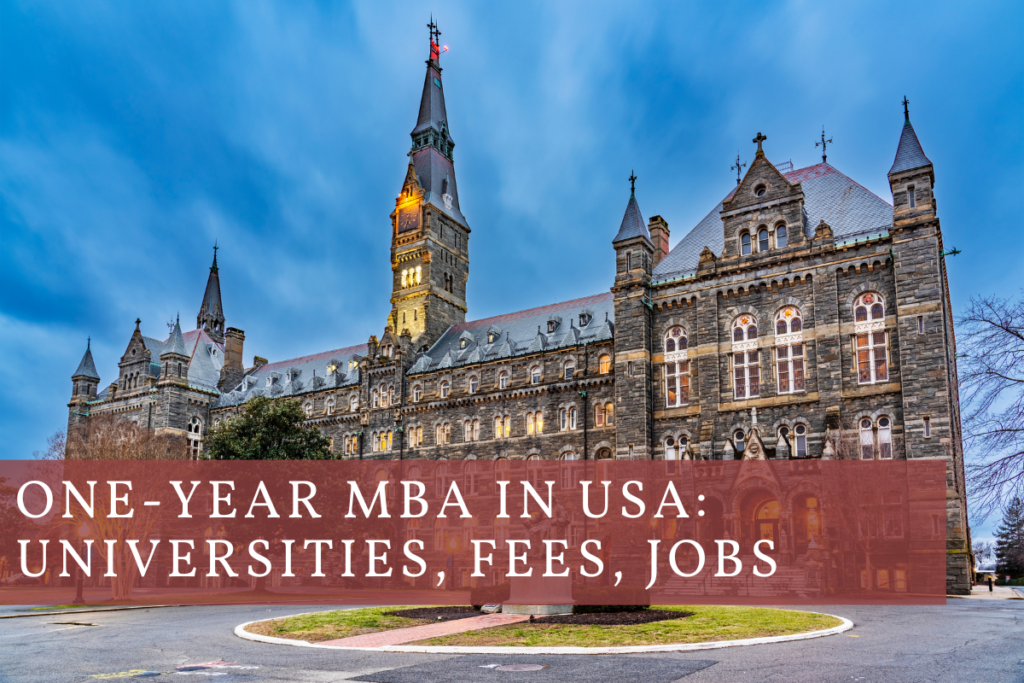
A 1 year MBA in the USA is a full-time accelerated program lasting 10–12 months, available at universities including Kellogg, Cornell Johnson, and NYU Stern. This guide covers the top programs for 2026, their costs in INR, GMAT requirements, STEM OPT eligibility, and how to decide whether the 1-year format is the right choice for your career stage and profile. In the US, the one-year MBA has become a popular choice for working professionals who want to spend as little time away from work as possible. This book tells you all about the best universities for 2026, how much tuition costs in Indian Rupees (INR), and if you need to take the GMAT. We also discuss the STEM designation, which is crucial for Indian students who want to do more OPT (Optional Practical Training) in the US. There are different types of accelerated formats, and this article will help you choose the right one for you based on your goals.
Why Choose a 1 Year MBA in USA?
The 1-year MBA format was designed for professionals who have already made career progress and need strategic skills, not foundational ones. For Indian applicants specifically, the STEM OPT extension available at Cornell Johnson, NYU Stern, and others means a 1-year program can provide up to 3 years of US work authorization, the same as a 2-year STEM program. The trade-off is no summer internship cycle and a compressed curriculum that requires full preparation before arrival.
For the most part, the accelerated version is the best choice for 2026 because of the following:
- Higher Return on Investment (ROI): If you finish the degree in 10–12 months instead of two years, you’ll get your money back much faster than if you had gone to a traditional two-year program.
- Overall Costs Are Lower: You pay 40% to 50% less than the total cost of a two-year program, which means you save a lot on both tuition and living expenses.
- STEM-Designated Work Rights: Many one-year programs are STEM-designated, which means Indian students can receive an additional 24 months of OPT. This designation allows them to work in the US for a total of three years without needing an H-1B visa immediately.
- Same Global Brand and Network: They get the same recognized degree and can connect with the same elite alumni networks and top recruiters as people who went to a two-year school.
- High Earning Potential: A one-year MBA is offered by some of the best schools in the US. Graduates make an average of $120,000 to $175,000 (₹1 Crore to ₹1.5 Crore) per year.
- Top Employers: Consulting, finance, and tech companies that are at the top of their fields hire people from these accelerated tracks because they value the candidates’ maturity and experience.

Choose your dream country
 UK
UK
 USA
USA
 Germany
 Australia
 Ireland
 Canada
 UAE
UAE
 France
 Sweden
 Italy
Italy
 Other
Other
When do you want to study abroad?
What's your highest level of education?
Select you current city
How Leap will help you

Personalised University Shortlist

Express Applications with Quicker Admits

End-to-End Application Support
Top Universities for 1 Year MBA in USA
Indian professionals seeking a quick ROI should be choosy about their one-year MBA school. For the 2026 school year, the best schools have changed their courses to focus on tech-driven leadership and STEM-designated paths that give students more time to work.
| University | US News Rank | Duration | Tuition (INR Approx.) | STEM OPT | Work Exp. Required |
|---|---|---|---|---|---|
| Northwestern Kellogg | #2 (tie) | 12 months (Jun-Jun) | ₹1.11 Crore ($119,996) | Full program | Business background required |
| Emory Goizueta | Top 20 | 12 months (May-May) | ₹95.9 Lakh ($103,800 est.) | Full program (all tracks) | 3+ years typical |
| Cornell Johnson (Tech) | Top 15 | 12 months (May-May) | ₹1.15 Crore ($124,000 est.) | STEM Designated | Tech/adjacent industry background |
| USC Marshall IBEAR | Top 30 | 12 months (Aug-Aug) | ₹1.34 Crore ($145,003) | Concentration-specific | 3+ years of international experience |
| Notre Dame Mendoza | Top 25 | 11 months (May-Apr) | ₹77.4 Lakh ($83,700 est.) | Varies by concentration | Business undergrad preferred |
| Indiana Kelley | Top 25 | 12 months (May-May) | ₹63.8 Lakh ($69,000 est.) | Business Analytics track | Business background required |
| Florida Warrington | Top 30 | 12 months (May-May) | ₹56.9 Lakh ($61,600 est.) | Concentration-specific | Business undergrad preferred |
| Babson Olin | Specialty | 12 months | ₹77.6 Lakh ($84,000 est.) | Varies by track | 2+ years of experience preferred |
Eligibility and Admission Requirements for a 1-Year MBA in USA
Admission to an accelerated MBA program in the United States requires more than just high academic standing. Admissions committees seek employees who can perform well under pressure in a fast-paced environment. Because these programs combine two years of study into one, they usually have stricter requirements for people who want to get in, like being sure of their job and being professionally mature.
1. Academic Qualifications
In the US, most of the top business schools want applicants to have a 4-year degree (10+2+4). However, bachelor's degrees in India (B.Com, B.Sc., and BBA) that only take 3 years are becoming more popular.
- Degree Equivalency: Many universities will accept 3-year degrees from NAAC-recognized schools with an "A" grade or from students who already have a Master's degree (10+2+3+2).
- GPA Needed: Applicants should aim for a GPA of 3.0 or higher on a 4.0 scale, which is about 60% to 70% in the Indian system.
2. Work Experience Requirement
Work experience is the primary factor that distinguishes one-year schools. Accelerated tracks are available only to professionals with more experience, though some recent college graduates may be able to enroll in standard two-year MBA programs.
- Duration: After graduation, most universities require two to five years of full-time employment.
- Quality over Quantity: Leadership development, impact, and professional maturity are more significant to admissions committees than years. You must demonstrate your capacity for accountability and incorporate real-world examples into your class discussions.
Scores on standardized tests continue to serve as a gauge for analytical and quantitative preparedness. A competitive score is essential for top-tier B-schools, even though some mid-tier institutions grant waivers for significant experience.
| University/Tier | Target GMAT Score | Target GRE Score |
|---|---|---|
| Top 20 (e.g., Kellogg, Cornell) | 710 – 740+ | 320 – 330+ |
| Top 50 (e.g., Emory, USC) | 680 – 710 | 310 – 320 |
| Mid-Tier & High ROI Schools | 600 – 680 | 300 – 310 |
4. English Proficiency
If you are an Indian applicant, you need to show that you can use English to communicate in a business setting.
- TOEFL (iBT): Aim for a score of 90 to 100 or more
- IELTS: An overall band score of at least 7.0 is normal, with no single band score below 6.5.
- Many schools now accept Duolingo scores of 120 to 135 or higher.
5. Documents Required
You don't have time to look into careers in an accelerated program; you have to get right to work.
- Statement of Purpose (SOP): SOPs from India often over-explain academic background. US programs want career goals, leadership examples, and a post-MBA plan. Keep the tone active and specific.
- Letters of Recommendation (LORs): LORs from supervisors in the work world are more credible than LORs from professors. They should attest to your leadership potential and ability to collaborate.
- Professional Resume: Unlike a regular CV, your MBA resume should only be one page long and focus on measurable accomplishments like how much money you saved, how many people you led, or how your projects changed things.
Is the 1 Year MBA Right for You?
The 1-year MBA works well for some Indian professionals and poorly for others. The format, cost, and no-internship structure create a specific profile fit. These three scenarios reflect the most common situations counselors see from Indian applicants.
Scenario 1: Excellent fit for the one-year MBA
If you are an Indian professional with 4-7 years of experience in technology, consulting, financial services, or product management and want to advance to senior management, product leadership, or strategy roles within the same broad industry, a 1-year MBA is likely the quickest and most cost-effective path. You already understand how businesses operate. You do not need two years to decide what to do next. Before re-entering the job market, you need a top MBA's brand signal, an accelerated network, and 12 months to consolidate your positioning.
This profile is particularly effective at schools where the one-year cohort joins the two-year cohort for electives and recruitment. At Kellogg, first-year students have access to the same career management center, on-campus recruiting events, and alumni network as second-year students. The result is the same degree with the same school seal.
Scenario 2: Consider a 2 Year MBA Instead
If you intend to switch industries completely, such as from software engineering to investment banking, operations to strategy consulting, or a corporate function to an entrepreneurial track, a two-year MBA is typically a better option. The one-year format excludes a summer internship. In a two-year program, the summer between years one and two is when career changers land their first job in the new industry. Recruiters at consulting firms and investment banks understand this structure and use summer internships as their primary screening mechanism for full-time offers. If you're making a significant career change, the one-year format eliminates the single most reliable mechanism for making it happen.
For students with 8 years or more of senior leadership experience, the Executive MBA in the United States may be a better structural fit than the 1-year or 2-year formats.
Scenario 3: The 2-year Format is Not the Appropriate Program for you Right now
If you have less than two years of full-time post-graduate work experience, a one-year MBA in the United States is not appropriate for your current stage. Admissions committees at programs such as Kellogg and Cornell Johnson expect applicants to contribute meaningfully to classroom case discussions and peer learning by drawing on real-world experience. A strong academic record from an IIT or BITS will not compensate for a lack of work. This program's pedagogical model assumes that you already understand what a profit and loss statement looks like on the inside.
If you graduated in 2024 or 2025, get 2–3 years of solid professional experience first. You will be a stronger candidate, your post-MBA goals will be clearer, and you will have a better chance of receiving scholarship money when you apply. See our guide to MBA programs in the United States without work experience for programs designed for early-career applicants.
1 Year vs. 2 Year MBA in USA
In the United States, picking between a 1-year or 2-year MBA is a strategic choice that depends on your current job position, your budget, and your long-term career goals. Both degrees are equally accredited and branded, but they differ in structure and target audience.
Key Differences
For Indian students, the main choice they have to make is between lower costs (1-year) and more job opportunities (2-year).
| Feature | 1-Year MBA (Accelerated) | 2-Year MBA (Traditional) |
|---|---|---|
| Program Duration | 10–12 months | 21–24 months |
| Typical Experience | 3–7+ years of work experience | 0–4 years of work experience |
| Internship | Usually no summer internship | Mandatory 2–3 month internship |
| Tuition & Living Cost | Lower (approx. ₹60L – ₹1.1 Cr) | Higher (approx. ₹1.5 Cr+) |
| Work Opportunity | High ROI, faster return to work | Stronger for total career pivots |
| STEM/OPT | 1 or 3 years (program dependent) | 1 or 3 years (program dependent) |
Cost of Living in USA for an Indian Student
The average monthly cost of living in the US for Indian students planning to study there in 2026 is between $1,500 and $3,000, or ₹1.2 Lakh and ₹2.5 Lakh. This figure does not include tuition fees. This costs between 10 and 20 Lakh rupees a year, depending on the city and the type of housing you choose.
Monthly Budget Breakdown
| Expense Category | Monthly Cost (USD) | Monthly Cost (INR Approx.) |
|---|---|---|
| Housing (Shared Apartment) | $700 – $1,500 | INR 63,000 – INR 1.35 Lakh |
| Food & Groceries | $250 – $500 | INR 22,000 – INR 45,000 |
| Health Insurance (Monthly share) | $125 – $250 | INR 11,000 – INR 22,500 |
Application Timeline for 1-Year MBA in USA
Indian students must adhere to a rigorous, month-by-month plan to secure a spot in a competitive 1-year MBA program for the 2026-27 academic year. Because 1-year programs are demanding, application windows are frequently shorter and more competitive than typical two-year programs.
| Month | Action Item | Indian Academic/Professional Context |
|---|---|---|
| Jan – Feb 2026 | Research 1-year programs, build a shortlist, and take the GMAT diagnostic. | Mid-year appraisal cycle at most Indian firms. Secure 1–2 months of solid prep before workloads peak. |
| Mar – Apr 2026 | Begin GMAT prep in earnest; identify 2–3 recommenders; request LORs. | Indian Board exam season (XII/University finals). It would be helpful to brief your supervisors early, as their availability may be limited. |
| May – Jun 2026 | Request a WES transcript evaluation, take the GMAT, and begin the SOP first draft. | Graduation month for most Indian universities. Please request the transcripts before the offices close for summer break. |
| Jul 2026 | Receive WES evaluation; finalize school list; start school-specific essays. | Q1 appraisal cycle in the IT/BFSI sectors. Confirm recommenders have submitted draft LORs by the month-end. |
| Aug 2026 | Complete Round 1 (R1) applications for scholarship priority. | The GMAT score must be in hand. Build in a retake buffer if your score is below the school average. |
| Sep – Oct 2026 | Please submit R1 applications and prepare for interview invitations. | Deadlines for schools like Kellogg or Emory historically fall in mid-September. |
| Nov – Dec 2026 | Preparation for interviews, receiving Round 1 decisions, and applying for Round 2 if necessary are important steps to consider. | R2 is the last window with meaningful scholarship access. R2 deadlines typically fall in early January. |
| Jan 2027 | Round 2 deadlines, I-20 request from school, and begin F-1 visa prep. | SEVIS registration is required. Consulate appointments in major cities can book out 4–8 weeks in advance. |
| Feb – Mar 2027 | Complete the F-1 visa interview, conduct housing research, and pay the enrollment deposit. | Consulate schedules in Mumbai, Delhi, and Chennai vary. Book your slot as soon as you receive your I-20. |
| Apr – May 2027 | Pre-departure orientation: complete any prerequisite courses. | The Indian academic year ends. Coordinate your notice period and last working day with your employer. |
| Jun 2027 | Arrive in the USA; the 1-year MBA begins. | Most accelerated programs (e.g., Kellogg, Emory) start in June, not September. |
Career Opportunities and Salary after a 1-Year MBA in USA
In the US, a 1-year MBA is more than just a quick-track degree; it's a high-speed career booster for working professionals who want to make more money without taking a long break from work. The results are especially beneficial for Indian students, who often move to a global career with salaries that are much higher than the averages in their home country.
Top Recruiters for Indian 1-Year MBA Graduates
Global companies that value cross-cultural leadership and experience often hire Indian graduates from US programs.
Big names in consulting include Deloitte, BCG, Bain & Co., and McKinsey & Company.
The top tech companies are Apple, Amazon, Google, and IBM.
Goldman Sachs, J.P. Morgan, and American Express are all financial institutions.
Major Jobs and Payment Package
| Job Role | Annual Base Salary (USD) | Annual Base Salary (INR Approx.) |
|---|---|---|
| Strategy Consultant | $160,000 – $192,000 | INR 1.35 Cr – INR 1.62 Cr |
| Senior Product Manager | $145,000 – $175,000 | INR 1.22 Cr – INR 1.48 Cr |
| Investment Banking Associate | $150,000 – $185,000 | INR 1.27 Cr – INR 1.56 Cr |
| Operations Manager | $115,000 – $145,000 | INR 97.2 Lakh – INR 1.22 Cr |
| Financial Analyst (Senior) | $120,000 – $155,000 | INR 1.01 Cr – INR 1.31 Cr |
| Business Development Director | $130,000 – $165,000 | INR 1.10 Cr – INR 1.39 Cr |
| Marketing Manager | $110,000 – $140,000 | INR 93.0 Lakh – INR 1.18 Cr |
Conclusion
Indian students should consider getting a one-year MBA in the United States to advance their careers quickly and keep costs low. The 1-year MBA has a much higher return on investment (ROI) than the traditional 2-year format because it cuts down on tuition costs and the time spent away from work by half. This means that international students can get jobs in the US faster and with less debt overall. There is more time for internships in 2-year programs, but many 1-year MBA programs now include intensive industry projects and capstones that provide students the same kind of hands-on experience. If you are a professional with three to five years of experience, the one-year route lets you learn advanced leadership skills without taking a long break from your job. The best choice for you will depend on your budget and career goals. If you want to make a quick, big change in your career, the 1-year MBA is usually the best option.
Verified by LeapScholar's USA counselling team. Have questions? Book a free session with a LeapScholar counselor.
FAQs
-
Is a 1-year MBA in the USA worth it for Indian students?Yes, it gives you a good return on investment because it cuts your tuition and living expenses in half and speeds up your entry into the US job market. It's perfect for professionals with three to seven years of experience who want to move up in their field instead of making a complete career change.
-
Can I do a 1-year MBA in the USA without work experience?
These programs cater to experienced professionals who can handle the fast-paced curriculum, making it rare and challenging. Most top schools want applicants to have between 2 and 5 years of work experience. New graduates should instead think about getting a Master's in Management (MiM) or a traditional 2-year MBA.
-
What is the cheapest 1-year MBA in the USA for Indian students?
Some of the least expensive 1-year paths are at Clark University (₹15.8L), the University of Maryland (~₹15.8L), and Harrisburg University (₹14.8L).
-
Is the GMAT mandatory for a 1-year MBA in USA?
Not at all. More than 60% of US schools no longer require the GMAT or let people with high GPAs or a lot of work experience skip it. But the best "M7" schools still want or need scores for their competitive review.
-
How many years can I stay in the USA after a 1-year MBA?
You can work while on OPT for a year. If your program is STEM-designated, you can ask for a 24-month extension. This will let you work for a total of three years.













Have Questions? Get Guidance to reach your Dream University
Connect with India's finest counsellors and biggest study abroad community.
Get Guidance