
Quick Read
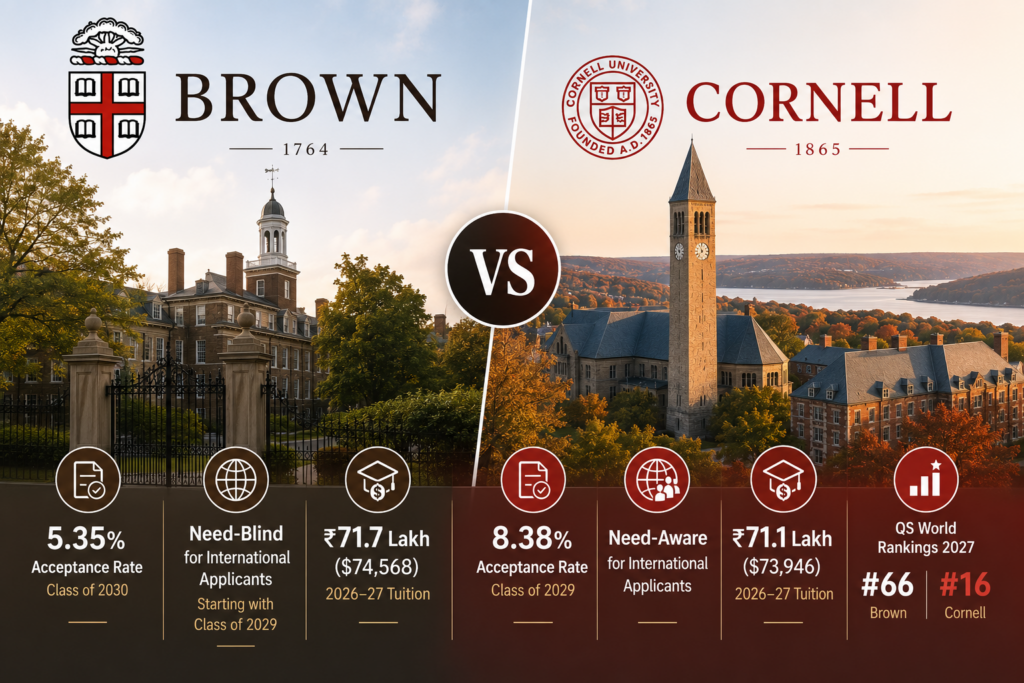
- Cornell’s confirmed acceptance rate was 8.38% for the Class of 2029; Brown’s confirmed rate is 5.35% for the Class of 2030.
- Brown is need-blind for international applicants starting with the Class of 2029.
- Cornell remains need-aware for international applicants, unlike Brown’s current policy.
- Brown’s 2026-27 tuition is Rs.71.7 lakh ($74,568); Cornell’s is Rs.71.1 lakh ($73,946).
- Cornell ranks #16 globally in QS 2027; Brown ranks #66 in the same edition.
- Brown’s open curriculum has no core requirements; Cornell’s eight colleges each set their own.
Brown vs Cornell at a Glance
| Details | Brown University | Cornell University |
|---|---|---|
| Location | Providence, Rhode Island | Ithaca, New York |
| Founded | 1764 | 1865 |
| Known for | Open curriculum, humanities, applied math, biomedical research | Eight-college system, engineering, computer science, hotel administration, agriculture |
| Popular undergrad programs | Computer Science, Economics, Applied Math, Public Health, PLME (medicine) | Computer Science, Engineering, Hotel Administration, Industrial Labor Relations, Business |
| Program length | 4 years (bachelor’s) | 4 years (bachelor’s) |
| Undergraduate enrollment | 7,900 | 16,100 |
Brown vs Cornell Rankings: Where Each Stands in 2026-27

Choose your dream country
 UK
UK
 USA
USA
 Germany
 Australia
 Ireland
 Canada
 UAE
UAE
 France
 Sweden
 Italy
Italy
 Other
Other
When do you want to study abroad?
What's your highest level of education?
Have you completed Class 12th?
What was your Class 12 CGPA/percentage?
Are you a student or a parent/guardian?
What do you want to study?
Select your current city
How Leap will help you

Personalised University Shortlist

Express Applications with Quicker Admits

End-to-End Application Support
Brown vs Cornell prestige questions usually start here, and the two schools diverge because of how each ranking body weighs research scale versus undergraduate focus.
| Ranking body | Cornell | Brown |
|---|---|---|
| QS World University Rankings 2027 | #=16 (#7 in the USA) | #66 |
| US News Best National Universities (2026 edition) | #12 | #13 (tied with Dartmouth) |
| Times Higher Education World University Rankings 2026 | #18 | #65 |
Cornell's larger research output and graduate programs push it ahead in the global tables, while both schools sit close together in US-focused rankings that weigh undergraduate teaching more heavily. Cornell ranks closer to Columbia and Yale; Brown sits nearer Dartmouth and, on flexibility, Amherst.
See LeapScholar's Ivy League universities in the USA guide for how all eight compare.
Counselor insight: A ranking gap this size rarely reflects classroom quality; it mostly reflects Cornell's larger PhD and research output. Don't let global rank alone decide your choice.
Brown vs Cornell Acceptance Rate: Which Is Easier to Get Into?
Is Brown or Cornell easier to get into?
Based on Brown's own Class of 2030 admissions announcement and Cornell's Class of 2030 admit numbers reported by the Cornell Daily Sun, Brown is currently the more selective school.
- Brown, Class of 2030 (confirmed): 5.35% overall (2,564 admitted from 47,937 applicants). ED: 16.5%. RD: 3.94%.
- Cornell, Class of 2030: Cornell admitted 5,776 students but hasn't published its applicant pool or rate yet; that appears in Cornell's Common Data Set later this year. Its last confirmed rate, Class of 2029, was 8.38% (6,077 of 72,523). ED: 18.78%. RD: 6.70%.
Cornell admits a higher share than Brown based on the most recent confirmed numbers, though its Class of 2030 rate should land closer to 7-8% once published. ED carries a real advantage at both schools, but it's binding, so use it only if one school is genuinely your first choice.
Counselor insight: Cornell's eight undergraduate colleges admit separately, so your real odds depend on which college you apply to, not the university-wide number. Engineering and Business are typically more competitive than some statutory colleges.
Cost of Brown vs Cornell in INR: Tuition, Cost of Living, and Scholarships
This is where Brown vs Cornell really diverges for Indian families, and it's the one factor most comparison articles skip: the aid policy, not the sticker price, decides your real cost.
1. Tuition Fees
The tuition figures look almost identical. The real difference is the policy behind them: Brown's need-blind admission means your ability to pay doesn't affect whether you get in, and it then meets 100% of demonstrated need. Cornell considers financial need as one factor in the decision, and skipping the aid application at admission means you won't be able to apply for aid later.
| Detail | Brown (2026-27) | Cornell (2026-27) |
|---|---|---|
| Tuition only | Rs.71.7 lakh ($74,568) | Rs.71.1 lakh ($73,946) |
| Estimated total cost of attendance | Rs.93.3 lakh ($97,016), officially confirmed | Rs.~96 lakh (~$99,900), calculated estimate; not yet officially published |
| Aid policy for international students | Need-blind since the Class of 2029 | Need-aware |
Sources: Brown University tuition and fees, 2026-27; Cornell Board of Trustees 2026-27 budget approval.
2. Cost of Living
Ithaca is slightly cheaper on rent but has fewer part-time job options nearby. Providence offers easier access to Boston for internships. Neither is cheap by Indian standards, so budget housing, food, and winter clothing separately. Brown Bears vs Cornell Big Red is a real Ivy League rivalry, but let academics and aid decide this one.
| Expenses | Providence, RI (Brown) | Ithaca, NY (Cornell) |
|---|---|---|
| 1-bedroom apartment, city centre | Rs.2,33,500 ($2,427.50)/month | Rs.2,08,412 ($2,166.67)/month |
| Average monthly net salary (local benchmark) | Rs.3,57,057 ($3,712) | Rs.3,27,581 ($3,405.56) |
Source: Numbeo Cost of Living data
3. Scholarships
| Type | Brown | Cornell |
|---|---|---|
| Merit scholarships | None | None |
| Institutional need-based aid | The Brown Promise meets 100% of demonstrated need, no loans | Cornell Grants and Endowed Scholarships meet 100% of demonstrated need |
| Named scholarship specifically for Indian students | None | Tata Scholarship for Students from India is a $25 million endowment funding around 20 need-based undergraduate scholars from India at any given time |
| Low-income US student programs | QuestBridge partner (not open to international citizens) | QuestBridge partner (not open to international citizens) |
No separate application is needed for the Tata Scholarship. You're automatically considered once admitted and once you've applied for aid via the CSS Profile. It favors students in Architecture, Engineering, Applied Economics and Management, or the sciences. Brown has no equivalent India-specific award; its aid runs entirely through the Brown Promise.
A quick note about external scholarships: Most of the well-known Indian names you'll see in scholarship lists, the Inlaks Shivdasani Foundation, the JN Tata Endowment, and the KC Mahindra Scholarship among them, fund postgraduate study only. They won't help you at the undergraduate level, so don't count on them when budgeting for a Brown or Cornell bachelor's degree.
For external scholarships you can actually apply for, see LeapScholar's scholarships for Indian students in the USA guide.
Open Curriculum vs Seven Colleges: Academic Structure
Brown's Open Curriculum:
- No core distribution requirements; you choose every course from day one.
- You can take classes pass/fail, with no mandated general education list.
- Suits students who already know roughly what they want to study or want an unconventional path across departments.
Cornell's Eight-College System:
- You apply to and enroll in one of eight undergraduate colleges: Arts and Sciences, Engineering, Business, Agriculture and Life Sciences, Human Ecology, Industrial and Labor Relations, Architecture, Art and Planning, and the Jeb E. Brooks School of Public Policy.
- Each college sets its admission criteria and degree requirements.
- You're admitted directly into your field; switching colleges later needs an internal transfer, which isn't guaranteed.
Decision Framework: Should You Choose Brown or Cornell?
If predictable aid matters most for a middle-income Indian family: Brown's need-blind policy for international applicants removes the risk that your ability to pay affects admission.
If you already know you want core engineering or CS at scale (the classic Brown vs Cornell engineering and Brown vs Cornell CS question): Cornell's College of Engineering and Bowers CIS offer wider specializations and a recruiting pipeline companies already know, at the cost of committing to that college at application. Brown's CS, inside the open curriculum, pairs easily with a second concentration like economics.
If you want to explore across humanities, social science, and STEM without being locked into one college's requirements: Brown's open curriculum is built for exactly this.
Entry Requirements: Documents Checklist
| Document | India-specific detail |
|---|---|
| Common Application | Both use the Common App (commonapp.org); no separate portal needed |
| Transcripts | Class 10 and Class 12 marksheets, plus provisional certificate if final marks are pending |
| SAT or ACT | Both schools reinstated mandatory testing; check current score ranges before applying |
| English proficiency test | Required unless English was your medium of instruction throughout secondary school; TOEFL, IELTS, or Duolingo accepted |
| CSS Profile | Required by both if applying for aid; neither offers a CSS Profile fee waiver to applicants from India |
| SOP and essays | Required by both; format differs by school |
| Letters of recommendation | Typically 2 teacher evaluations plus 1 counselor recommendation |
Post-Study Work Rights: OPT or STEM for Brown vs Cornell Graduates
Post-study work authorization is a federal F-1 benefit, identical for both schools' graduates:
- Every F-1 graduate gets 12 months of standard OPT, regardless of major.
- A DHS-designated STEM degree adds a 24-month extension, for up to 36 months total, with an E-verified employer and a filed Form I-983.
- Cornell: Engineering, CS, and several agriculture and applied economics degrees are STEM-designated by default.
- Brown: Depends on your concentration. CS, applied math, and the ScB engineering track qualify; most humanities concentrations don't.
- Confirm your CIP code on your I-20 with your international student office before graduating.
Application Calendar for Indian Applicants
If you're researching your options in mid-2026, the cycle open to you is Fall 2027 entry (Fall 2026 admissions closed back in March-April 2026):
| Month | What to do? |
|---|---|
| July-August 2026 | Finalize your college list, register for SAT/ACT test dates, start brainstorming essay and SOP topics |
| September 2026 | Sit for SAT/ACT if not already done, request recommendation letters from teachers, start your Common Application |
| October 2026 | Finalize Early Decision essays and SOP; if applying for aid, complete the CSS Profile |
| November 1, 2026 | Early Decision deadline (Brown and Cornell) |
| November-December 2026 | Keep working on Regular Decision applications to other schools as a backup while you wait on ED |
| Mid-December 2026 | ED decisions released |
| January 2, 2027 | Cornell Regular Decision deadline |
| January 5, 2027 | Brown Regular Decision deadline |
| January-February 2027 | Class 12 board exam preparation intensifies; submit any pending financial aid documents now, before boards take over |
| February-March 2027 | Board exams underway; keep application follow-ups to a minimum during this stretch |
| Late March 2027 | RD decisions released for both schools on Ivy Day |
| April 2027 | Compare financial aid offers; board results may still be pending depending on your board |
| May 1-2, 2027 | Enrollment deposit due |
| May-June 2027 | Board results published; submit final transcripts; start your F-1 visa process (DS-160, SEVIS fee, visa interview slot) |
| June-July 2027 | Visa interview and travel preparation |
| Late August 2027 | Cornell classes begin |
| Early September 2027 | Brown classes begin |
Here's what catches most Indian applicants off guard: Both RD decisions land on Ivy Day in late March, right in the thick of board exam season, and your enrollment deposit is due around May 1, before most results are out. Build your SOP, testing, and recommendation letters into October-November, well before boards eat your time, and check early with your school on provisional marksheets if final results aren't ready by the deposit deadline.
See LeapScholar's Fall intake in USA guide for the full US calendar.
What to Do If Things Go Wrong?
Deferred or waitlisted: Both allow a letter of continued interest. Cornell's waitlist has historically admitted about 4% of students who accept a spot; Brown doesn't rank its waitlist and reviews everyone remaining if space opens.
Cornell aid offer falls short: Cornell reconsiders only if your family's finances have genuinely changed since you applied; it won't adjust based on other schools' offers.
Skipped applying for aid at admission: Both schools bar later institutional aid if you skipped it initially. Apply for aid upfront even if unsure you'll need it.
Visa interview delayed near-term start: Contact your international student office immediately. Neither school can expedite a US embassy appointment.
See LeapScholar's US visa rejection rate and reasons guide.
3 Key Takeaways on Brown vs Cornell
1. If predictable aid matters more than ranking, Brown's need-blind policy for international applicants is the deciding factor, not the QS gap. A few rank positions won't shape your daily experience as much as knowing your admission has nothing to do with your family's income.
2. Match your major to each school's actual strength: Cornell for engineering and CS at scale, Brown for that plus genuine interdisciplinary freedom. Don't pick a school for its overall rank and hope your intended field works out.
3. Apply for financial aid during admission at both schools, regardless of your confidence level; neither school allows you to apply for institutional aid later if you skip it upfront. Filing the paperwork now keeps that option available, even if you don’t end up needing it.
Verified by: LeapScholar's USA counseling team, with hands-on experience guiding Indian students through Ivy League applications, financial aid strategy, and F-1 visa preparation.
Have questions about applying to Brown or Cornell? Book a free session with a LeapScholar counselor.
Frequently Asked Questions About Brown vs Cornell
-
Is Brown or Cornell easier to get into?
Right now, Cornell is the easier school to get into. Its last confirmed number was 8.38% (Class of 2029), against Brown's confirmed 5.35% (Class of 2030). Cornell's Class of 2030 figure isn't out yet, but expect it near 7-8%.
-
Is Brown better than Cornell, or is Cornell better than Brown?
It depends on what you're optimizing for. Cornell wins on global rankings by a wide margin (QS #16 versus #66), mostly on research output. Brown wins if you want the freedom to build your own academic path without a college dictating your course plan.
-
Does Cornell offer need-blind admission for international students?
No, and this distinction trips people up because Cornell's domestic admissions are need-blind. For international applicants, Cornell weighs financial need alongside your application. Brown dropped that consideration entirely from the Class of 2029, so it's genuinely need-blind for everyone now, Indian applicants included.
-
Which is better, Brown or Cornell, for computer science?
For scale and a recruiting pipeline that companies already know, Cornell's Bowers CIS is the stronger bet. Brown's open curriculum makes it easier to do CS alongside something else entirely, without having to fight a rigid plan.
-
Can international students get a full scholarship at Cornell University?
Cornell does not offer merit scholarships. What it has is need-based aid, and if your family's demonstrated need is high enough, that package can cover most or all of tuition, room, and board.
-
What happens if my Cornell financial aid appeal is rejected?
Cornell only revisits your aid if something in your finances has genuinely changed since you applied. A better offer from another school won't change anything, so plan around Cornell's first offer.
-
Should I apply Early Decision to Brown or Cornell?
Only if you're genuinely sure, since both are binding. The numbers do favor early: Brown's ED rate was 16.5% against 3.94% RD; Cornell's ED rate for the Class of 2029 was 18.78% against 6.70% RD.
-
How much does it cost to study at Brown vs Cornell for an Indian student?
On paper, the costs are almost the same. Brown's 2026-27 tuition is Rs.71.7 lakh ($74,568); Cornell's is Rs.71.1 lakh ($73,946), with total costs between Rs.93 and Rs.96 lakh before aid. What actually decides your bill is whether you qualify for aid, not that small gap.
-
What is the acceptance rate for Indian students at Brown and Cornell?
Neither university publishes a country-specific rate, so there's no separate "India" number to chase. You're competing within the same international applicant pool as everyone else, and that pool is only getting bigger each year. Treat the overall rates (Brown 5.35%, Cornell 8.38% last confirmed) as your baseline, and put your energy into the things you can actually control: strong test scores, essays that reflect your real context in India rather than a generic template, and recommendation letters that say something specific about you.





Have Questions? Get Guidance to reach your Dream University
Connect with India's finest counsellors and biggest study abroad community.
Get Guidance