
Quick Read
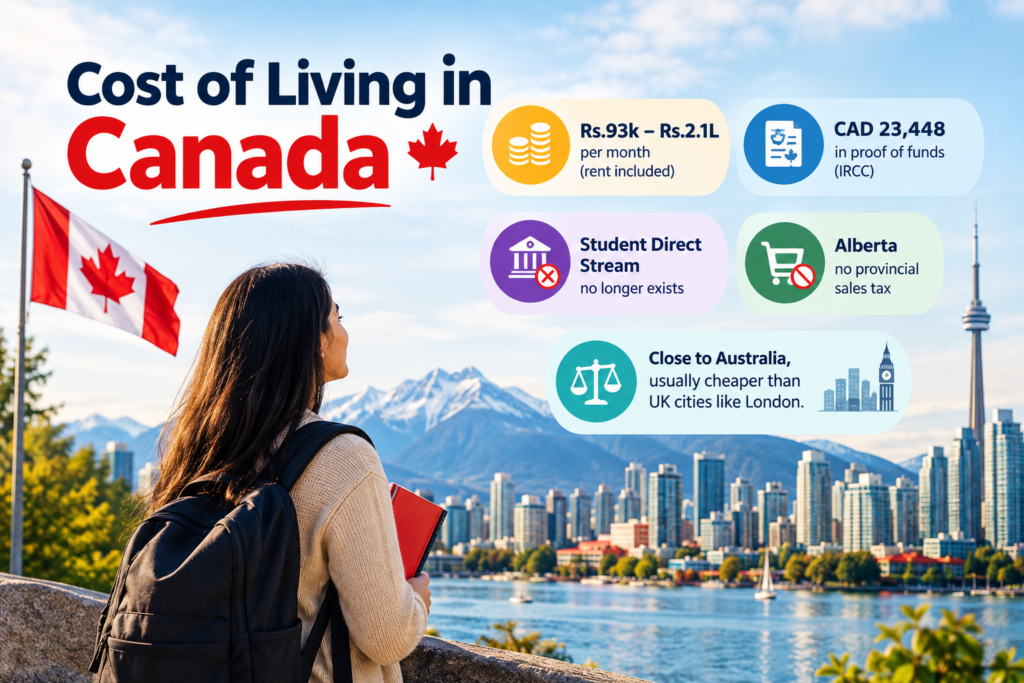
- Most students spend Rs.93,000 to Rs.2.1 lakh a month, rent included.
- IRCC now asks for CAD 23,448 in proof of funds, up from last year’s number.
- The Student Direct Stream doesn’t exist anymore, so the GIC route has changed.
- Alberta charges no provincial sales tax, which quietly lowers everyday costs.
- Canada runs close to Australia and is usually cheaper than UK cities like London.
What the Cost of Living in Canada Actually Looks Like Each Month
The number changes fast depending on where you land. Statistics Canada and IRCC’s own cost-of-living data show a clear split: shared housing in a smaller city like Winnipeg or Saskatoon runs close to the bottom of every range below, while a private rental in Toronto or Vancouver pushes you to the top of each one, sometimes past it.
Here’s the category-by-category breakdown that holds up across most Canadian cities.

Choose your dream country
 UK
UK
 USA
USA
 Germany
 Australia
 Ireland
 Canada
 UAE
UAE
 France
 Sweden
 Italy
Italy
 Other
Other
When do you want to study abroad?
What's your highest level of education?
Have you completed Class 12th?
What was your Class 12 CGPA/percentage?
Are you a student or a parent/guardian?
What do you want to study?
Select your current city
How Leap will help you

Personalised University Shortlist

Express Applications with Quicker Admits

End-to-End Application Support
| Expense | Monthly Cost (CAD) | Monthly Cost (INR) |
|---|---|---|
| Rent (shared or off-campus) | 700 - 1,800 | Rs.47,803 - Rs.1,22,922 |
| Groceries and food | 300 - 500 | Rs.20,487 - Rs.34,145 |
| Public transit pass | 90 - 150 | Rs.6,146 - Rs.10,244 |
| Utilities and internet | 120 - 250 | Rs.8,195 - Rs.17,073 |
| Personal and miscellaneous | 100 - 250 | Rs.6,829 - Rs.17,073 |
| Health insurance (prorated) | 50 - 100 | Rs.3,415 - Rs.6,829 |
Source: Government of Canada, Prepare Financially
Rent is the one line item that swings everything else. The federal government's own newcomer guidance points out that housing and utilities alone typically eat up 35% to 50% of what you actually take home, which lines up with what most students report once they've settled in.
My insight: Students almost always budget for rent and forget the deposit. Most Canadian landlords ask for the first and last month upfront, so double your monthly rent figure for your actual move-in cost.
Cost of Living in Canada Annually: The Full-Year Number
Monthly figures are useful for planning your weekly grocery run, but the number that actually matters for a loan application or a conversation with your parents is the annual one. Add up the monthly ranges above across twelve months, and you get a workable picture of the cost of living in Canada annually.
| Scenario | Annual Cost (CAD) | Annual Cost (INR) |
|---|---|---|
| Lean budget, shared housing, smaller city | 16,320 | Rs.11.15 lakh |
| Mid-range budget, average city | 24,000 | Rs.16.39 lakh |
| Higher budget, Toronto or Vancouver | 36,600 | Rs.25.00 lakh |
Source: Calculated from the monthly category breakdown above, based on the Government of Canada (Prepare Financially)
Notice that the cost of living in Canada annually can more than double depending purely on which city you pick. That's the single biggest lever a student has, more than any amount of couponing on groceries.
Cost of Living in Canada by Province, Including Alberta
City choice gets most of the attention, but the province you land in changes your bill too, mostly through sales tax. Canada charges a federal Goods and Services Tax of 5% on most purchases, and then provinces add their own tax on top, except for a few that don't.
| Province | Added Provincial Tax | What This Means for You |
|---|---|---|
| Alberta | None (5% GST only) | Everyday purchases cost noticeably less than in HST provinces |
| Ontario | 13% HST | Grocery staples are exempt, but most goods and services cost more |
| British Columbia | 12% (GST + PST) | Similar overall tax load to Ontario |
| Quebec | 14.975% (GST + QST) | Highest combined tax rate among major student destinations |
This is precisely why the cost of living in Canada, Alberta, comes up so often in student forums. Calgary and Edmonton already have lower rent than Toronto or Vancouver, and the missing provincial sales tax stretches every rupee a bit further on top of that. If you're chasing the cost of living in Canada, Alberta specifically, expect your day-to-day spending to land toward the lower end of the monthly ranges above.
IRCC’s 2027 Proof of Funds Requirement, and Why the GIC Isn’t an SDS Thing Anymore
Two things changed here that many older guides, including some still ranking on Google, haven't caught up with. Here's what you actually need to know:
- The Student Direct Stream was discontinued by IRCC in late 2024. There's no separate fast-track category anymore, so every applicant, regardless of country, now goes through the same study permit process.
- The cost-of-living threshold went up. IRCC raised it to CAD 23,448 for a single applicant, effective September 2026, replacing the older CAD 22,895 figure.
That threshold is in addition to tuition and travel costs, not instead of them, and it increases if family members join you.
| Applicant Situation | Funds Required (CAD) | Funds Required (INR) |
|---|---|---|
| Single student | 23,448 | Rs.16.01 lakh |
| Student + 1 family member | 29,192 | Rs.19.94 lakh |
| Student + 2 family members | 35,888 | Rs.24.51 lakh |
| Student + 3 family members | 43,572 | Rs.29.76 lakh |
Source: Government of Canada, IRCC Study Permit Program
My insight: A GIC is still one of the cleanest ways to show this money; just don't call it an "SDS GIC" on your application. The stream is gone; the certificate itself isn't.
For a before-and-after on what changed, see our guide on the difference between SDS and non-SDS Canada.
For a complete document checklist, check out our blog on the requirements for a student visa in Canada.
Cost of Living in Canada vs Australia and the UK
Students weighing Canada against other countries usually want a straight comparison rather than a paragraph of hedging, so here's the short version.
| Comparison | How Canada Stacks Up | What Drives the Gap |
|---|---|---|
| Cost of living in Canada and Australia | Fairly close; Canada is often slightly cheaper | Regional Canadian cities like Montreal or Edmonton undercut Australian equivalents modestly |
| Cost of living in Canada and UK | Canada usually comes out cheaper | London's rent alone pushes UK averages above most Canadian cities, Toronto included |
Neither comparison is a blowout in either direction. If your decision genuinely comes down to cost, the city you pick within each country usually matters more than the country itself.
Read the full breakdowns: Canada vs Australia for Indian students and Canada vs UK for Indian students
Which Cost of Living in Canada Bracket Fits Your Situation
There's no single "right" budget here. It depends on what you're optimizing for.
- If you're a single student watching every rupee: Look at Winnipeg, Saskatoon, or a smaller Alberta city. Shared housing plus public transit keeps you near the lower end of every table above, and Alberta's tax situation helps quietly.
- If you're bringing a spouse or child: Your proof of funds jumps to at least CAD 29,192, and your monthly budget realistically needs a two-bedroom rather than a shared room. Factor these considerations in before you commit to a city.
- If you want the networking and job market of Toronto or Vancouver: Budget toward the higher end of every table here, and treat the extra cost as the price of a bigger part-time job market and more internship access.
What to Do If Your Proof of Funds Falls Short
Falling short of CAD 23,448 isn't a disaster, and it's a more common situation than most students expect.
Consider an education loan
A structured loan from an Indian bank or NBFC is accepted as valid proof of funds, and it can close the gap without draining family savings.
Our study loan for Canada guide covers what lenders actually ask for.
Check your GIC timing
Banks need time to issue the confirmation letter IRCC wants to see, so don't leave this for the last two weeks before you apply.
Get a gift affidavit right if a relative is helping
A loan dressed up as savings gets flagged. A notarized gift letter from the person actually providing the funds does not.
My insight: The most common refusal reason we see isn't a low balance; it's a large deposit that appeared two weeks before applying. Keep your funds settled for at least three months.
How to Bring Down Your Monthly Cost of Living in Canada?
A few practical habits can really help without making student life miserable.
- Split rent properly: A three-person shared apartment is almost always cheaper per head than a two-person one, and it's the single biggest lever you have.
- Buy a monthly transit pass, not single tickets: Most Canadian cities price passes to reward regular riders.
- Work part-time where it's allowed: It won't cover your full budget, but it takes the edge off.
Our guide to part-time jobs in Canada for Indian students has realistic expectations on pay and hours.
- Pick your city with intention: A city that saves you Rs.15,000 a month on rent isn't a win if it also has a thin part-time job market and no direct flights home. Weigh rent against local hiring demand and how easily you can travel back for a break before you commit.
3 Key Takeaways on Cost of Living In Canada
- City and province choice affects your budget more than any single saving habit, so decide where you're headed before you fine-tune the details.
- Confirm the current IRCC proof of funds figure directly on canada.ca before you apply, since CAD 22,895 is now out of date and the SDS route no longer exists.
- Keep tuition and living costs as two separate numbers when you plan, and aim a little above CAD 23,448 instead of cutting it close.
Verified by: LeapScholar's Canada counseling team. They work with students on this exact paperwork week to week, from GIC applications to picking a city that fits the budget.
Still working out your numbers? Book a LeapScholar counselor and map out a realistic, city-by-city budget instead of guesswork.
Frequently Asked Questions About Cost of Living in Canada
-
How much does it actually cost to live in Canada as a student?
Most students land somewhere between Rs.93,000 and Rs.2.1 lakh a month once rent is included, though that range genuinely depends on your city. Someone in Winnipeg and someone in Toronto are living on two different budgets entirely, even though they're both technically answering the same question.
-
Has the IRCC proof of funds amount actually gone up?
Yes, and it catches people off guard because the older figure is still floating around online. The current requirement for a single applicant is CAD 23,448, up from the previous CAD 22,895, effective September 2026. Always check IRCC's own page before you finalize your numbers.
-
Is the GIC still connected to the Student Direct Stream?
No, and this is worth repeating because many guides haven't caught up. IRCC discontinued the Student Direct Stream in late 2024. The GIC itself still exists as one accepted way to show proof of funds, but it's no longer tied to a separate fast-track application category.
-
Why does Alberta keep coming up as a cheaper option?
Mostly because of tax, not just rent. Alberta doesn't charge a provincial sales tax on top of the federal 5% GST, while Ontario adds 13% and Quebec adds nearly 15%. Combine that with Calgary and Edmonton's lower rent compared to Toronto, and the savings add up over a year.
-
Is Canada cheaper than Australia for students?
It's close, honestly closer than most comparison articles make it sound. On the cost of living in Canada and Australia question, regional Canadian cities tend to undercut their Australian equivalents slightly, but the gap isn't dramatic enough to be the only reason to choose one country over the other.
-
How does Canada compare to the UK on cost?
Canada usually ranks slightly higher here. On the cost of living in Canada and UK comparison, London's rent alone drags UK averages up to a level that even Toronto doesn't quite reach, and outside London the gap narrows but rarely disappears entirely.
-
What happens if my bank balance doesn't meet the CAD 23,448 requirement?
Your study permit application can be refused on financial grounds, so the application isn't something to leave until the last minute. An education loan or a documented gift from a sponsor are both accepted routes to close the gap before you apply.
-
Does the cost of living in Canada include tuition?
No, and this issue trips people up constantly. Every figure in this guide covers rent, food, transport, and daily expenses only. Tuition is a separate line item entirely, and a realistic Canada budget needs both worked out side by side.
-
Which Canadian city should a budget-conscious student actually pick?
Winnipeg, Saskatoon, and most Alberta cities consistently rank lower on rent and daily costs than Toronto or Vancouver, without a dramatic drop in quality of life. The trade-off is usually a smaller part-time job market, which matters more for some students than others.









Have Questions? Get Guidance to reach your Dream University
Connect with India's finest counsellors and biggest study abroad community.
Get Guidance