
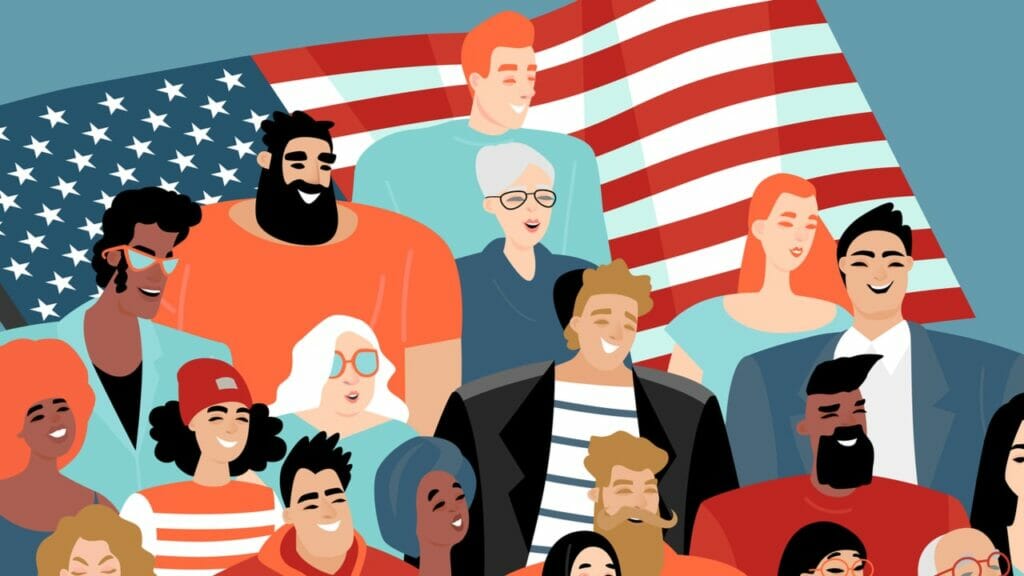
America is a land of opportunities, drawing people from all over the world to travel, study, work, or vacation. Apart from being one of the largest superpowers in the world, America is also a land rich in culture and heritage. The melting pot of different cultures and people from various origins, the culture in the US is complex and heartwarming to understand at the same time. Learning the languages, traditions, people, and etiquette is an experience international students will thoroughly love and enjoy. If you are an aspirant, this article covers nearly everything you should know about the culture in the US before your big move.
Origin of the Culture in the US
The cultural pluralism of American culture has roots that stem back to its very foundation and before. The English and Spanish people settled in America during the colonial rule of their respective countries. These settlers gave America its roots in Europe. Historical immigration from countries like Germany, Italy, Ireland, and Japan has added to its cultural diversity. One cannot speak of the culture in the US without mentioning the Native Americans, also known as American Indians. The original inhabitants of America have significant and subtle influences on what American culture is today.
Today, the U.S. culture continues to evolve while maintaining these deep historical foundations. Waves of immigration from Latin America, Asia, and Africa in the 20th and 21st centuries have further enriched the traditions, languages, and cuisines across the country. Modern American culture reflects a dynamic blend of its historical roots and contemporary influences, visible in regional customs, music, arts, and daily life practices.
About the American People

Choose your dream country
 UK
UK
 USA
USA
 Germany
 Australia
 Ireland
 Canada
 UAE
UAE
 France
 Sweden
 Italy
Italy
 Other
Other
When do you want to study abroad?
What's your highest level of education?
Have you completed Class 12th?
What was your Class 12 CGPA/percentage?
Are you a student or a parent/guardian?
What do you want to study?
Select your current city
How Leap will help you

Personalised University Shortlist

Express Applications with Quicker Admits

End-to-End Application Support
People are the foundation of any civilization. The diversity of individuals in America contributes to the enrichment of its culture. For ages, people from all over the world have been coming to this nation. What American culture actually is has been evolving continuously as a result of the contributions made by each immigrant group and their eventual assimilation.
As of 2025, the U.S. population is approximately 334 million, reflecting a wide range of ethnicities, languages, and cultural practices. Americans are known for valuing individualism, innovation, and civic engagement, while regional differences influence social norms and traditions. The Northeast and West Coast tend to be more liberal, embracing multiculturalism, whereas the Midwest and South maintain more traditional values. Social diversity is further reflected in urban centers like New York, Los Angeles, and Chicago, which host vibrant communities from every corner of the globe.
For those planning to stay long-term, it is essential to understand the requirements for a [working visa for the USA].
Ethnicity & Religion in The US
The United States is a mosaic of diverse ethnic and religious backgrounds. According to the U.S. Census Bureau’s latest estimates, the population breakdown is:
White (Non-Hispanic): Approximately 59%
Hispanic or Latino: Approximately 19%
Black or African American: Approximately 14%
Asian American: Approximately 6%
American Indian or Alaska Native: Approximately 2%
Native Hawaiian or Other Pacific Islander: Approximately 0.2%
Two or more races: Approximately 3%
The states with the highest ethnic diversity include Hawaii, California, Nevada, Maryland, Washington D.C., Texas, New Jersey, New York, Georgia, and Florida, making them vibrant hubs for cultural exchange and international students..
While the U.S. government practices the separation of church and state, the country remains one of the most religiously developed in the world. Daily life often reflects religious values, even as organized religion becomes less central. According to recent estimates:
Christians: Approximately 65% of adults
- White Christians: 40%
- Christians of color: 25%
Religiously unaffiliated (including atheists and agnostics): Approximately 28%
Non-Christian religions: Approximately 7%, including Jewish Americans, Muslims, Buddhists, Hindus, and Unitarian Universalists..
The cultural pluralism of American culture has roots that stem back to its very foundation and before. The English and Spanish settlers, historical immigration from Germany, Italy, Ireland, and Japan, and the influence of Native Americans continue to shape American culture today.
Government & Politics
For effective separation of powers, the American government is divided into three branches:
- Legislative (law-makers):
- Consists of two chambers: the Senate and the House of Representatives.
- Each state elects two senators, while the number of representatives in the House is determined by the state’s population.
- Responsible for creating and passing laws.
- Consists of two chambers: the Senate and the House of Representatives.
- Executive (law-enforcers):
- Includes the President, Vice President, and the Cabinet.
- Implements and enforces laws passed by the Legislative branch.
- Includes the President, Vice President, and the Cabinet.
- Judicial (law-interpreters):
- Comprises the Supreme Court, U.S. Courts of Appeals, District Courts, and state and county courts.
- Interprets laws and ensures they comply with the Constitution.
- Comprises the Supreme Court, U.S. Courts of Appeals, District Courts, and state and county courts.
Since 1852, the Democratic and Republican parties have been the two dominant political forces in the United States.
American Language
English is considered America's de facto national language, but the country does not have an official language. The dialect of English in the US is also known as American English. This dialect can be further divided into numerous regional dialects. The North, Midland, South, and West are the broader regional dialects, but other dialects exist as well.
Besides English, the primary language, more than 300 languages are spoken in America. These include the languages of the indigenous people (Native Americans) and the languages of immigrants.
Actionable Tips for International Students:
- Focus on American English: Pay attention to vocabulary, spelling differences, and pronunciation to adjust smoothly to academic and social settings.
- Understand regional dialects: Be aware that expressions and accents differ across the North, Midland, South, and West regions. This awareness helps in communication and social integration.
- Learn cultural expressions: Idioms and everyday phrases can vary from other English-speaking countries, so observing and practicing them will improve interactions.
- Engage with multilingual communities: Exposure to languages spoken by Native Americans and immigrant communities can enhance cultural understanding and networking opportunities.
American Holidays
Thanksgiving is perhaps the most well-known American holiday. Traditionally, the holiday is celebrated with a family reunion and a large lunch. It is a custom of gratefulness for all that one has. The American Declaration of Independence is celebrated as Independence Day (Fourth of July) with fireworks and festivities. Christmas, St. Patrick's Day, and Halloween are other common holidays one should know of.
| Date | Holiday |
| January 01 | New Year's Day |
| Third Monday of January | Martin Luther King Jr. Day |
| Third Monday of February | Washington's Birthday/President's Day |
| Last Monday of May | Memorial Day |
| June 19 | Juneteenth |
| July 04 | Independence Day |
| First Monday of September | Labor Day |
| Second Monday of October | Columbus Day |
| November 11 | Veterans Day |
| Fourth Thursday of November | Thanksgiving Day |
| December 25 | Christmas |
Famous Cuisines in The US
American food is just as diverse as the people. The country is also vast geographically, which greatly impacts the food habits and preferences of the people residing in different regions of their home country. While the country is well-known for its fast food, a variety of foods and cuisines are available across the US.
| Types | Food & Cuisines Available |
| Primary Cereal Grains | Wheat, Corn |
| Commonly Used Ingredients | Turkey, Chicken, Potato, Sweet Potato, Corn, Squash, Maple Syrup, and indigenous foods |
| Iconic Dishes | Apple Pies, Donuts, Fried Chicken, Pizzas, Hamburgers, Hot Dogs, French Fries, Burritos, Tacos |
| Popular Non-American Cuisines | American, Chinese, Italian-American, Mexican, Vietnamese, Korean, Thai, German, Indian |
Day-to-Day Etiquettes in The US
Now that you have gone over the origins, History, and taken a broad look at the culture in the US, it is time to get to know some etiquette tips. Knowing the basic etiquette can help you immensely during your transition phase in America and help you avoid embarrassing situations. If you offend someone, do not be afraid to apologise, correct your behaviour, and ensure those around you know that you are learning and will do better. Generally, it is good to remember that etiquette is just a set of rules that people in a region follow. As long as your actions do not offend, hurt, or disrespect those around you, you can take your time to get the hang of them.
1. Dressing & Modesty
- Wear clean and neat clothes
- Casual clothing is fine for school or everyday settings.
- Follow your educational institute's dress code to avoid getting called out
- Most places accept casual wear, so you don’t need to overdress.
- Respect how others choose to dress, even if it’s different from what you’re used to.
- Avoid making fun of or commenting on someone else’s clothing choices.
2. Social Courtesies
- A handshake is exchanged when meeting someone formally for the first time
- Hugs are exchanged between relatives and friends when meeting
- Some people may also choose to kiss (on the cheeks) hello or goodbye
- Always ask the person if they are comfortable with being hugged or kissed by you before you decide to do so
- You can smile at strangers; it is considered polite
- Use words like 'sorry,' 'excuse me,' 'thank you,' whenever needed
- Make eye contact when someone is speaking to you
- Maintain physical distance and respect the personal space of the person you are in conversation with
3. House Party Etiquette
- Arrive on time, or inform the host if you are running late.
- It is a good idea to bring a small gift for the host.
- You can keep your shoes on, but ask the host what they want you to do.
- Food is passed around the table. Serve yourself, and pass the bowl ahead. If you do not want to eat something, pass the bowl on without taking anything.
4. Dating Etiquette
- It is right for women to ask someone out.
- How someone dresses is not an invitation for misbehaviour or harassment.
- Respect a "no" or an implied no when said to you.
- If you think the person is unsure about the "yes" they said, ask them again.
Understanding the broader [education system in the USA] can also help you prepare for classroom expectations and academic life.
Top Universities to Study in The US
Many Indian students are studying in the United States of America (USA), where they can find top-notch instruction, an original curriculum, a multicultural setting, and lots of chances to enhance their lives and careers.
With a vast array of academic programmes and research opportunities, the United States is home to some of the top institutions and colleges in the world.
| University | Annual Tuition (USD) | Annual Tuition (INR) |
| Harvard University | $54,496 | ₹48,341,000 |
| Stanford University | $59,254 | ₹52,535,000 |
| Yale University | $62,250 | ₹55,187,000 |
| MIT | $57,590 | ₹5,108,000 |
| Caltech | $58,479 | ₹5,187,000 |
| University of Chicago | $61,179 | ₹5,431,000 |
| University of Pennsylvania | $56,212 | ₹4,986,000 |
| Princeton University | $57,410 | ₹5,088,000 |
| Columbia University | $63,000 | ₹5,583,000 |
| UC Berkeley | $44,000 | ₹3,902,000 |
Final Thoughts
In conclusion, the culture in the US offers a truly enriching experience for international students from different countries. You will come across new values, and ways to live life, new cuisines, food, and art, and have several never-before experiences. It is important to have an open mind and a non-judgmental outlook when trying to assimilate with Americans.. In a country as large and diverse as the US, you will always find people and places that feel like home, but embracing new experiences will help you create lasting memories and make the most of your time in America.
For personalized guidance on moving to the US and making the most of your experience, connect with Leap Scholar to plan your journey, understand cultural nuances, and get expert support every step of the way.
Frequently Asked Questions (FAQs)
-
What are the major differences between Indian and American culture?
If there’s one thing Indian and American cultures have in common, it is that they are both formed of many different traditions and customs. Apart from this, the two cultures are massively different from each other.
In the American culture, individuals are prioritised over family values, and one’s goals may gain precedence over family. Americans plan and are more mobile in their outlook on life. On the contrary, stability is one of the key goals in the life of any Indian. On the lighter end of things, Americans do appreciate punctuality. -
What are the most important values in American culture?
The culture in the US forms itself based on values of liberty, equality, democracy, individualism, unity, and diversity. Other American values include achievement, action, work, informality, progress, and directness.
-
How to address someone senior in American culture?
There is no one right way to address someone older than you in America. Depending on what the person prefers, you can choose to call them by one of these names/titles:
Aunt (First Name/Last Name), Uncle (First Name/Last Name)
Ma’am, Sir
Mrs., Ms., or Mr. (Last Name)
First Name -
What is the culture and tradition of the US?
An eclectic blend of traditions and customs from almost every corner of the globe makes up American culture. It includes speech, writing, music, visual arts, performing arts, food, religion, law, technology, and other local practices, beliefs, and knowledge systems that are specific to the United States.
-
How do Americans celebrate the Super Bowl?
Americans love to get together on Super Bowl Sunday to watch football on television at home or at local eateries and pubs with their loved ones. People wear their favourite team's colours or jerseys to Super Bowl celebrations across the nation. Even though it's not a recognised holiday, Super Bowl Sunday is a time when plenty of friends and family, even those who aren't typically football fans, join together to watch the game. Although in the past Super Sunday meant a packed house at sports pubs, more and more individuals are choosing to watch the game at home.
-
What are traditions, culture, and customs in the U.S?
In the U.S., customs are practices that might be temporary or specific to families and individuals, such as personal ways of celebrating birthdays or local community events. Traditions are long-standing practices passed down through generations and widely observed, like Thanksgiving, Fourth of July, or Memorial Day celebrations. Together, these traditions, culture, and customs shape everyday life in the U.S., influencing social behavior, festivals, food, and etiquette. Understanding them helps international students navigate and appreciate the diverse cultural environment of the country.
-
What is the culture of etiquette in the United States?
The culture of etiquette refers to the set of social standards that define what is considered proper, courteous, and respectful within a society. In the context of USA culture and traditions, etiquette shapes both professional and social interactions. Key practices include punctuality, polite greetings, respectful communication, and maintaining personal space. For example, firm handshakes and direct eye contact are common in professional settings, while casual “hi” or “hello” is acceptable in informal situations. Understanding these norms helps international students and visitors navigate daily life confidently while respecting the culture of etiquette in the U.S.
-
Which culture is famous in USA?
The cultures of African Americans, Asians, Latin Americans, and Indigenous Americans have also influenced American culture. Golden Beacon USA states that various cultures have given their unique "flavours" to American culture, resulting in the description of the United States as a "melting pot" at times.
-
What is language etiquette?
In every communicative event, linguistic etiquette refers to the set of standards and guidelines for courteous speech conduct that uphold an observance that guarantees the existence of polite communication and the appropriateness of the linguistic action.
-
Is the US known for freedom?
Democracy and freedom are values that the US is well-known for upholding. The United States, according to Freedom House, is a federal republic whose citizens have a rich history of civil rights, a dynamic political system, and great freedoms of speech and religion. Abolition of slavery, the adoption of the Bill of Rights, and the Declaration of Independence are just a few examples of the nation's long history of protecting its citizens' freedom.
-
What are some of the civil liberties enjoyed by Americans?
Based on the interpretation and clarification provided by the US Supreme Court and lower federal courts, civil liberties are certain inalienable rights that residents of the US are entitled to under the US Constitution. Individuals who possess greater authority than themselves, such as corporations, other people, or government agencies, are protected by the Constitution and the law, among other liberties. The freedom of expression, the ability to keep and bear arms, and the right to privacy are among the clearly stated liberties that comprise the Bill of Rights.
-
What do Americans value?
Freedom, equality, independence, and self-reliance are just a few of the values held by Americans. Americans' daily lives are shaped by the United States' well-known dedication to democracy and freedom. The principles of the American people, including individualism, competitiveness, informality, and human decency, are reflected in the wide diversity of American culture.





Have Questions? Get Guidance to reach your Dream University
Connect with India's finest counsellors and biggest study abroad community.
Get Guidance