
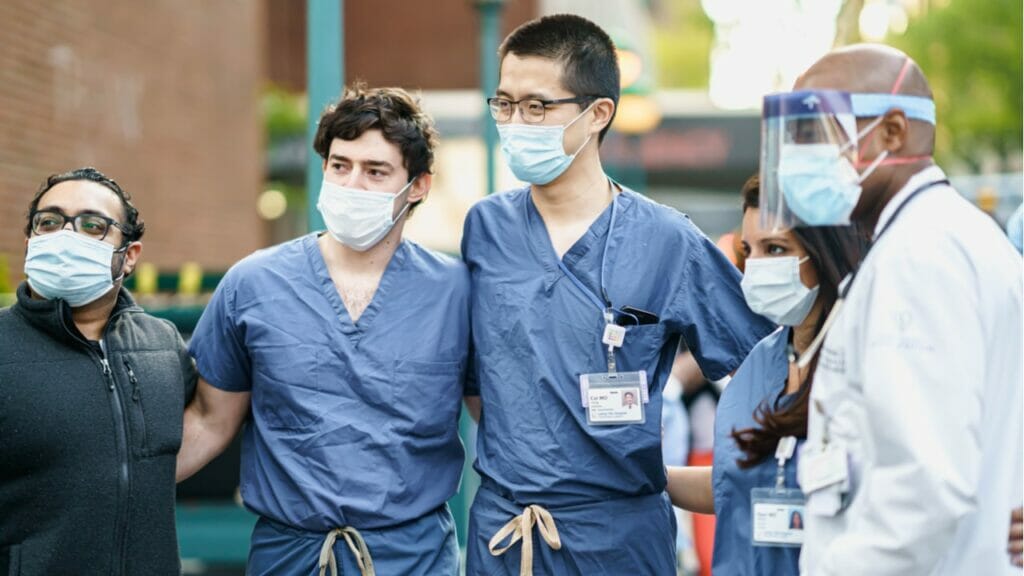
How to become a doctor in USA is a common question among Indian students seeking advanced medical careers. Physicians in the USA earn an average of $242,000 (≈₹2 crore) per year, according to the US Bureau of Labor Statistics 2025, which makes this path highly rewarding. To achieve this, students must complete a four-year undergraduate degree, four years of medical school, and 3–7 years of residency, depending on their chosen specialization. After completing these steps, a medical license is required to start practicing professionally.
We will detail the process of becoming a doctor in the USA from India, covering pathways after 12th grade and MBBS, eligibility requirements, residency and licensing, visas, costs, scholarships, and career opportunities.
How to Become a Doctor in USA after 12th?
You can start preparing for medical school in high school by completing Advanced Placement (AP) courses in biology, chemistry, physics, and mathematics, which can later fulfill undergraduate coursework requirements. Additionally, volunteering in healthcare, shadowing doctors, and participating in extracurricular activities strengthen your med school application.
Here’s a step-by-step process of becoming doctor in the USA from India.

Choose your dream country
 UK
UK
 USA
USA
 Germany
 Australia
 Ireland
 Canada
 UAE
UAE
 France
 Sweden
 Italy
Italy
 Other
Other
When do you want to study abroad?
What's your highest level of education?
Have you completed Class 12th?
What was your Class 12 CGPA/percentage?
Are you a student or a parent/guardian?
What do you want to study?
Select your current city
How Leap will help you

Personalised University Shortlist

Express Applications with Quicker Admits

End-to-End Application Support
1. Complete Your Undergraduate Degree
To become a medical professional, the first step is to earn a bachelor's degree, which usually takes about four years to complete. While there's no specific major required, many students aiming for med school choose majors in biology, chemistry, or related fields.
Key requirements:
- Complete prerequisite courses: 2 semesters of biology with lab, 2 semesters of general chemistry with lab, 2 semesters of organic chemistry with lab, 1 semester of biochemistry, 2 semesters of physics with lab, 2 semesters of math (calculus/statistics), 2 semesters of English or writing-intensive courses, 1 semester of behavioral sciences (psychology/sociology recommended).
- Maintain a high GPA, typically 3.5/4.0 or above, for competitive international applications.
- Some universities offer early assurance programs granting conditional acceptance into MD programs.
Top Undergraduate Degrees to Become a Doctor in USA
The top undergraduate degrees and specialisations that one can opt for to become a Doctor in the US are:
- BA/BS in Biological Sciences
- Medical Anthropology and Global Health (Specialization)
- Introduction to Neurobiology
- Mechanisms of Disease
- BA/BS in Health & Human Sciences
- Global Health Policy (Course/Minor)
- Sociology of Health and Illness
- BS in Biochemistry
- BS in Human Biology and Society
- BS in Neuroscience
- Emergency Medical Services (EMS) Certification/Minor
- BS in Psychology (Pre-Med Track)
2. Pre-Medical Education
The term “pre-med” in the USA doesn’t refer to a specific major but a track required for undergraduate students to prepare for medical school. Pre-medical education is a crucial step that prepares you for meeting requirements at some of the best medical universities in USA. It involves:
- Completing required science courses
- Gaining healthcare-related experience through internships or volunteering
- Building a strong academic and extracurricular profile
3. Pass the MCAT Examination
The Medical College Admission Test (MCAT) is mandatory for MD programs. Key points:
- Duration: 5 hours, computer-based
- Tests: verbal reasoning, critical thinking, biology, chemistry, physics, and psychology
- For international students, English proficiency via TOEFL or IELTS is required
- Competitive applicants aim for 510+ out of 528
Note: GRE is not required for US medical schools
4. Apply to Medical School
Once you obtain your bachelor’s degree and MCAT scores, the next step is applying to medical schools.
- Applications are submitted through the American Medical College Application Service (AMCAS) for MD programs or the American Association of Colleges of Osteopathic Medicine Application Service (AACOMAS) for DO programs.
- Primary applications are submitted starting in June, followed by secondary applications (essays) and interviews.
- Apply to 10–20 schools to maximise acceptance chances.
- MD programs are highly competitive; DO programs focus more on primary care.
5. Complete the 4 Years of Medical School
Medical education in the USA typically lasts four years:
- First 2 years: Classroom-based learning covering basic medical sciences, including anatomy, physiology, pharmacology, pathology, and medical ethics. Students focus on diagnosis, disease mechanisms, and treatment principles.
- USMLE Step 1: Taken after the second year. Note that as of 2022, Step 1 is pass/fail and tests foundational medical knowledge.
- Last 2 years: Clinical rotations in hospitals and clinics under supervision of experienced physicians. Students gain hands-on experience in specialties like internal medicine, surgery, pediatrics, obstetrics, and psychiatry.
- USMLE Step 2 CK (Clinical Knowledge) is taken during the final year and evaluates clinical reasoning and patient management skills.
Some schools offer combined programs (6–8 years) integrating undergraduate and medical education, which can shorten the total duration.
You can also opt for a research-oriented medical institution or a medical school solely focusing on primary care. The two medical degree options available are:
- MD (Doctor of Medicine) – The standard degree for practicing medicine in the USA.
- DO (Doctor of Osteopathic Medicine) – Includes a holistic approach and emphasizes primary care; DOs have the same licensing and practice rights as MDs.
Top Postgraduate and Doctorate Degrees to Become a Doctor in US
For further studies in the field of medicine, you can opt for a postgraduate (Doctor of Medicine) program and doctorate courses in the specialised fields of your interest, such as:
Postgraduate Degrees (Clinical Specialization):
- MD Specializations: Psychiatry, Ophthalmology, Obstetrics, Pediatrics, Gynecology, Internal Medicine, Surgery, Anesthesiology, etc.
- MS or Master’s programs: Medical Technology, Community Health, Clinical Research
Doctorate / Research-Oriented Degrees:
- PhD in Biomedical Sciences, Public Health, Clinical Research, Pathology, Human Medicine
- Advanced professional degrees: DDS (Dental Surgery), Optometry, Clinical Psychology
These postgraduate and doctoral programs allow doctors to specialize further, pursue research, or focus on teaching and academic medicine.
6. Find Residency and Choose Specialisation
Once you graduate from medical school, you must complete a residency program to gain hands-on training. Residency length varies based on the specialty you choose.
- For example, Pediatrics is usually 3 years, while General Surgery can take 5–7 years.
- Residency is obtained through the National Residency Matching Program (NRMP).
- International students must complete ECFMG certification (Educational Commission for Foreign Medical Graduates) before they can apply for residency.
7. Pass Part 3 of the USMLE and Complete Residency
After completing residency, you will need to pass USMLE Step 3. This is the final licensing exam, and it tests your ability to apply medical knowledge in clinical settings.
- You will typically take Step 3 during the first year of residency.
Once you pass Step 3 and complete your residency, you will be fully licensed to practice as a doctor in the USA.
8. Opting for Fellowships or Continuing Education
After completing residency and obtaining ECFMG certification (for international medical graduates), doctors can pursue fellowships to specialize in a subspecialty within their field.
- Duration: Fellowships typically last 1–3 years, depending on the specialty.
- Purpose: Provides advanced clinical training and expertise, e.g., cardiology after internal medicine, pediatric surgery after general surgery.
- Benefits: Increases career opportunities, higher earning potential, and eligibility for leadership positions or academic roles.
Continuing Medical Education (CME):
- In the USA, all licensed physicians are required to participate in ongoing education to stay current with medical advancements and maintain board certification.
- CME can include conferences, online courses, workshops, or research publications.
9. Earn Board Certification
Once the medical school and the residency are completed, you have to select a specialisation from 24 American Board of Medical Specialities subjects (ABMS) and then appear in front of a board regarding the field. Some of those specialisations are:
- Forensic medicine
- Anaesthesia
- Psychiatry
- Physiology
- Anatomy
- General medicine
- Pharmacology
Board certification is optional but highly recommended, as it improves employability and career advancement opportunities in the USA.
10. Obtain a State License
To legally practice medicine, doctors must obtain a state medical license in the state where they intend to work.
Requirements:
- Completion of medical school and residency.
- Passing USMLE exams:
- Step 1: Tests understanding of basic medical sciences (pass/fail).
- Step 2 CK (Clinical Knowledge): Evaluates clinical reasoning and patient management.
- Step 3: Assesses ability to practice medicine independently.
- Step 1: Tests understanding of basic medical sciences (pass/fail).
- Some states may require additional documentation, letters of recommendation, or jurisprudence exams.
Each state board sets its own rules, so it’s important to check specific state licensing requirements.
Note: After obtaining a license, you can practice independently, join hospitals, start private practice, or take academic and research positions.
Eligibility Criteria for Indian Students
Indian students aiming to become doctors in the USA must meet requirements at different stages: undergraduate admission, medical school, and residency.
1. High School / 12th Grade Requirements (Undergraduate Admission)
- Subjects: Physics, Chemistry, Biology (PCB) are mandatory.
- Marks: Minimum 75–80% in PCB is recommended for competitive US pre-med programs.
- Additional Courses: Advanced Placement (AP) courses in Biology, Chemistry, Physics, and Math can strengthen your application.
- English Proficiency: TOEFL or IELTS scores are required if your schooling was not in English. Typical TOEFL score: 90+, IELTS: 6.5+.
2. Undergraduate Prerequisites for Medical School (Post-12th)
- Complete a bachelor’s degree in any major while fulfilling pre-medical coursework:
- 2 semesters of Biology with lab
- 2 semesters General Chemistry with lab
- 2 semesters of Organic Chemistry with lab
- 1 semester Biochemistry
- 2 semesters of Physics with lab
- 2 semesters Math (Calculus/Statistics)
- 2 semesters of English or writing-intensive courses
- 1 semester Behavioral Science (Psychology/Sociology)
- 2 semesters of Biology with lab
- GPA: Minimum 3.5/4.0 for competitive international applicants.
3. Medical School Admission Requirements
- MCAT exam (Medical College Admission Test) – Competitive score: 510+
- Letters of Recommendation (LOR): Typically, 2–3 academic or professional references
- Statement of Purpose (SOP): Explains your motivation for studying medicine in the USA
- Extracurriculars & Clinical Experience: Volunteering, shadowing doctors, and research experience
4. Residency Requirements
- ECFMG Certification: Required for international medical graduates before applying for US residency
- USMLE Step 1, Step 2 CK, Step 3: Must be cleared as per residency requirements
- Visa: J-1 or H-1B for residency training
Eligibility for Indian students is multi-layered: strong 12th-grade marks, a completed undergraduate degree with pre-med courses, high MCAT scores, English proficiency, and fulfillment of USMLE and residency requirements.
Visa Process for Indian & International Students
To study medicine and train in the USA, Indian students must secure the correct visa type.
1. F-1 Visa (Undergraduate/Medical School)
- Required for students pursuing a bachelor’s degree or medical school.
- Allows full-time study at a SEVP-certified institution.
- Students can work on campus up to 20 hours/week during semesters and full-time during breaks.
- Optional Practical Training (OPT): After graduation, students may work in the US for 12 months in a field related to their studies.
2. J-1 Visa (Residency/Clinical Training)
- For international medical graduates entering residency or fellowship programs.
- Sponsored by the Educational Commission for Foreign Medical Graduates (ECFMG).
- Typically requires returning to the home country for 2 years after training unless waived.
3. H-1B Visa (Work Authorization)
- Allows graduates to work in the US in a specialty occupation, including medicine. Unlike the J-1 visa, the H-1B does not require a two-year home-country stay, making it a preferred option for many physicians.
- Many doctors transition from J-1 to H-1B using a J-1 waiver, such as the Conrad 30 program, or by working in Health Professional Shortage Areas (HPSAs). Recent updates include a $100,000 (≈₹82 lakh) fee and a proposed merit-based system favoring higher-skilled, higher-paid applicants.
4. Green Card Opportunities
- After residency or via employment sponsorship, doctors may apply for permanent residency (green card).
- Some hospitals sponsor physicians under the EB-2 National Interest Waiver (NIW) program.
Important Tips for Indian Students:
- Visa approval requires financial proof, a valid passport, and medical school acceptance (I-20 for F-1 or DS-2019 for J-1).
- Start the application process early, as visa interviews and processing times can be long.
- Keep copies of all SEVIS documents; they are essential for entry and status maintenance.
Cost of Studying Medicine in the USA (2025–2026)
The financial investment to become a doctor in the USA is significant, especially for international students from India. Costs include undergraduate tuition, medical school tuition, and living expenses. Planning is essential to avoid financial strain during the 8–10 years of education and training.
| Expense Category | Annual Cost (USD/INR) | Details |
| Undergraduate Tuition (4 yrs) | $28,500 (₹2,529,375) | Public universities (out-of-state); private institutions can be higher. |
| Medical School Tuition (4 yrs) | $66,000 (₹5,857,500) | Public medical schools; private schools may exceed this amount. |
| Living Expenses (per year) | $20,000 (₹1,775,000) | Includes rent, food, transport, and health insurance; varies by location. |
Note: INR values in the table are calculated using an exchange rate of 1 USD = ₹88.75. Actual rates may fluctuate.
Total Estimated Cost (8 Years): Approximately $350,000–$450,000 (₹3.1–4 crore) depending on the university and location. During residency, doctors typically receive a stipend of $60,000–$75,000 (₹53,25,000–₹66,56,250) per year. However, in high-cost cities, careful budgeting is required, as living expenses, health insurance, and personal costs can vary widely.
Top Medicine/MBBS-Related Scholarships in USA
- Harvard Medical School – Need-Based Financial Aid
- Coverage: Full tuition and mandatory fees for eligible students.
- Eligibility: Based on demonstrated financial need.
- Details: International students are evaluated for financial aid in the same manner as U.S. citizens.
- Application Deadline: March 15, 2025, for first-year MD students.
- Coverage: Full tuition and mandatory fees for eligible students.
- Yale School of Medicine – Need-Based Aid
- Coverage: Full tuition, room, board, and fees.
- Eligibility: International students are evaluated like U.S. citizens.
- Details: Yale offers need-based financial aid, ensuring that admitted students can attend regardless of their financial background.
- Application Deadline: April 15, 2025, for returning students.
- Coverage: Full tuition, room, board, and fees.
- American University of Antigua (AUA) – Provost Scholarship
- Coverage: Up to $100,000 (₹88,75,000) over the course of the program.
- Eligibility: Awarded based on academic excellence and leadership potential.
- Details: AUA offers substantial scholarships to international students, including those from India, to pursue their medical degrees.
- Coverage: Up to $100,000 (₹88,75,000) over the course of the program.
- NYU Grossman School of Medicine – Full Tuition Scholarship
- Coverage: Full tuition for all students.
- Eligibility: All admitted students receive this scholarship, regardless of financial need.
- Details: NYU Grossman School of Medicine is one of the few medical schools in the U.S. to offer a full-tuition scholarship to all its students.
- Coverage: Full tuition for all students.
- Association of Schools Advancing Health Professions (ASAHP) – Scholarship of Excellence
- Coverage: $1,000 (₹88,750) scholarship.
- Eligibility: Medical students demonstrating exceptional leadership skills and academic performance.
- Details: This scholarship recognizes students who have shown outstanding commitment to the field of health or medical professions.
- Application Deadline: June 6, 2025.
- Coverage: $1,000 (₹88,750) scholarship.
Note: Scholarship availability, eligibility criteria, and application deadlines are subject to change. It's essential for prospective students to regularly check the official websites of the respective scholarships and institutions for the most current information.
Career Opportunities After Becoming a Doctor in the USA (2025–2026)
1. Clinical Practice
- Primary Care Physicians (PCPs): Specialize in general health maintenance and disease prevention.
- Specialists: Focus on specific areas of medicine, such as cardiology, dermatology, or orthopedic surgery.
2. Non-Clinical Roles
Physicians can transition into non-clinical careers, including:
- Medical Education: Teaching at medical schools or universities.
- Healthcare Administration: Managing hospitals or healthcare organizations.
- Medical Research: Conducting studies to advance medical knowledge.
- Pharmaceutical Industry: Working in drug development or regulatory affairs.
- Medical Informatics: Utilizing technology to improve healthcare delivery.
- Public Health: Addressing health issues at the community or policy level.
Physician Salaries in the USA (2025–2026)
According to the 2025 Medscape Physician Compensation Report, the average annual salary for physicians in the USA is $374,000 (₹33,175,000).
Specialty-Specific Salaries:
| Specialty | Average Salary (USD) | Average Salary (INR) |
| Primary Care Physicians | $287,000 | ₹25,470,250 |
| Specialists | $404,000 | ₹35,890,000 |
| Orthopedic Surgery | $571,000 | ₹50,689,250 |
| Plastic Surgery | $576,000 | ₹51,080,000 |
| Cardiology | $490,000 | ₹43,487,500 |
| Dermatology | $438,000 | ₹38,887,500 |
| Radiology | $534,000 | ₹47,441,500 |
| General Surgery | $500,000 | ₹44,375,000 |
| Psychiatry | $336,000 | ₹29,460,000 |
| Pediatrics | $231,000 | ₹20,487,500 |
Note: Salary figures are approximate and may vary based on location, experience, and practice setting.
Curious to know how much Doctors earn in the USA? Read more: Average Salary of US Doctors in 2025
Job Outlook for Physicians
The U.S. Bureau of Labor Statistics projects employment of physicians and surgeons will grow 3% from 2024 to 2034, about as fast as the average for all occupations. Approximately 23,600 openings for physicians and surgeons are projected each year on average over the decade.
Opportunities for International Medical Graduates (IMGs)
Indian medical graduates seeking to practice in the USA can explore several pathways:
- Residency Programs
IMGs must apply to U.S. residency programs through the Electronic Residency Application Service (ERAS). Matching into a residency is required to practice clinically in the U.S. Residency programs typically last 3–7 years, depending on the chosen specialty. - Observerships and Research Fellowships
IMGs can participate in observerships (non-clinical shadowing of U.S. physicians) or research fellowships. These provide exposure to the U.S. healthcare system, improve understanding of clinical practices, and strengthen residency applications. - State-Specific Licensure
Each U.S. state has its own licensing requirements for IMGs. For example, Washington State offers a two-year supervised practice license that allows IMGs to gain experience while completing licensure requirements. IMGs must also pass all parts of the USMLE and obtain ECFMG certification to be eligible for full licensure.
Wrapping Up
To become a doctor in the USA, start by building a strong academic foundation in high school and plan your undergraduate degree carefully. Prepare for and take the MCAT, complete the necessary medical school prerequisites, and gain clinical experience through volunteering, observerships, or research.
Next, focus on securing a residency program by applying through the NRMP, passing all USMLE exams, and obtaining your state medical license. Staying persistent, organized, and proactive at each step will help you successfully launch a medical career in the USA.
Looking for guidance to study medicine in the USA? Get expert advice from LeapScholar today!
Frequently Asked Questions
-
Q. How much do doctors earn in the US?
A. The average annual salary of a doctor in the US is INR 14,040,029. A doctor's salary in the US depends on various factors, including specialisations, experience, location and expertise.
-
Q. Which is better, MBBS in US or India?
A. When it comes to pursuing further studies, the level of education, theoretically and practically, is always better in countries abroad, like the US. The recruitment is high for students with an MBBS in a foreign country.
-
Q. What is MBBS called in the US?
A. An MBBS equals an MD degree in the US, a professional degree you earn after completing your bachelor’s degree. If you have an MBBS, you do not need to make a traditional bachelor’s degree.
-
Q. At what age do you become a doctor in US?
A. The journey to become a doctor in US is full of hard work and deviation. However, it is all worth it once you don that white coat. The average age of a medical student is 24, which means they become licensed doctors in their mid to late 30s.
-
Q. Do doctors get paid during residency in the US?
A. Doctors get paid during residency, given the long hours and hard work. The salary will be less than what you get after finishing residency, but it is enough to cover your cost of living expenses.
-
Q. Can foreigners become doctors in the USA?
A. Yes, it’s definitely possible for international students to become doctors in the USA, but it does involve a few important steps. You’ll need to get certified by the ECFMG, pass all parts of the USMLE exam, and complete a medical residency in the USA.
-
Q. How can an Indian become a doctor in the USA?
A. If you are wondering “how to become a doctor in the USA after 12th”, you must first complete a 4-year undergraduate degree in the U.S., preferably in sciences, then pass the MCAT to gain admission into a 4-year medical school. After earning the MD degree, they must complete a residency program and pass the USMLE exam for Indian students to obtain licensure.
-
Q. What is the fastest way to become a doctor in the US?
A. The fastest route to become a doctor in the US is by doing an integrated BS/MD program. The duration of this program is usually 6-7 years, which combines undergraduate and medical education. These programs are highly competitive and require early commitment to the medical profession.
-
Q. What is the cost of medical school in the USA?
A. The average cost of studying at medical school in the USA is approximately INR 2 Cr, which includes tuition fees and living expenses over 4 years. The costs can vary based on the institution you choose and your residency status.
-
Q. How many years does it take to become a doctor in the USA?
A. It takes 11-15 years to become a doctor in the US, which includes completing 4 years of bachelor’s degree, 4 years of medical school, and 3-7 years of residency training. Additionally, doing fellowships in specialised fields can extend this timeline further, requiring extra training years.
-
Q. What is MBBS called in the US?
A. An MBBS is called an MD degree in the USA, which is a professional degree you earn after completing your bachelor’s degree. Completing MBBS in the USA can open doors to many global opportunities.






Have Questions? Get Guidance to reach your Dream University
Connect with India's finest counsellors and biggest study abroad community.
Get Guidance