
If 2024 was about “wait and watch,” 2025 has been the year Indian students officially broke the mould. We have seen a massive transition from “hoping for the best” to “calculating the best”, where every degree is scrutinised for its global market value.
After analyzing the journeys of 3 million students, the data tells a powerful story: In 2026, you aren’t just an applicant; you are a strategic investor. The old question “Can I afford to go?” has been replaced by the high-stakes reality: “What will this degree actually give me?“
Beyond the traditional hubs, a “Great Destination Shift” is underway. From the 55x explosion of interest in the UAE to the strategic rise of tuition-free Germany, Indian students are redrawing the global map in search of affordable excellence. With AI Master’s interest skyrocketing by 186% and working professionals leading the race to upskill, the 2026 intake is no longer about just a degree; it is about securing a seat in the future of work.
To help you navigate this new era, let’s take a look at this Year-End Report by Leap Scholar to uncover the trends defining your future.
Chapter 1: Aspirant Profile & Demographics
The demographic profile of Indian aspirants in 2024–25 exhibits a structural shift compared to the cohort from three years earlier. Analysis of data from over three million applicants and survey respondents on the Leap Scholar platform indicates a transition in the broader educational landscape.
Age Distribution
While the primary age distribution follows established patterns, granular analysis reveals specific compositional changes:
The data indicates that while the majority of aspirants (65.5 per cent) are in the 18-25 age bracket, there is a significant cohort of mature students. Notably, over one-third of the applicants are aged 26 or older, suggesting a trend of working professionals seeking qualifications later in their careers.
Gender Distribution
What Students Are Interested In Studying
Degree Level Distribution 2025
Master’s programmes are overwhelmingly the most popular choice, as students seek
specialised skills after completing affordable undergraduate degrees in India. PhD
interest has also surged to over 6 per cent this year, a 60 per cent increase compared
to the previous year, signalling a growing appetite for research careers.
Financial Determinants of Mobility
While career aspiration initiates the decision-making process, post-study career advancement governs the final matriculation.
Post-Study Career Advancement as Critical Driver
Candidates seek clear career pathways rather than academic credentials alone when deciding to study abroad.
Students aren’t just looking for degrees. They’re looking for clear pathways to global careers.
Cost Sensitivity as a Secondary Driver
Survey data indicates that price sensitivity is currently at an all-time high. This renewed focus on affordability correlates with the substantial surge in interest to destinations like the UAE, New Zealand and the continued interest towards Germany.
What’s Driving These Choices?
Contemporary students prioritise clear employment pathways and return on investment (ROI) over mere credentialism. The high concentration of enrolments in Master’s and MBA programmes reflects market signals identifying these qualifications as conduits to high-value global roles.
Since 2020, a surge in PhD demand has further highlighted an intensified focus on research sectors, particularly artificial intelligence and biotechnology.
Financial strategy remains a dominant force. With 68 per cent of students citing affordability as a top priority, cost sensitivity is driving a tangible shift towards value-centric destinations such as Germany. Students are selecting locations based on long-term economic viability.
What This Tells Us
The aspirations for international study are undergoing genuine democratisation, driven by digital access and career clarity rather than geography. Post-study career advancement is pivotal, with 85 per cent of applicants rating it a top concern.
This reinforces the view of international education strictly as a strategic career investment. The modern student cohort is more diverse and intentional, funding their pursuits with prudent financial planning focused sharply on employability.
Chapter 2: The AI Revolution in Global Education

The Seismic Shift Towards Artificial Intelligence
A profound transformation in the educational approach of Indian students pursuing studies abroad has emerged over the last two years, initially spurred by the launch of ChatGPT in November 2022.
Specifically, Master’s degree programmes in artificial intelligence recorded a striking 186.2 per cent year-on-year increase between 2023 and 2024. This dramatic growth occurred even as enrolments in more traditional Computer Science disciplines experienced a concurrent decline. This trend signifies a strategic recognition that artificial intelligence will define the future of work across all professional sectors.
The ChatGPT Effect: AI Tools in the Student Journey
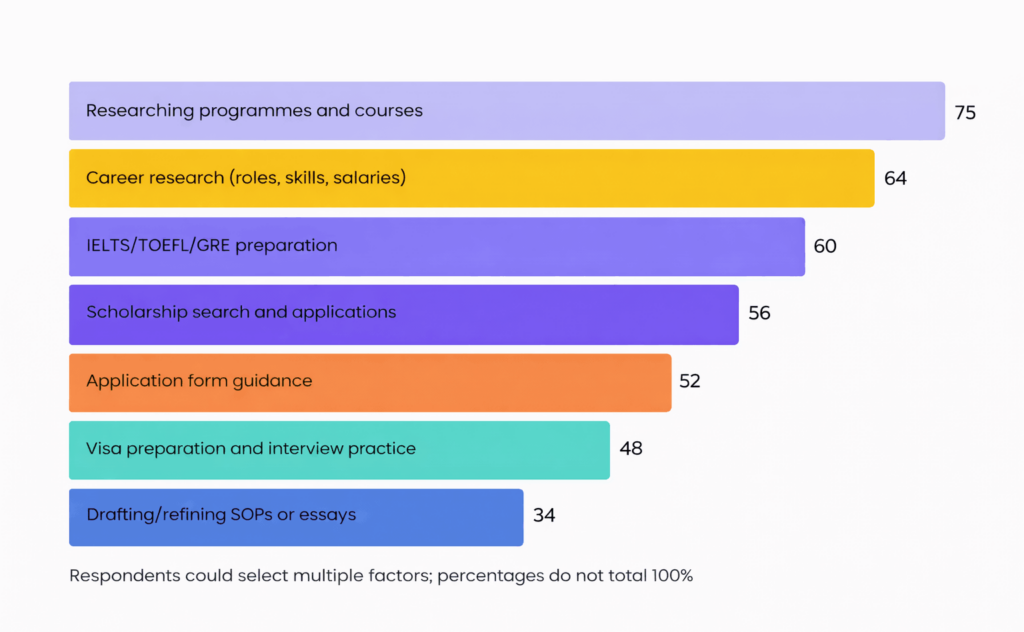
Students are heavily relying on AI tools for the initial stages of their journey, with 75 per cent using them to research programmes and courses. The usage decreases for more personal tasks like drafting SOPs (34 per cent), indicating students still value human input for subjective application elements.
This technological shift is generating democratising effects within the admissions landscape. Students without access to specialist counselling can now receive immediate, sophisticated guidance on programme suitability. Similarly, individuals preparing for examinations like the IELTS without expensive coaching can utilise AI tutors for practice.
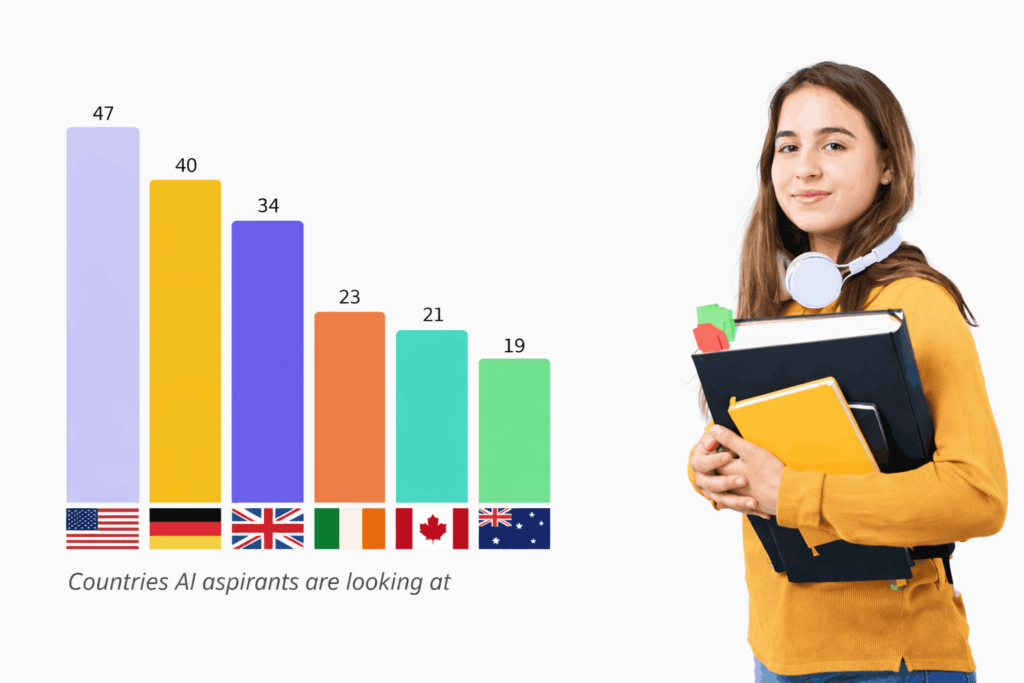
Which Countries Are AI Aspirants Looking At?
Students were enabled to nominate multiple potential destinations for pursuing AI-related disciplines. Analysis of these preferences reveals patterns that simultaneously align with and deviate from broader international mobility trends.
Important Factors In Picking Universities
When picking a university, students appraise various metrics for AI education, yet specific determinants consistently emerge as primary drivers.
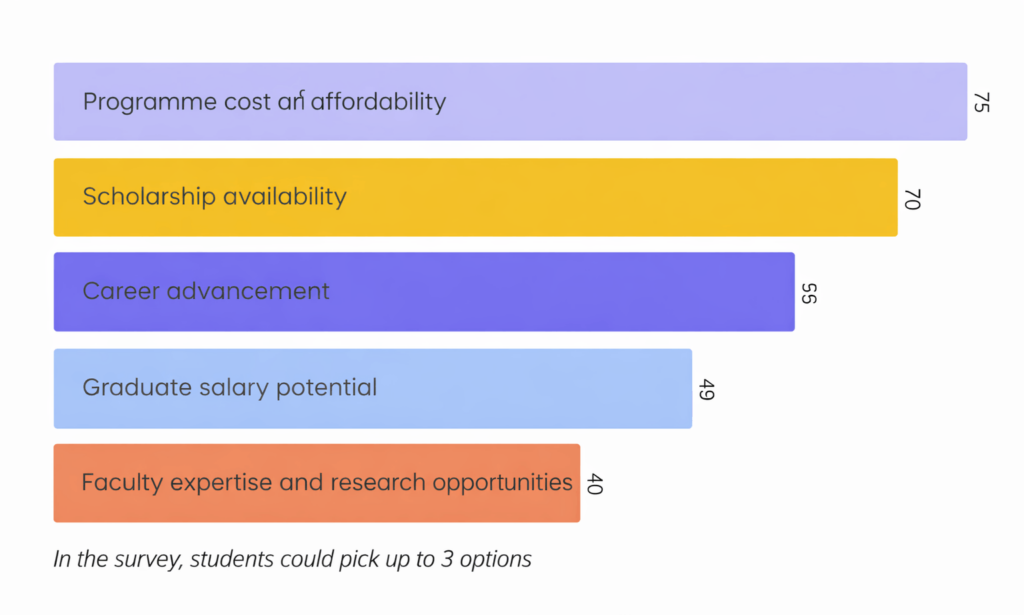
The pronounced emphasis on scholarships and affordability underscores a significant demographic reality. The AI-driven shift in Indian student mobility is propelled principally by middle-class aspirants rather than the economic elite. These students execute calculated financial decisions, prioritising programmes that deliver substantial academic value at a reasonable cost, whilst ensuring clear pathways to remunerative post-graduation employment.
Why AI? Motivational Drivers and Strategic Intent
When we asked students why they are pursuing AI education abroad, their responses revealed a picture of pragmatic ambition:
The prevalence of upskilling suggests that, rather than abandoning their primary disciplines, professionals are acting to integrate AI capabilities into their existing expertise. For instance, marketing specialists are seeking proficiency in AI-driven consumer analytics, whilst finance graduates aim to master algorithmic trading. Consequently, artificial intelligence is emerging as a universal competency across industries, necessitating fluency for career progression.
Distinct from those upskilling, approximately 20 per cent of the cohort intends to pivot their careers entirely towards AI. These individuals, often migrating from saturated professional fields, identify artificial intelligence as a trajectory towards more robust and sustainable employment prospects. This shift signifies the nascent stages of a fundamental restructuring in global education and workforce dynamics. Projections suggest that within a decade, a deficit in AI literacy may become a professional liability comparable to a lack of proficiency in Microsoft Excel today.
The Long-Term Implications
What we are witnessing is the early stage of a fundamental restructuring of global education and work. Ten years from now, a lack of understanding of AI may be comparable to not knowing MS Office today.
For Indian students specifically, this juncture presents a duality of challenge and opportunity. The primary challenge involves maintaining alignment with rapid technological evolution to select enduringly relevant programmes. Conversely, the opportunity is rooted in India’s substantial technical talent pool and expanding AI industry, which collectively position the nation to cultivate global leadership in this sphere.
Ultimately, the observed cohort is not merely adhering to a passing trend but executing strategic decisions regarding the skills that will define the coming decade of employment. The emerging consensus is definitive: artificial intelligence represents the immediate reality of education rather than a distant future.
Chapter 3: The Great Destination Shift

The Growing Appeal of Non-Traditional Study Destinations
The Country-by-Country Transformation
Year-on-Year percentage growth in Student Interest
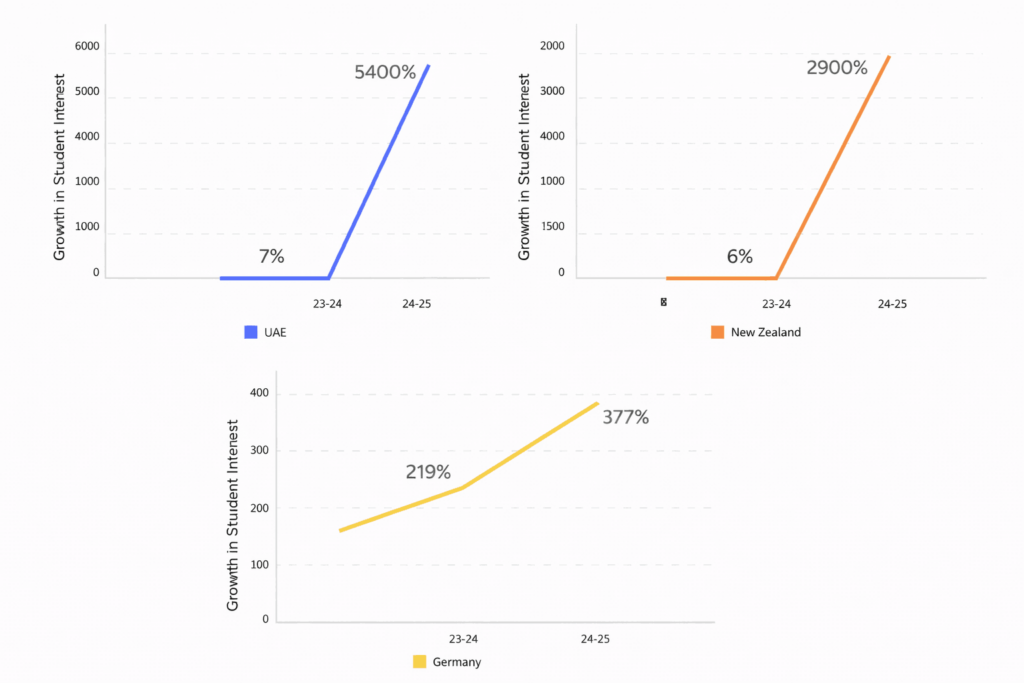
Germany’s competitive position in higher education relies on its distinct funding model. In contrast to the United States or the United Kingdom, where degrees often cost USD 50,000 to USD 80,000, most German public universities remain tuition-free. Scholars typically incur only USD 1,500 in administrative charges for a full two-year programme.
To mitigate historical language barriers, institutions have rapidly expanded English-medium curricula, especially within STEM faculties. This strategic pivot is essential for integrating international talent into the domestic academic system.
Post-graduation, the nation’s immigration policy facilitates retention through an 18-month job-seeking residence permit. As Europe’s largest economy faces a skilled labour shortage in technology, the transition from study to permanent residency offers a favourable trajectory for graduates.
The Strategic Emergence of the UAE
The United Arab Emirates has successfully positioned itself as a global education hub, utilising free zones to host international branch campuses at competitive price points. For students targeting post-study employment within the Middle East, the region serves as a strategic entry point. Furthermore, geographic proximity remains a decided advantage; flight durations from India average three to four hours, offering families reassurance compared to the long-haul travel required for destinations in North America.
Crucially, the UAE offers a middle path for students seeking international exposure without the prohibitive costs often associated with Western higher education. While academic programmes generally cost more than tuition-free options in Germany, they remain more affordable than comparable degrees in the United States or the United Kingdom. Additionally, the living environment provides a degree of cultural familiarity that significantly aids the transition for Indian students.

Why the Shifts Matter
For study abroad counsellors and educational institutions, comprehending these trends is imperative. The decision-making paradigm for students has evolved beyond simple destination selection. Applicants now prioritise locations that ensure fiscal prudence, provide relevant skill acquisition, and offer distinct pathways to desired careers. Consequently, the nations that address these pragmatic criteria most convincingly are securing a competitive advantage in the recruitment of Indian talent.
Chapter 4: Looking Ahead – 2025 and Beyond

The Trends That Will Define the Next Five Years
As we conclude this analysis, it is necessary to reflect on the future trajectory of Indian student mobility based on the data collected from over 3 million student interactions between 2020 and 2025. The insights derived from this extensive dataset, combined with qualitative feedback, suggest that distinct patterns will govern the landscape in 2025 and beyond.
AI’s Integration Across All Fields
The transformation driven by artificial intelligence is currently in its nascent stages but is accelerating rapidly. Empirical data indicates a 186.2 per cent year-on-year growth in AI-focused Master’s programmes between 2023 and 2024, signalling a massive shift in student interest. We anticipate that AI components will standardise across nearly every postgraduate discipline within the next five years.
This integration will likely see business programmes incorporating AI-driven analytics and healthcare courses embedding AI diagnostics. Consequently, the distinct advantage will belong to students who position themselves at the intersection of AI and domain expertise. While 36.2 per cent of aspirants currently pursue specialised degrees in AI or Data Science, a significant 59.6 per cent are opting for broader Master’s programmes with AI components, indicating a strategic preference for hybrid competence.
The operational side of education is evolving in tandem with curriculum changes. With approximately 75 per cent of student interactions now occurring via mobile devices, the reliance on digital tools is absolute. We are already observing students utilising generative AI to research programmes and draft application materials. Future counselling frameworks will likely leverage AI to match students to universities based on deep data analysis, democratising access to guidance.
The Continued Rise of Value Destinations
Economic pragmatism is reshaping destination preferences, with 68 per cent of students now rating programme cost and affordability as a top priority. This financial sensitivity is driving a migration towards nations offering high value. Germany has witnessed a staggering 5,376 per cent cumulative increase in interest since 2020, driven largely by its affordability; the estimated total cost for a degree in Germany ranges from ₹10 lakh to ₹20 lakh, compared to ₹50 lakh to ₹75 lakh in the United States.
We observe similar traction for emerging hubs like the United Arab Emirates, which appeals due to its proximity and the presence of international branch campuses. Even within traditional strongholds like the United Kingdom and the United States, demand is likely to shift towards mid-tier institutions in affordable cities. Students are increasingly prioritising return on investment over prestige, seeking locations that balance educational quality with financial viability.
The Opportunity for India
India currently exports human capital at a significant scale, yet the demographic composition of these aspirants suggests potential for reverse migration. Notably, 36 per cent of AI aspirants are already working professionals, with many possessing between three and six years of experience. These individuals are upskilling with the intent of securing high-impact careers rather than merely seeking entry-level roles.
As India’s technology sector matures, these globally trained professionals may return to drive domestic innovation. This cyclical flow of talent, mirroring developmental patterns seen in other major economies, could significantly bolster the local tech ecosystem. Students equipped with global expertise and AI literacy will be well-positioned to lead India’s digital future upon their return.
Final Thoughts
The era of speculative study abroad has yielded to a focus on calculated ROI. The metrics highlight this pragmatic transition, evidenced by a 186.2 per cent year-on-year rise in AI programme enrolments and 75 per cent of students now utilising AI tools for programme research. These figures indicate a student body prioritising fiscal value and efficiency over traditional prestige.
We are witnessing a mature cohort where 36 per cent of aspirants are experienced professionals and nearly 60 per cent opt for broader Master’s programmes incorporating AI components. Their decisions are driven by clear demands, with 85 per cent prioritising post-study work rights and 68 per cent focusing on affordability. As India’s technology sector matures, this strategic investment bridges global ambition with economic reality.







Have Questions? Get Guidance to reach your Dream University
Connect with India's finest counsellors and biggest study abroad community.
Get Guidance