
Quick Read
- UK MIM tuition starts at Rs.37.8L (Warwick) and goes up to Rs.67.9L (LBS); MBA ranges from Rs.49.7L to Rs.1.53Cr.
- Zero work experience? MIM is your only realistic option at any QS-ranked UK school.
- LBS MIM class of 2024: average base salary £44,541 (~Rs.57.1L), average bonus £12,483 (~Rs.16L), 93% placed within 3 months.
- Graduate Route visa: September 2026 graduates apply after Jan 2027; meaning 18 months, not 2 years.
- Most UK MIM programs let you skip the GMAT; LBS and LSE are the exceptions.
MIM vs MBA in UK: The Core Comparison Indian Students Need
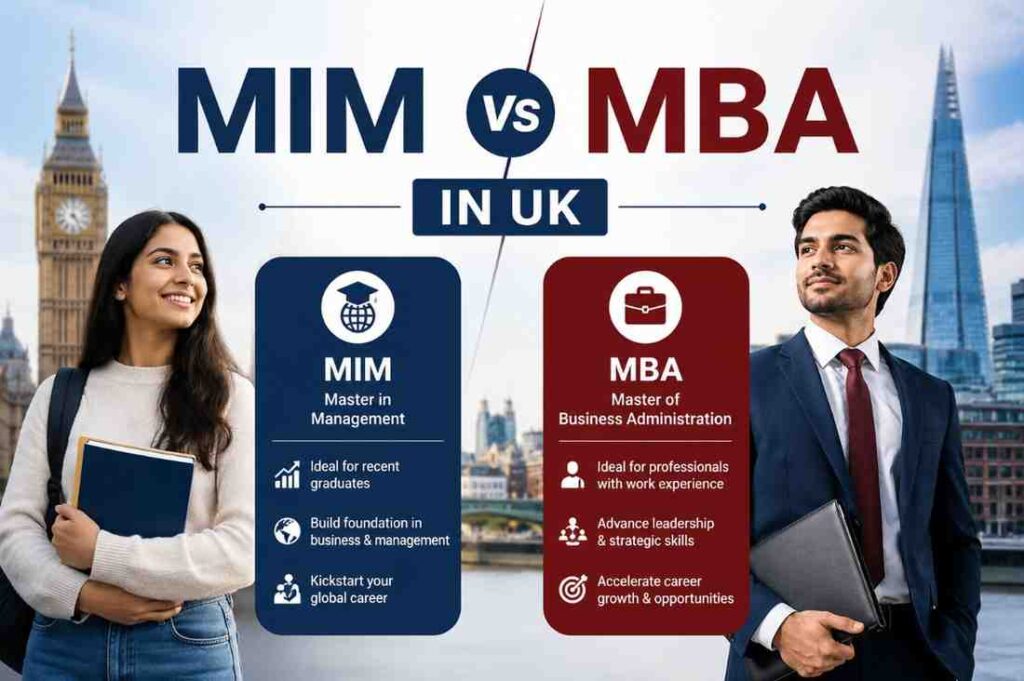
Both MIM (Master in Management) and MBA (Master of Business Administration) teach business. The difference is where you are in your career when you apply.
| Feature | MIM in UK | MBA in UK |
|---|---|---|
| Duration | 10-12 months | 12-21 months (most UK MBAs: 12 months) |
| Tuition (INR) | Rs.37.8L to Rs.67.9L | Rs.49.7L to Rs.1.53Cr |
| Work experience required | 0-2 years (some programs accept 0) | Minimum 3 years (top schools: 5-6 years preferred) |
| GMAT | Optional at most schools; required at LBS (avg 667) and LSE | Required at most schools; top-tier average: 680-710 |
| Avg starting salary UK (INR) | Rs.45L-Rs.83L (entry to mid-level roles) | Rs.1.05Cr-Rs.1.4Cr (mid to senior roles) |
| Target cohort age | 22-25 years | 28-32 years |
| Entry-level roles | Analyst, Associate, Graduate Scheme | Consultant, Product Manager, Senior Analyst, Associate VP |
| Graduate Route visa | Yes: 18 months (applications from Jan 2027) | Yes: 18 months (applications from Jan 2027) |
| Scholarship access | Warwick, Bath, Manchester offer partial funding; Chevening eligible | Chevening eligible; most top schools award scholarships in R1/R2 |

Choose your dream country
 UK
UK
 USA
USA
 Germany
 Australia
 Ireland
 Canada
 UAE
UAE
 France
 Sweden
 Italy
Italy
 Other
Other
When do you want to study abroad?
What's your highest level of education?
Have you completed Class 12th?
What was your Class 12 CGPA/percentage?
Are you a student or a parent/guardian?
What do you want to study?
Select your current city
How Leap will help you

Personalised University Shortlist

Express Applications with Quicker Admits

End-to-End Application Support
Exchange rate used throughout this article: Rs.128.26 per GBP (June 2026). Verify the current rate before finalizing your budget.
Counselor insight: Business and management is the most popular subject across all UK higher education: 20% of all student enrollments in 2024-25, according to HESA's January 2026 data. The competition for the best roles is real. UK recruiters value a degree from LBS, LSE, or Imperial much more than one from a Tier 2 business school. If your budget allows only a mid-tier MBA and your experience is under 5 years, a top-tier MIM is likely the better ROI decision.
MIM in UK: What Indian Students Actually Study and Earn
What It Is and Who It Is For
MIM is a pre-experience master's degree designed for recent graduates. You do not need corporate work experience to apply. Programs run for 10-12 months and cover core business disciplines: finance, marketing, strategy, operations, organizational behavior, and leadership.
According to GMAC's 2025 research, MIM programs were among the highest-growth programs globally for applications. The UK accounts for 25% of international MIM candidate destination choices, second only to France.
Top UK Universities for MIM (QS Business Masters Rankings 2026)
| University | QS MIM Rank 2026 | Tuition (GBP) | Tuition (INR approx.) | GMAT Required? |
|---|---|---|---|---|
| London Business School | #2 | £52,950 | Rs.67.9L | Yes (avg 667) |
| Imperial College London | #9 | £47,000 | Rs.60.3L | Recommended |
| LSE (London School of Economics) | #14 | £42,900 | Rs.55L | Recommended |
| University of Warwick (WBS) | #35 | £37,270 | Rs.47.8L | Optional |
| University of Manchester (Alliance MBS) | #45 | £35,000 | Rs.44.9L | Optional |
| University of Bath | #102 | £31,000 | Rs.39.8L | Optional |
Source: QS Business Masters Rankings: Management 2026
MIM Salary in UK for Indian Graduates (2025 Data)
According to the LBS Masters in Management Employment Report 2024 (most recently published data):
- Average base salary: £44,541 (~Rs.57.1L)
- Average bonus: £12,483 (~Rs.16L)
- Employment rate within 3 months of graduation: 93%
For non-LBS programs (Warwick, Manchester, Bath), expect starting salaries of £30,000-£38,000 (~Rs.38.5L-Rs.48.7L) in roles such as Business Analyst, Graduate Consultant, and Operations Associate.
Top recruiters for MIM graduates: McKinsey, BCG, Bain, Goldman Sachs, J.P. Morgan, Google, Amazon, and Unilever.
For a detailed look at MIM universities and programs, see our guide to MIM in the UK.
MBA in UK: What Indian Students Actually Study and Earn
What It Is and Who It Is For
An MBA is a post-experience degree. It assumes you already understand how businesses work and focuses on strategy, leadership, case-study learning, and network building with peers who have real industry experience. Most UK MBA programs run for 12 months.
The UK's one-year format is a practical advantage for Indian applicants: it costs less than a two-year US MBA, reduces the career gap, and still grants access to the Graduate Route visa.
Top UK Universities for MBA (QS Global MBA Rankings 2026)
| University | QS Global MBA Rank 2026 | Tuition 2026-27 (GBP) | Tuition (INR approx.) | Min. Work Exp. |
|---|---|---|---|---|
| London Business School | #6 | £115,000-£120,000 | Rs.1.47Cr-Rs.1.53Cr | 2 years (avg 5-6 years) |
| Cambridge Judge Business School | #7 | £78,000-£82,000 | Rs.1Cr-Rs.1.05Cr | 3 years |
| Oxford Saïd Business School | #12 | £86,000-£90,000 | Rs.1.1Cr-Rs.1.15Cr | 3 years |
| Imperial College Business School | #19 | £73,000-£77,000 | Rs.93.6L-Rs.98.8L | 2-3 years |
| Warwick Business School | #30 | £57,000-£61,000 | Rs.73.1L-Rs.78.2L | 3 years |
| Alliance Manchester Business School | #39 | £50,000-£54,000 | Rs.64.1L-Rs.69.3L | 3 years |
| University of Edinburgh Business School | #66 | £40,900 | Rs.52.5L | 3 years |
Source: QS Business Masters Rankings 2026; fees verified from university admissions pages.
For budget-conscious applicants, see our guide to the cheapest MBA in the UK and the 1-year MBA in the UK.
MBA Salary in UK for Indian Graduates (2025 Data)
According to the LBS MBA Employment Report 2025:
- Average base salary: £91,928 (~Rs.1.17Cr)
- 83% received bonuses or additional compensation
- 88% received a job offer within 3 months of graduation
- Consulting (40%), Finance (25%), Technology (24%) were the top sectors
For Manchester, Warwick, and Edinburgh graduates, expect starting salaries of £60,000-£85,000 (~Rs.77L-Rs.1.09Cr) depending on the sector.
For a full university-by-university breakdown, see our guide to the best MBA colleges in the UK.
Counselor insight: Indian applicants routinely underestimate the work experience quality bar for UK MBA programs. Schools like LBS and Cambridge are not just counting years; they are evaluating career progression, scope of responsibility, and leadership impact. An Indian IT professional with 5 years of coding experience but no project leadership will struggle at LBS. An IT professional who moved into client delivery and team management after 3 years has a much stronger case. It is not the years; it is what happened during them.
Total Cost of MIM vs MBA in UK for Indian Students in 2026-27
Beyond tuition, you need to budget for living, visa fees, and the Immigration Health Surcharge (IHS).
Living Costs: London vs Other Cities
The UK government's mandated proof-of-funds requirements for a 2026 student visa application are:
- London: £1,483/month (Rs. 1.9L/month) for up to 9 months = £13,347 (Rs. 17.1L)
- Outside London: £1,136/month (Rs.1.46L/month) for up to 9 months = £10,224 (Rs.13.1L)
Source: UKVI Student Visa financial requirements
In reality, you should budget for 12 months of living costs. Full-year estimates:
- London: £15,000-£20,000 (~Rs.19.2L-Rs.25.7L)
- Manchester, Edinburgh, Birmingham: £10,000-£13,000 (~Rs.12.8L-Rs.16.7L)
Additional Mandatory Costs
| Cost Item | Amount | INR (approx.) |
|---|---|---|
| IHS (Immigration Health Surcharge) | £776/year | Rs.99,530/year |
| UK Student Visa fee | £558 | Rs.74,239 |
| IELTS UKVI (Academic) | ~£215 | Rs.27,576 |
| Airfare (one-way, economy) | Rs.35,000-60,000 | Rs.35,000-60,000 |
All-In Cost Estimates for Indian Students
| Program Tier | Tuition (INR) | 12 Months Living (INR) | Visa + IHS + Other (INR) | Total Estimate (INR) |
|---|---|---|---|---|
| MIM at Manchester or Bath (non-London) | Rs.39.8L-Rs.44.9L | Rs.12.8L-Rs.16.7L | Rs.1.3L-Rs.1.5L | Rs.54L-Rs.63L |
| MIM at LBS or Imperial (London) | Rs.60.3L-Rs.67.9L | Rs.19.2L-Rs.25.7L | Rs.1.3L-Rs.1.5L | Rs.80.8L-Rs.95L |
| MBA at Manchester or Warwick (non-London) | Rs.64.1L-Rs.78.2L | Rs.12.8L-Rs.16.7L | Rs.1.3L-Rs.1.5L | Rs.78.2L-Rs.96.4L |
| MBA at LBS, Cambridge, or Oxford (London) | Rs.1Cr-Rs.1.53Cr | Rs.19.2L-Rs.25.7L | Rs.1.3L-Rs.1.5L | Rs.1.2Cr-Rs.1.8Cr |
Scholarships to Reduce Costs
- Chevening Scholarship (UK Government): Fully funded (tuition + living + airfare). Open to Indian applicants. Approximately 100-110 awards are available each year for India. Applications for the 2027-28 cycle will open August 2026; the deadline is typically October 2026.
Note: Chevening requires you to return to India for 2 years after graduation. It is incompatible with staying in the UK on the Graduate Route.
- University-specific awards: Warwick Chancellor's International Scholarship (full funding + stipend); Manchester Global Futures (up to £6,000); LBS and Cambridge scholarship pools are the largest in Round 1/2 applications.
- GREAT Scholarship: £10,000 toward tuition. Available for postgraduate Indian students.
For the full list of options, see our guide to scholarships in the UK for Indian students and MBA scholarships in the UK.
For a full breakdown of living and tuition costs, see cost of studying in the UK.
Documents Indian Students Need for MIM vs MBA in UK
Many Indian applicants lose time here. Indian university documents have specific formats that UK admissions teams are not always familiar with. Get these ready before the application window opens.
| Document | MIM Required? | MBA Required? | India-Specific Notes |
|---|---|---|---|
| 10th & 12th marksheets | Yes | Yes | Board-issued originals; scanned PDF copies accepted for applications |
| Bachelor's degree certificate | Yes (or provisional) | Yes (or provisional) | If in final year, submit a provisional certificate or a letter from your registrar confirming expected graduation date |
| Consolidated academic transcript | Yes | Yes | Must show all semesters; get university-attested copies; some UK schools require WES evaluation |
| Work experience letter | No (but strengthens application) | Yes (mandatory) | Must be on company letterhead, signed, dated, with designation, joining date, and relieving date; include salary details if requested |
| GMAT/GRE scorecard | Varies by school | Usually required | Valid for 5 years; send official score reports directly to the university; do not submit self-reported scores |
| IELTS Academic (UKVI version) | Yes | Yes | Critical: Book IELTS for UKVI, not standard Academic IELTS. These are different test variants. Submitting the wrong one is the most common preventable visa refusal for Indian applicants. |
| Letter of Recommendation (LOR) | 2 LORs | 2-3 LORs | For MIM: professors or internship supervisors. For MBA: at least 1 from a direct manager and 1 from a senior professional reference. |
| Statement of Purpose (SOP) | Yes | Yes | Most schools: 500-800 words. LBS requires 2 essays of 500 words each. |
| Passport | Yes | Yes | Must be valid for the entire duration of your program; many schools require 6 months validity beyond course end |
| Financial proof (bank statement or loan sanction letter) | For visa application | For visa application | You must show that the funds have been held for 28 consecutive days. Education loans from SBI, HDFC Credila, and Axis Bank are accepted. A loan sanction letter from a government-approved bank is accepted by UKVI as proof of funds. |
Counselor insight: Provisional certificate delays are where Indian applications stall most often. DU, Mumbai University, and many state-board-affiliated colleges routinely take 4-6 months to issue final degree certificates after results are out, and some autonomous colleges take longer. Contact your registrar's office in January or February of your application year, not after the results are declared. Ask for a letter on official letterhead confirming your expected graduation date, your CGPA or percentage to date, and the full name of your program. That letter is what UK admissions teams will accept for a conditional offer. If your registrar says it will take time, escalate to the Dean's office. This is a standard request, and universities are used to it.
MIM vs MBA in UK: Which Should You Choose?
This is a profile decision, not a prestige decision. Here are three scenarios covering the most common Indian student profiles.
Scenario 1: Final-year graduate, 0-1 year experience, budget Rs. 60L-75L
You just finished your BBA, B.Com, or BMS. You have an internship or two but no full-time work experience. Your family can support Rs. 60L-75L all-in (tuition plus living).
The right choice: MIM. You are the exact candidate MIM was built for. Target Warwick (Rs. 47.8L tuition) or Manchester (Rs. 44.9L) outside London to keep living costs manageable. With LBS or Imperial on your shortlist, expect total costs of Rs.90L-Rs.1.1Cr, including London living expenses.
Do not attempt an MBA now. Without real work experience, you will not get past the application stage at any QS-ranked UK MBA program, and even if you did, the peer-to-peer learning advantage of an MBA (its core value) requires a cohort with actual industry experience.
Scenario 2: BTech/BE graduate, 2-3 years work experience, GMAT 620-650, budget Rs.80L-1Cr
You have been working in IT, consulting, or operations since graduation. You have a GMAT score, but it is not in the 680+ range. You want to shift into product management or consulting.
The right choice: MIM or mid-tier MBA, with a clear rationale. At this experience level, a strong MIM from LBS or Imperial will serve you better than a mid-tier MBA. Both lead to similar entry-level consulting and analyst roles, but the LBS MIM program provides opportunities that a Tier 3 MBA does not.
If you are targeting an MBA specifically, Warwick, Manchester, and Edinburgh accept GMAT scores in the 600-660 range.
Check the MBA in the UK without GMAT and MBA in the UK without work experience guides for schools that have more flexible criteria.
Scenario 3: Working professional, 4-6 years experience, target: consulting or senior finance, budget Rs. 1Cr-1.3Cr
You have been in a real corporate role with measurable achievements. You are aiming for a McKinsey or Goldman Sachs type of role, or a senior position on return to India.
The right choice: MBA. Apply to Cambridge Judge, Oxford Saïd, or LBS. The MBA cohort's peer network, the case-study intensity, and the recruiter access at these schools justify the Rs. 1 Cr+ investment. Apply in Round 1 (October-November 2026 for September 2027 intake) to access the largest scholarship pools.
Counselor insight: The "MIM now, MBA later" path is a real and common career progression, not a fallback. Among Indian professionals who pursued UK MBAs in the 2023-25 cohorts, a notable subset had already completed an MIM 5-7 years earlier. The MIM gave them the international baseline and the professional network that eventually made their MBA application stronger. If you are a fresher with limited funds, a top MIM now does not prevent you from applying for an MBA later.
3 Things to Do Before You Apply
- If you have 0-2 years of experience, apply for a top-tier MIM (LBS, Imperial, Warwick) instead of a mid-tier MBA. The brand value and recruiter access at a top MIM school will outperform a lower-ranked MBA at the same or higher cost.
- If you have 3+ years of experience and are targeting consulting or senior finance, apply for the MBA in Round 1 (October-November for September intake). Round 1 applicants access the largest scholarship pools at LBS, Cambridge, and Oxford, where early applications receive priority consideration for funding.
- Begin gathering your documents in January of your application year: provisional certificate from your registrar, work experience letter on company letterhead (for MBA), and IELTS for UKVI (not standard Academic IELTS). These three documents are the most common bottlenecks for Indian applicants and all require lead time.
Verified by: LeapScholar's UK counselling team. Our counselors have reviewed applications to LBS, Warwick, Imperial, and Manchester MIM and MBA programs and have guided students through the UK Student Visa process, including the UKVI IELTS error that catches most Indian applicants off guard.
Have questions about MIM vs MBA in the UK? Book a free session with a LeapScholar counselor.
Frequently Asked Questions About MIM vs MBA in UK
-
My CGPA is below 60%; can I still apply for MIM or MBA in UK?
A CGPA below 60% (approximately 6.0 on a 10-point scale) is below the stated minimum for most QS-ranked UK programs. Your options: submit a strong GMAT score (650+ for MIM, 680+ for MBA) to offset the academic record; apply to Tier 2 programs with more flexible entry criteria; or write an SOP that explicitly addresses the CGPA and explains the trajectory. Do not omit or minimize it. UK admissions officers will see it, and a direct, honest explanation is better than silence.
-
What is the Graduate Route visa, and how does it work after MIM or MBA in UK?
The Graduate Route is a post-study work visa that allows international graduates of UK universities to work in the UK without employer sponsorship. For applications submitted before 1 January 2027, the visa grants 2 years. For applications submitted on or after 1 January 2027 (which applies to most September 2026 starters who graduate in 2027), the visa grants 18 months. After the Graduate Route ends, you need to switch to a Skilled Worker Visa with employer sponsorship to remain in the UK.
-
Can I do MIM first and MBA later?
Yes, and many Indian professionals follow this path. The typical progression: MIM at 22-23, 5-7 years of corporate experience, MBA at 28-30. The MIM gives you the international foundation and early career network; the MBA gives you the career acceleration and seniority jump that works best when you actually have the experience to draw on in case studies and peer discussions. The two degrees serve different career stages and are not redundant.
-
How much do MIM vs MBA in UK cost for an Indian student?
All-in cost means tuition plus 12 months of living plus visa fees (IHS, student visa, IELTS UKVI). At Rs.128.26/GBP (June 2026):
- MIM at Warwick or Manchester (outside London): Rs. 54L-Rs. 63L
- MIM at LBS or Imperial (London): Rs. 80.8L-Rs. 95L
- MBA at Manchester or Warwick (outside London): Rs. 78.2L-Rs. 96.4L
- MBA at LBS, Cambridge, or Oxford (London): Rs. 1.2Cr-Rs. 1.8Cr
London adds roughly Rs. 6.4L-Rs. 11.5L per year in living costs compared to Manchester or Edinburgh. If your shortlist includes both London and non-London options, that gap alone covers one semester of tuition at a Tier 2 school. -
Can I do an MBA in the UK without work experience?
Most QS-ranked UK MBA programs set a hard floor of 3 years full-time experience, and schools like LBS and Cambridge typically see cohorts averaging 5-6 years. A handful of lower-ranked programs will admit you with less, but on-campus recruitment is thinner, and the peer learning (the main reason to pay MBA fees) falls flat when classmates have little to draw on. If you are 22-24 with under 2 years of experience, a top MIM from Warwick, Imperial, or LBS will get you further, faster, at a lower cost.
-
Do I need a GMAT for MIM in the UK?
GMAT is optional at most UK MIM programs outside London. LBS requires it (average admitted score: 667), and LSE strongly recommends it. Warwick, Manchester, Bath, and Edinburgh accept applicants without a GMAT score, though a strong score strengthens your application and can help with scholarship consideration. GRE is accepted as an alternative at most schools.
-
What is the MBA salary in the UK for Indian graduates in 2026?
According to the LBS MBA Employment Report 2025, the average base salary is £91,928 (~Rs. 1.17Cr), with 83% of graduates receiving additional bonuses. For mid-tier schools (Manchester, Warwick, Edinburgh), expect starting salaries of £60,000-£80,000 (~Rs. 77L-Rs. 1.03Cr) depending on sector and role.
-
What is the MIM salary in the UK for Indian graduates in 2026?
LBS MIM graduates earn an average base salary of £44,541 (~Rs. 57.1L) plus a £12,483 (~Rs. 16L) average bonus. For Warwick, Manchester, and Bath graduates, starting salaries typically range from £30,000 to £40,000 (~Rs. 38.5L-Rs. 51.3L) in analyst and associate roles.
-
Which is better for a fresher, MIM vs MBA in UK?
MIM is the right choice for a fresher. UK MBA programs require a minimum of 3 years of full-time work experience, and most competitive programs prefer 5 years. Applying for an MBA without substantive work experience will result in rejection at any QS-ranked program. A top-tier MIM from LBS, Imperial, or Warwick gives a fresh graduate the business education, network, and UK job market access that an MBA would provide later in their career.










Have Questions? Get Guidance to reach your Dream University
Connect with India's finest counsellors and biggest study abroad community.
Get Guidance