
Quick Read
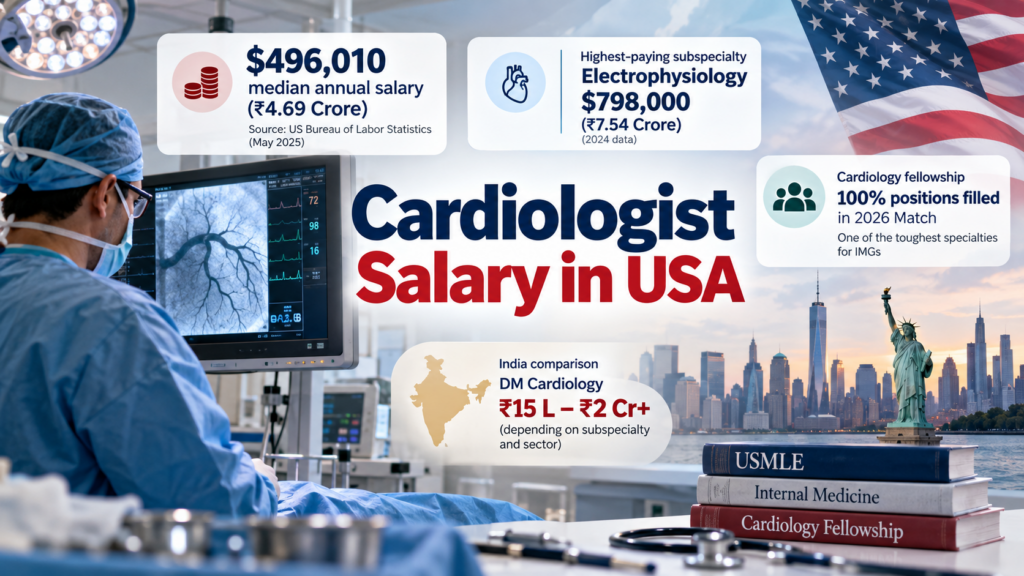
- Cardiologist salary in USA sits at a median of Rs.4.69Cr ($496,010) a year.
- Private compensation surveys report cardiologist salary in USA figures from Rs.4.91Cr to Rs.6.57Cr, higher than the government median.
- DM Cardiology in India pays Rs.15L to Rs.2Cr+ depending on subspecialty and sector.
- Cardiology fellowship in the US filled 100% of its positions in the 2026 Match, making it one of the toughest specialties for IMGs to enter.
Cardiologist Salary in USA
Most articles on cardiologist salary in USA quote whatever a private survey reports, without saying which one or why the numbers vary by hundreds of thousands of dollars. Here is the one number with a government source behind it.
The US Bureau of Labor Statistics puts the cardiologist salary in USA at a median of Rs.4.69Cr ($496,010) a year, based on its May 2025 wage survey, the same dataset used to track every occupation in the country.

Choose your dream country
 UK
UK
 USA
USA
 Germany
 Australia
 Ireland
 Canada
 UAE
UAE
 France
 Sweden
 Italy
Italy
 Other
Other
When do you want to study abroad?
What's your highest level of education?
Have you completed Class 12th?
What was your Class 12 CGPA/percentage?
Are you a student or a parent/guardian?
What do you want to study?
Select your current city
How Leap will help you

Personalised University Shortlist

Express Applications with Quicker Admits

End-to-End Application Support
- Cardiologists: Rs.4.69Cr ($496,010)
- Radiologists: Rs.3.98Cr ($420,860)
- Anesthesiologists: Rs.3.70Cr ($391,490)
- All physicians and surgeons (median across every specialty): Rs.2.61Cr ($275,930)
This makes cardiology the second highest-paid physician specialty the BLS tracks separately, behind only pediatric surgery.
Source: US Bureau of Labor Statistics, Occupational Outlook Handbook, Physicians and Surgeons, May 2025 data Exchange rate used: Rs.94.5 per USD (September 2026). Verify the current rate before finalizng your budget.
Counselor insight: Students often ask why every website quotes a different cardiologist salary in USA figure. The BLS number reflects every practising cardiologist in the country, salaried and private, junior and senior. Private surveys skew toward the doctors who choose to respond, which usually means more established, procedure-heavy practices. Neither number is wrong; they are measuring different populations.
Cardiologist Salary in US Per Month, Per Hour, and After Tax
Most searches for cardiologist salary in US per month or cardiologist salary in US per hour are trying to convert one annual headline figure into something more usable. Here is that breakdown, including the cardiologist salary in US in Indian rupees per month, based on the BLS median.
| Measure | USD | INR |
| Cardiologist salary in US per year | $496,010 | Rs.4.69Cr |
| Cardiologist salary in US per month (gross) | $41,334 | Rs.39.06L |
| Cardiologist salary in US per hour (based on a standard 2,080-hour work year) | approx. $238 | approx. Rs.22,491 |
| Cardiologist salary in US after tax per month (estimated, 30-35% effective tax) | approx. $27,000 to $29,000 | approx. Rs.25.5L to Rs.27.4L |
The after-tax figure is an estimate only. Actual take-home pay depends heavily on which US state you practise in, since state income tax ranges from zero (Texas, Florida) to over 13 percent (California), on top of federal tax. Run your specific state through a US paycheck calculator before treating any after-tax number as final.
This table is a direct arithmetic breakdown of the BLS median cited in the section above.
Why Private Salary Surveys Show a Higher Cardiologist Salary in USA
If you've seen a cardiologist salary in USA figure above Rs.5Cr, it likely came from one of these industry surveys, not the government.
| Source | What It Measures | Cardiologist Salary in USA |
| BLS OEWS (government) | Median wage, all practising cardiologists | Rs.4.69Cr ($496,010) |
| Medscape Physician Compensation Report 2025 | Average total compensation | Rs.4.91Cr ($520,000) |
| Doximity Physician Compensation Report 2025 | Median total compensation | Rs.5.55Cr ($587,360) |
| MedAxiom / ACC Cardiovascular Provider Compensation Survey 2024 | Median annual wage, self-reported | Rs.6.57Cr ($695,000) |
None of these private figures is a government statistic. They are self-reported surveys from established physicians, which is why they consistently run higher than the BLS median. Use the BLS number for realistic planning and the survey numbers to understand your ceiling once you are established.
Sources: Medscape Physician Compensation Report 2025, Doximity Physician Compensation Report 2025, MedAxiom Cardiovascular Provider Compensation Survey
Cardiologist Salary in USA by Subspecialty and Career Stage
Cardiology splits into subspecialties, and the cardiologist salary in USA gap between them is significant, and the ranking has recently shifted.
- Electrophysiology (arrhythmia ablation, pacemakers, ICDs): now the highest-paying cardiology subspecialty, at a median of Rs.7.54Cr ($798,000) in 2024, having overtaken invasive and interventional cardiology for the first time in over a decade.
- Invasive cardiologist salary in US (includes diagnostic catheterisation and broader invasive procedures): median Rs.7.31Cr ($774,000) overall, the second-highest subspecialty. Invasive cardiologists in private practice alone reported an even higher median of Rs.7.81Cr ($826,000), 7.8 percent above their integrated-practice peers.
- Interventional cardiologist salary in US: median Rs.7.09Cr ($750,000), the third-highest subspecialty.
- Advanced heart failure cardiology: median Rs.6.15Cr ($651,000).
- Non-invasive cardiologist salary in US (general cardiology): median Rs.6.14Cr ($650,000), the lowest of the major adult subspecialties tracked, though still well above the overall physician median.
- Pediatric cardiology: not covered by this survey, but consistently reported as lower-paying than adult cardiology subspecialties across other physician compensation data.
By career stage, cardiologists under 35 (MedAxiom's proxy for a starting cardiologist) had a median total compensation of Rs.5.65Cr ($597,393) in 2023, about 90 percent of the overall cardiology median that year. Pay then continues to climb through the first decade of practice as procedural volume and referral networks grow.
Source: MedAxiom 2025 Cardiovascular Provider Compensation & Production Survey, reported in Cardiovascular Business, October 2025 (2024 data); MedAxiom, starting cardiologist compensation trend
Counselor insight: If you've seen cardiologist salary in US figures discussed on Reddit's physician communities and they looked wildly different from what's here, that's normal. Those threads are individual, self-reported data points, often from a single practice setting or region, not a statistically representative sample the way BLS or a large physician survey is. Treat Reddit anecdotes as colour, not as your planning number.
Cardiologist Salary in USA vs. Cardiologist Salary in India
For an Indian MBBS graduate deciding between DM Cardiology at home and the US path, this is the number that matters most.
| Career Stage | India (DM Cardiology) | USA (Post-Fellowship) |
| Immediately post-qualification | Rs.17L to Rs.43L | Rs.4.69Cr ($496,010) median |
| Senior consultant (5 to 10 years) | Rs.72L to Rs.2Cr | Rs.5.55Cr+ ($587,360+) |
| Interventional subspecialty | Rs.30L to Rs.1Cr+ | Rs.7.09Cr ($750,000) |
Source: India figures from DM Cardiology salary structure as reported across Indian medical career guidance platforms citing government pay scales and private hospital packages, 2026; USA figures from BLS and MedAxiom, both cited above.
The gap is real, but so is the path to it. DM Cardiology in India has approximately 300 to 400 seats nationally each year across all institutions combined, making it one of the most competitive super-specialty seats to secure through NEET-SS. The US route through USMLE has a different bottleneck, covered in the next section.
Counselor insight: Parents frequently focus on the India-vs-USA salary multiple, roughly 10x at the entry level, without accounting for the 6 to 9 years of US training (residency plus fellowship) during which an Indian DM-qualified cardiologist is already earning and building a practice. Model both timelines before deciding, not just the endpoint salary.
Decision Framework: Which Path Actually Leads to a Cardiologist Salary in USA
- If you are an MBBS student who has decided on cardiology early: Don't wait until your final year to start USMLE prep. Begin Step 1 preparation during your clinical years, since a strong Step 1 and Step 2 CK score is the single biggest lever for matching into a US internal medicine residency, the mandatory first step before any cardiology fellowship.
- If you missed a DM Cardiology seat through NEET-SS: You have two realistic options: reattempt with a focused one-year plan, or pivot to the USMLE and IMG route, which has its own multi-year timeline but does not depend on a single national exam rank the way NEET-SS does. If you are also weighing a US path from scratch, our guide on pursuing an MBBS or MD in the USA breaks down the earlier-stage version of this decision.
- If you are already in a US internal medicine residency and unsure whether to pursue cardiology: Cardiology fellowship is one of the most competitive subspecialty matches in the country. Talk to your program director about your Step scores and research output honestly before committing your third year of residency to a cardiology-only application strategy.
Counselor insight: The students who match into US cardiology fellowships as IMGs almost always have one thing in common: they treated the US internal medicine residency Match as the hard part, not the fellowship. Programs remember residents who worked hard as interns and asked for cardiology-relevant electives early.
The USMLE and Match Pathway to a Cardiologist Salary in USA
Becoming a practising cardiologist in the US after an Indian MBBS is a multi-year process with several fixed checkpoints.
- Pass USMLE Step 1 and Step 2 CK.
- Get ECFMG certified, the mandatory credential for any international medical graduate applying to US residency programs.
- Match into a 3-year US Internal Medicine residency through the NRMP.
- Apply for and match into a 3-year Cardiovascular Disease fellowship, also through the NRMP.
- Optionally, complete a further 1-year fellowship in interventional cardiology or electrophysiology.
- Pass ABIM board certification in Cardiovascular Disease.
The cardiology fellowship Match is genuinely competitive. In the 2026 NRMP Specialties Matching Service cycle, all 1,347 Cardiovascular Disease fellowship positions filled, a 100 percent fill rate across 292 programs with zero unfilled programs.
Non-US IMGs secured 355 of those 1,347 positions, about 26.4 percent, out of 680 non-US IMG applicants who ranked the specialty, meaning just over half of non-US IMGs who applied to cardiology fellowship actually matched. Interventional Cardiology, a common next step, was comparatively less saturated: only 76.9 percent of its 307 positions filled overall in 2026, with non-US IMGs taking 30.0 percent of them.
Source: NRMP Specialties Matching Service, Results and Data 2026, NRMP Charting Outcomes in the Match: International Medical Graduates
What to Do If You Don’t Match Cardiology Fellowship the First Time
- If you don't match on your first cardiology fellowship application: Most successful IMGs reapply after strengthening research output and getting a strong program director letter, rather than switching specialties immediately. A second attempt with better positioning often succeeds where the first did not.
- If your USMLE Step scores are below competitive cardiology fellowship averages: Consider building a strong case through research publications and a standout residency performance instead. Programs do weigh the complete file, not Step scores alone.
- If cardiology fellowship doesn't work out despite multiple attempts: A completed US Internal Medicine residency alone still supports a strong hospitalist or general internal medicine salary in the US, well above what the same years of experience would pay in India, so the residency itself is not a wasted investment.
Planning Calendar for the US Cardiology Pathway (2027-28)
| Period | Action |
| Now to mid-2027 | Complete USMLE Step 1 and Step 2 CK; begin ECFMG certification |
| Mid to late 2027 | Secure US clinical experience (observerships/externships); collect letters of recommendation |
| September 2027 | Register for the 2028 NRMP Match; submit ERAS applications for Internal Medicine residency |
| March 2028 | Match results for Internal Medicine residency |
| Year 3 of residency (2030-31) | Apply for Cardiovascular Disease fellowship through the NRMP |
3 Takeaways on Cardiologist Salary in USA
- The cardiologist salary in USA has two honest numbers: Rs.4.69Cr as the government-measured median, and Rs.4.91Cr to Rs.6.57Cr from private surveys of established physicians, use the lower figure for realistic planning.
- The real bottleneck for Indian MBBS graduates isn't the cardiologist salary itself, it's matching into US Internal Medicine residency and then the highly competitive cardiology fellowship on top of it.
- DM Cardiology in India and the US cardiology pathway both lead to strong outcomes, but on very different timelines and risk profiles, model the full 6 to 9 year US path before comparing endpoint salaries alone.
Verified by: LeapScholar's USA counseling team, with hands-on experience guiding Indian MBBS graduates through USMLE preparation and residency Match cycles.
Have questions about the cardiology pathway abroad? Book a free session with a LeapScholar counselor.
Frequently Asked Questions on Cardiologist Salary in USA
-
What is the average cardiologist salary in USA?
The US Bureau of Labor Statistics reports a median cardiologist salary in USA of Rs.4.69Cr ($496,010) per year as of May 2025, which works out to roughly Rs.39.06L ($41,334) per month before tax. Private physician compensation surveys, including Medscape and Doximity, report higher averages between Rs.4.91Cr and Rs.5.55Cr, since they sample established, self-reporting physicians rather than the full workforce.
-
How much does a cardiologist make in the US per hour and after tax?
Based on a standard 2,080-hour work year, the BLS median works out to approximately $238 an hour before tax. After federal and state tax, most cardiologists keep roughly 65 to 70 percent of gross pay, so a $496,010 salary typically nets around $27,000 to $29,000 a month, though the exact figure depends heavily on which state you practise in.
-
How much does an interventional cardiologist make a year in the US?
Interventional cardiologist salary in the US had a median of Rs.7.09Cr ($750,000) in 2024, per the MedAxiom Cardiovascular Provider Compensation Survey, the third-highest of the major cardiology subspecialties after electrophysiology and invasive cardiology.
-
Is cardiologist salary in USA higher than other physician specialties?
Yes, for most specialties. The BLS May 2025 data places cardiologists at Rs.4.69Cr, second only to pediatric surgeons among the specialties it tracks separately, and well above the Rs.2.61Cr median for all physicians and surgeons combined.
-
How much does a DM Cardiology graduate earn in India compared to the USA?
A newly qualified DM Cardiology graduate in India typically earns Rs.17L to Rs.43L annually, compared to a median cardiologist salary in USA of Rs.4.69Cr post-fellowship. The gap narrows in relative terms once you account for the additional 6 to 9 years of US training required to reach that point.
-
Can an Indian MBBS graduate become a cardiologist in the USA?
Yes. The path requires passing USMLE Step 1 and Step 2 CK, getting ECFMG certified, matching into a 3-year US Internal Medicine residency, and then matching into a 3-year Cardiovascular Disease fellowship. The full pathway typically takes 6 to 9 years after MBBS.
-
How competitive is the cardiology fellowship Match for international medical graduates?
Very competitive. All 1,347 Cardiovascular Disease fellowship positions filled in the 2026 NRMP Match, and non-US IMGs secured only 26.4 percent of those positions, filled by just over half of the non-US IMG applicants who ranked the specialty that year.
-
What happens if I don't match into a cardiology fellowship on my first attempt?
A missed cardiology fellowship Match is not the end of the path. Most unmatched applicants reapply after adding research output and stronger letters of recommendation. A completed Internal Medicine residency alone still supports a strong US physician salary even without a cardiology fellowship.
-
What is the highest-paying cardiology subspecialty in the USA?
Electrophysiology is currently the highest-paying cardiology subspecialty in the USA, at a median of Rs.7.54Cr ($798,000) in 2024, having overtaken invasive cardiology (Rs.7.31Cr) and interventional cardiology (Rs.7.09Cr) for the first time in over a decade, per the MedAxiom Cardiovascular Provider Compensation Survey.
-
Does the cardiologist salary in USA justify the cost of the USMLE and residency pathway?
For most Indian doctors who successfully match, yes. Residency stipends of Rs.55L to Rs.60L a year during training already cover living costs and USMLE preparation expenses within the first year or two, before the much higher post-fellowship cardiologist salary begins.
-
How many DM Cardiology seats are available in India each year?
Approximately 300 to 400 DM Cardiology seats are available across all Indian institutions combined each year through NEET-SS, making it one of the most competitive super-specialty seats in Indian medical education.





Have Questions? Get Guidance to reach your Dream University
Connect with India's finest counsellors and biggest study abroad community.
Get Guidance