
Beyond Borders: How Indian Students Are Redefining Global Education in 2025–26
If 2024 was about “wait and watch,” 2025 has been the year Indian students officially broke the mould. We have seen a massive transition from “hoping for the best” to “calculating the best”, where every degree is scrutinised for its global market value.
After analyzing the journeys of 3 million students, the data tells a powerful story: In 2026, you aren’t just an applicant; you are a strategic investor. The old question “Can I afford to go?” has been replaced by the high-stakes reality: “What will this degree actually give me?“
Beyond the traditional hubs, a “Great Destination Shift” is underway. From the 55x explosion of interest in the UAE to the strategic rise of tuition-free Germany, Indian students are redrawing the global map in search of affordable excellence. With AI Master’s interest skyrocketing by 186% and working professionals leading the race to upskill, the 2026 intake is no longer about just a degree; it is about securing a seat in the future of work.
To help you navigate this new era, let’s take a look at this Year-End Report by Leap Scholar to uncover the trends defining your future.

Choose your dream country
 UK
UK
 USA
USA
 Germany
 Australia
 Ireland
 Canada
 UAE
UAE
 France
 Sweden
 Italy
Italy
 Other
Other
When do you want to study abroad?
What's your highest level of education?
Select you current city
How Leap will help you

Personalised University Shortlist

Express Applications with Quicker Admits

End-to-End Application Support
Ground Zero: The “ROI-First” Reality in India
A strategic outlook from the leaders behind Leap: There is a fundamental shift happening in the thousands of conversations we have with students every day. We have moved past the era of "speculative" study abroad, where moving across borders was driven by hope alone. Today, Indian families are acting as strategic co-planners, shifting their focus from simply "funding a degree" to "financing a career".
- The Big Shift: The core question has evolved from a simple "Can I afford to go?" to a rigorous "What will this degree actually give me?"
- Pragmatic Ambition: Students are no longer chasing academic credentials alone; they are prioritizing clear career pathways, global employability, and long-term residency stability.
- Intense Evaluation: In a world of rising global inflation, 2025–26 aspirants are treating education as a strategic investment, measuring Return on Learning (ROL) to calculate how a specific degree impacts their long-term income potential.
This isn't just data; it’s the story of Indian ambition reshaping itself to be more intentional, diverse, and sharply focused on outcomes.
Who is Leading the Race? Aspirant Profile & Demographics
The face of the Indian student is changing. It is no longer just the 18-year-old fresh out of school.
1. Age and Maturity Trends
While 65.5% of aspirants are in the 18–25 age bracket, over one-third (34.5%) are mature students aged 26 or older. This indicates a massive trend of working professionals seeking specialized degrees to pivot or accelerate their careers.
2. Gender and Field of Study
- Narrowing Gap: Male applicants constitute 58% of the base, while females account for 42%. However, this gap is narrowing as more women pursue STEM and technology-focused programmes abroad.
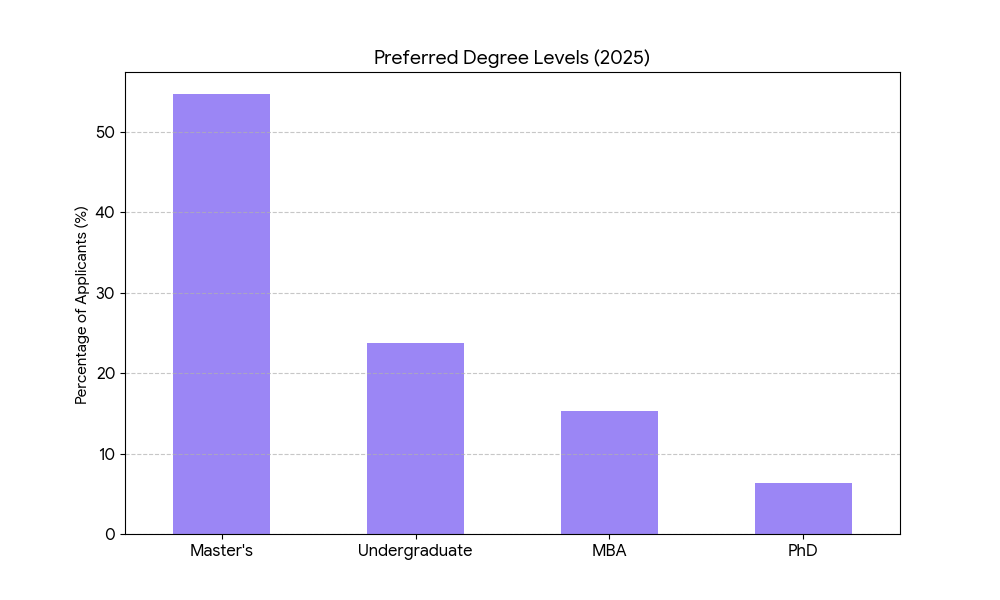
- Degree Popularity: Master’s programmes are the overwhelming choice (54.7%), followed by Undergraduate degrees (23.7%).
- Research Surge: Interest in PhDs has jumped by 60% year-on-year, reaching 6.3% of applicants and signaling a growing appetite for high-tech research careers.
3. Financial Determinants of Mobility
While career aspiration initiates the journey, financial viability governs the final decision.
- Career Advancement as a Driver: 85% of candidates prioritize post-study career advancement over academic credentials alone.
- Cost Sensitivity: Price sensitivity is at an all-time high, with 68% of students citing affordability as a top priority.
- Value-Centric Shifting: This sensitivity is driving a tangible shift toward destinations that offer long-term economic viability, such as Germany, the UAE, and New Zealand.
What This Tells Us
The aspirations for international study are undergoing a genuine democratisation.
- Strategic Investment: Education is now viewed strictly as a strategic career investment rather than a mere academic milestone.
- Intentional Planning: The modern student cohort is more diverse and intentional, funding their pursuits with prudent financial planning focused sharply on employability.
- Outcome Focused: Success is measured by the clarity of employment pathways and the immediate Return on Investment (ROI).
The AI Revolution in Global Education
Artificial Intelligence isn't just a subject; it’s now the backbone of the entire student journey. At Leap, we’ve observed that the adoption of these tools isn't about cutting corners; it’s about the democratization of global education. Students who once lacked access to specialist counselling are now using technology to level the playing field, making sophisticated guidance accessible to every aspirant from Jaipur to Siliguri.
The "ChatGPT Effect"
Since late 2022, AI has fundamentally reshaped the admissions landscape. Our data reveals a student body that is tech-savvy and strategically reliant on automation:
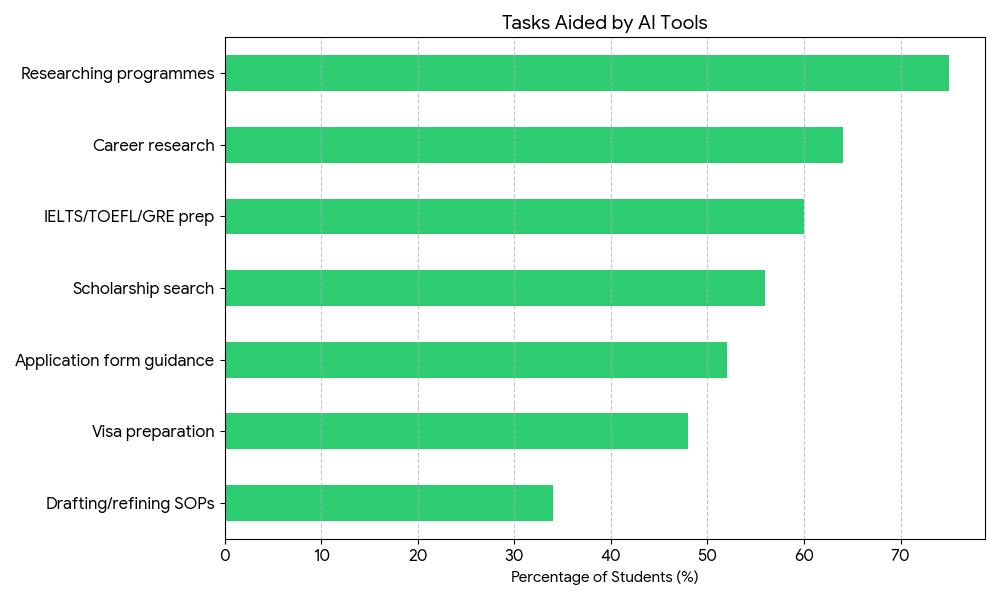
- Comprehensive Research: 75% of students use AI to research programmes and identify "best-fit" courses.
- Testing Precision: 60% utilize AI for high-stakes test prep like IELTS, TOEFL, or GRE, effectively using AI tutors to replace expensive coaching.
- Career Mapping: 64% of aspirants leverage these tools for deep-dive career research, looking at future roles, required skills, and global salary potential.
- Human Touch Remains: While AI handles the data, the "soul" of the application stays human; only 34% use AI for drafting or refining SOPs, as students still value human expertise for personal storytelling and subjective elements.
Why Students are Racing Towards AI Programmes
Interest in AI isn't just about using the tools; it's about mastering them.
- The 186.2% Surge: Enrolments in specialized Master's in AI programmes nearly tripled between 2023 and 2024.
- Strategic Intent: Nearly half of these students (49.9%) aim to upskill within their existing fields, like marketing analytics or finance, rather than switching fields entirely.
- Workforce Reality: Approximately 36% of AI aspirants are already working professionals, proving that technical upskilling has evolved from an option to an occupational necessity.
The Great Destination Shift: Beyond the “Big Four”
High costs and shifting visa norms in the traditional "Big Four" (US, UK, Canada, and Australia) have fundamentally altered the student mindset. We are now seeing a "strategic migration" where students are prioritizing long-term economic viability over legacy prestige. If you are looking for high-value alternatives that balance top-tier education with sensible financial planning, these emerging hubs deserve your focus.
1. Germany: The New Strategic Leader
Indian students have officially become the largest international cohort in Germany, with nearly 59,000 students enrolled.
- Zero Tuition: Most public universities remain tuition-free; students typically only pay around $1,500 (approx. ₹1.27 Lakh) in administrative charges for an entire two-year programme.
- STEM Excellence: To help Indian students thrive, German institutions have rapidly expanded English-medium curricula, particularly in STEM faculties.
- Job Seeking: You can benefit from an 18-month job-seeking residence permit, providing a clear path to residency in Europe’s largest economy.
2. UAE: The Proximity Powerhouse
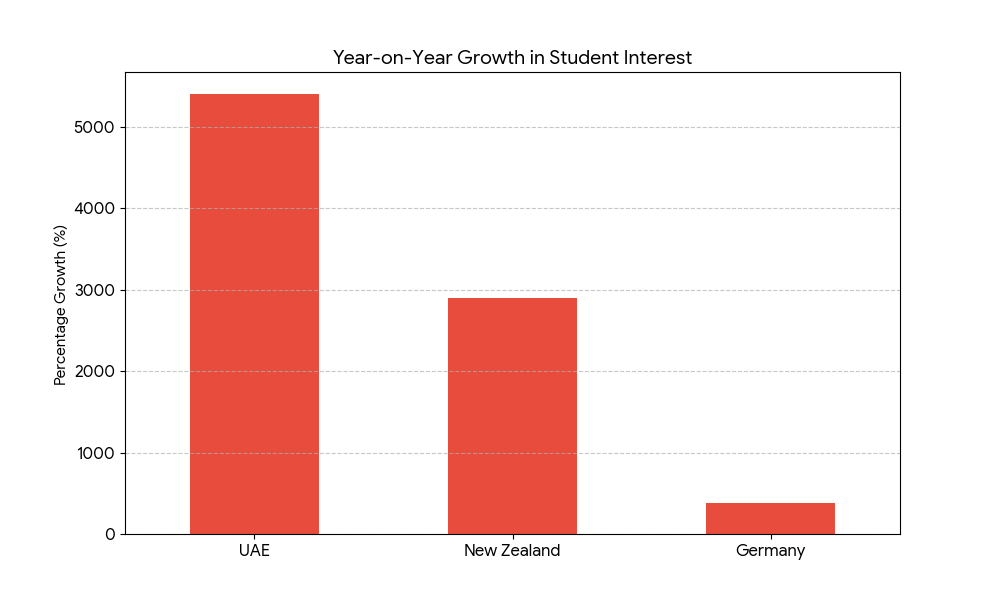
Interest in the UAE has surged by an incredible 55x (5400%) this year as the nation positions itself as a global education hub.
- Cultural Comfort: With an average flight time of just 3–4 hours from India, the UAE offers geographic proximity that provides immense reassurance to families.
- Global Quality: By hosting international branch campuses in free zones, the UAE allows you to earn a Western degree at competitive price points.
- Tax-Free Potential: The region serves as a strategic entry point for those targeting high-paying, tax-free employment within the Middle East.
3. New Zealand: The "Green List" Advantage
With a 30x (2900%) growth in interest, New Zealand is the new "middle path" for students seeking quality of life and career stability.
- Residency Pathways: The government’s "Green List" for critical skills in engineering and health streamlines the residency process for qualified graduates.
- Generous PSW: You can live and work for up to three years after your studies through their Post-Study Work Visa.
- Investment Balance: With tuition fees typically ranging between $20,000 and $30,000 USD (approx. ₹16.8 Lakh – ₹25.2 Lakh), it offers a balanced value proposition
| Destination | Primary Advantage | Estimated Total Fee (Master's) |
| Germany | Zero Tuition in Public Universities | ₹1.3L – ₹1.7L (Semester fees) |
| UAE | High ROI & Cultural Familiarity | ₹8L – ₹15L (Branch Campuses) |
| New Zealand | Clear PR Pathways (Green List) | ₹16L – ₹25L ($20k – $30k USD) |
Looking Ahead: The Next 5 Years (2025–2030)
What should you expect as you plan your 2026–27 applications?
1. AI + Core Skills: The New Advantage
AI transformation is accelerating rapidly, and we anticipate that AI components will become standardized across nearly every postgraduate discipline within the next five years. Whether it is business programmes incorporating AI-driven analytics or healthcare courses embedding AI diagnostics, the distinct advantage will belong to students who position themselves at the intersection of AI and domain expertise.
2. Choosing Value Over Brand Names
Economic pragmatism is reshaping destination and university preferences, with 68% of students now rating programme cost and affordability as a top priority. This financial sensitivity is driving a migration toward nations offering high-value and mid-tier institutions in affordable cities, as students increasingly prioritize return on investment over mere prestige.
3. Why Global Talent Is Returning to India
India currently exports human capital at a significant scale, but we are seeing a potential for "reverse migration". Since 36% of AI aspirants are already working professionals, these globally trained individuals are upskilling with the intent of securing high-impact careers. As India’s technology sector matures, these leaders will likely return to drive domestic innovation and lead India’s digital future
In Conclusion
The era of choosing a university based on a "dream" is yielding to a mature cohort of students who act as strategic investors. With 85% of applicants prioritizing post-study career advancement and 68% focusing on affordability, the path forward is clear: success belongs to those who align their global ambition with economic reality. This strategic shift, intensified by the AI revolution, is democratizing global education and creating a new generation of Indian professionals ready to thrive in a borderless workforce.
Planning for the September 2026 intake? Start your preparation now. The most successful students in 2026 won't just be those with the highest scores; they will be those with the smartest ROI strategies.
Ready to build your global career? Leap Scholar’s experts and AI-driven guidance engine are here to help you pinpoint the best-fit universities and navigate your journey with confidence. Connect with a Leap Scholar Mentor today!
Frequently Asked Questions (FAQs)
-
1. Is AI replacing traditional consultants in India?
No. While 75% of students use AI for initial research, they still prefer human experts for complex tasks like visa compliance and personalized SOP strategies.
-
2. Which country is best for AI studies for Indian students in 2026?
The USA (47%), Germany (40%), and the UK (34%) are currently the top three nominated destinations for AI disciplines.
-
3. How much can I save by studying in Germany?
In German public universities, you can save nearly ₹30 Lakh to ₹50 Lakh in tuition fees compared to traditional Western destinations, as tuition is essentially free.
-
4. Can I work in the UAE after my studies?
Yes. The UAE has introduced post-study and job-seeker visas to help international graduates transition into their fast-growing economy.
-
5. What is the New Zealand "Green List"?
It is a list of high-demand roles (like Engineering and Medicine) that allows students with those qualifications to apply for straight-to-residence or work-to-residence pathways.











Have Questions? Get Guidance to reach your Dream University
Connect with India's finest counsellors and biggest study abroad community.
Get Guidance