
Quick Read
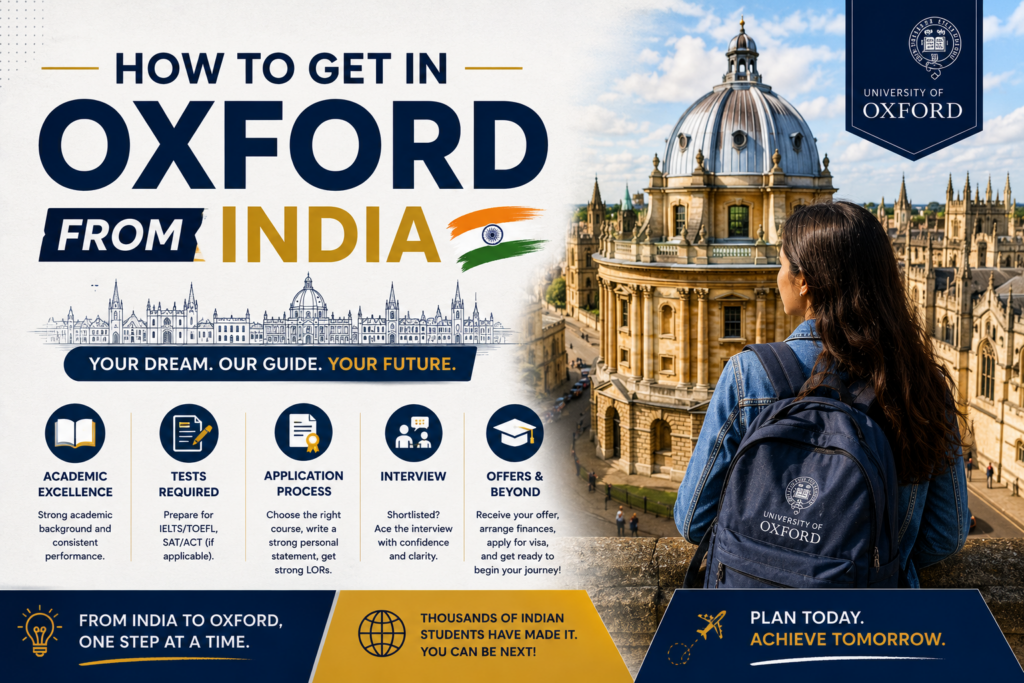
- The UCAS deadline for 2027 entry is 15 October 2026 at 6pm UK time.
- Oxford now requires ESAT, TARA, TMUA, UCAT, or LNAT; test varies by course.
- Graduate scholarships like Clarendon and Felix need no separate application; apply by the January deadline for automatic consideration.
- Oxford accepts only CBSE and ISC for UG entry; state board and NIOS qualifications are not accepted.
Undergraduate Eligibility: After Class 12
Oxford accepts only CBSE (All-India SSC) and CISCE (ISC) for direct undergraduate entry. State board qualifications and NIOS Year XII are not accepted.
CBSE results arrive after the October UCAS deadline, so Oxford assesses applications on predicted grades submitted by your school in the UCAS reference. Schools must submit realistic predictions; inflated grades that are not met at the results stage can lead to automatic withdrawal of an offer.

Choose your dream country
 UK
UK
 USA
USA
 Germany
 Australia
 Ireland
 Canada
 UAE
UAE
 France
 Sweden
 Italy
Italy
 Other
Other
When do you want to study abroad?
What's your highest level of education?
Have you completed Class 12th?
What was your Class 12 CGPA/percentage?
Are you a student or a parent/guardian?
What do you want to study?
Select your current city
How Leap will help you

Personalised University Shortlist

Express Applications with Quicker Admits

End-to-End Application Support
Grade Requirements by Course Tier
| A-level Equivalent | CBSE Requirement | CISCE (ISC) Requirement |
|---|---|---|
| AAA (highest tier) | A1 A1 A1 A1 A2, with A1 in relevant subjects | 90% overall; 95%+ in four subjects (incl. relevant); 85%+ in fifth |
| A*AA | A1 A1 A1 A2 A2, with A1 in relevant subjects | 90% overall; 95%+ in three subjects (incl. relevant); 85%+ in other two |
| AAA | A1 A1 A2 A2 A2, with A1 in relevant subjects | 90% overall; 95%+ in two subjects (incl. relevant); 85%+ in remaining three |
Note for Class 10 students: There is no direct post-Class 10 route to Oxford. The earliest entry point is after a full Class 12 with CBSE or ISC. Pick your class 11 and 12 subjects based on the Oxford course you wish to study, and start building your academic profile from the start.
How to Get in Oxford From India: Postgraduate Eligibility for Indian Students
Oxford assesses Indian bachelor's degrees on a case-by-case basis, with preference for degrees from recognized institutions such as IITs, NITs, and central universities.
| Program | Minimum Indian Equivalent | Additional Requirements |
|---|---|---|
| Taught Master's | 65% to 70%+ from a recognised university (First-class equivalent) | IELTS higher or standard level depending on course |
| Upper Second (2:1) courses | 60% to 65% depending on institution | Minimum for most master's programs |
| DPhil (PhD) | Master's degree with distinction-level performance | Research proposal; supervisor agreement; strong references |
| MBA (Said Business School) | Bachelor's degree in any discipline | 3 to 5 years of professional experience; GMAT 650+ or competitive GRE |
| BCL (Graduate Law) | Strong law undergraduate degree from top institution | LNAT not required at PG level; writing sample typically needed |
| MSc/DPhil Engineering | B.Tech. 70%+ from NIRF-ranked institution | GRE helpful; check course page for specific requirements |
English Language Requirements
| Level | IELTS Score | Who does it apply to? |
|---|---|---|
| Higher Level | 7.5 overall; a minimum of 7.0 in each component | All UG courses; most humanities, law, and business PG courses |
| Standard Level | 7.0 overall; min 6.5 in each component | Some science and engineering PG courses |
Important: Oxford will stop accepting TOEFL iBT scores taken from 21 January 2026 onwards while it reviews the revised test format. Check Oxford's current policy before booking a TOEFL test.
Counselor insight: In our experience working with Indian PG applicants, the most common rejection at Oxford is not grade-related; it is the research proposal for DPhil applicants. A proposal submitted without prior contact with a potential supervisor is almost always unsuccessful. Identify your supervisor before the December deadline, not after.
How to Get in Oxford from India: The New 2027 Admissions Tests
Oxford retired all previous in-house tests (MAT, PAT, TSA, BMAT, and others) for 2027 entry. From the 2027 entry cycle, the following framework applies:
| Test | Courses |
|---|---|
| ESAT | Physics, Physics and Philosophy, Engineering Science, Biomedical Sciences |
| TARA | PPE, Economics and Management, Psychology (Experimental), Psychology, Philosophy and Linguistics, Human Sciences, History and Economics, History and Politics |
| TMUA | Mathematics, Mathematics and Statistics, Computer Science, Mathematics and Computer Science, Mathematics and Philosophy, Computer Science and Philosophy |
| UCAT (unchanged) | Medicine and Graduate-entry Medicine |
| LNAT (unchanged) | Law (Jurisprudence) and Law with Foundation Year |
Key points to remember:
- All UAT-UK tests are computer-based and sat at Pearson VUE test centres. Test accounts will open on 1 June 2026. All standard UG applicants (applying by the 15 October UCAS deadline) must sit the October 2026 sitting.
- The January 2027 sitting is not available for standard Oxford undergraduate courses. LNAT registration opens 1 August and closes 15 September 2026, with the test to be completed by 15 October 2026.
- Old MAT and PAT past papers are not directly applicable to the new tests. Use official preparation materials at the UAT-UK website.
Counselor Insight: Pearson VUE slots in Indian metro cities fill up fast. Book your test slot as soon as registration opens, not after submitting your UCAS application.
Personal Statement, References and Interview
| Component | What does Oxford look for? | Key Dos and Don'ts |
|---|---|---|
| Personal Statement (3 structured UCAS questions; 4,000 characters total; a minimum of 350 per question) | Intellectual curiosity; academic engagement beyond the syllabus | Do: dedicate 80% to academic content, specific books, ideas, and independent thinking. Do not: list extracurriculars and prizes as the main content. |
| Academic Reference (LOR) | Subject-specific evidence of academic drive, independent study, and potential | A reference must come from a teacher with direct knowledge of your academic work in the relevant subject. Generic endorsements do not help. |
| Interview (online via Microsoft Teams, December 2026) | How you think when given an unfamiliar problem, not whether you already know the answer | Think aloud when stuck. Say, "I would approach this by..." Re-read your personal statement before the interview; tutors ask about it. |
Oxford interviews approximately 40% to 70% of applicants depending on the course. The interview replicates the Oxford tutorial format: an academic conversation about your subject, not a personality test.
Cost of Living in Oxford
1. Tuition Fees (Overseas Students)
| Program | Annual Fee (GBP) | Component |
|---|---|---|
| Undergraduate (standard courses) | £37,380 to £62,820 | Rs.47.47 lakh to Rs.79.78 lakh |
| Undergraduate (Clinical Medicine, Years 4 to 6) | £65,250 | Rs.82.87 lakh |
| MBA (Said Business School) | Approx. £83,770 | Approx. Rs.1.06 crore |
| Postgraduate (varies by course) | Course-dependent | Check course page |
2. Estimated Annual Living Costs
| Expense | Annual Cost (GBP/INR) |
|---|---|
| Accommodation (college-guaranteed for Year 1) | £9,500 to £13,800 (Rs.12.07 lakh to Rs.17.5 lakh) |
| Food and groceries | £3,600 to £4,800 (Rs.4.57 lakh to Rs.6.1 lakh) |
| Study materials and books | £600 to £1,200 (Rs.76,200 to Rs.1.5 lakh) |
| Transport | £900 to £1,200 (Rs.1.14 lakh to Rs.1.5 lakh) |
| Personal and miscellaneous | £1,500 to £3,000 (Rs.1.91 lakh to Rs.3.81 lakh |
| Total living costs estimate | £16,100 to £24,000 (Rs.20.45 lakh to Rs.30.48 lakh) |
Source: Numbeo Oxford cost of living
For the UK student visa, you must demonstrate funds covering Year 1 tuition plus nine months of living costs, typically upwards of Rs.65 to 70 lakh in verified bank statements.
Counselor insight: Oxford college accommodation is guaranteed in Year 1, which removes the uncertainty that affects students at most UK universities. In our counseling sessions, families consistently underestimate Year 2 and Year 3 private rental costs in Oxford, which can run 20–30% higher than the figures above. Budget for £13,000–£15,000/year in private accommodation from Year 2 onwards.
For a city-by-city breakdown, see our cost of living in the UK for Indian students guide.
How to Get in Oxford from India with a Scholarship?
Most Oxford graduate scholarships require no separate application. Submitting your Oxford course application by the relevant January funding deadline automatically enters you into consideration for all scholarships you are eligible for. This includes Clarendon and Felix, two of the most valuable awards available to Indian students.
| Scholarship | Who it is for? | Coverage | How to apply? |
|---|---|---|---|
| Rhodes | PG; Indian students aged 18 to 23 (exceptions up to 27); academic and leadership excellence | Full tuition + £20,400/year stipend (Rs.25.91 lakh, 2025-26 rate) + travel | Separate application to Rhodes Trust; 5 awards per year for India |
| Clarendon | All PG nationalities | Full tuition + UKRI-rate living stipend | Automatic consideration by January deadline; no separate form |
| Felix | Indian nationals only; master's or DPhil | Full tuition + approx. £19,000/year (Rs.24.13 lakh) + return flight | Automatic consideration by December or January deadline |
| Reach Oxford | UG only; financially disadvantaged students | Full tuition + living grant + return airfare | Separate application by 4 February, after receiving an Oxford offer |
| Chevening | One-year master's; 2+ years professional experience | Fully funded by UK government | External application via Chevening portal; India deadline varies |
| Weidenfeld-Hoffmann | PG: leadership focus | Full tuition + living costs | Automatic at Oxford; supplementary leadership statement required |
UK Student Visa and Post-Study Work
After accepting your Oxford offer, apply for your UK Student Visa with the following documents ready:
- CAS (Confirmation of Acceptance for Studies) from Oxford
- Bank statements showing funds for Year 1 tuition plus nine months of living costs
- Valid passport and IELTS score meeting the Higher Level requirement
- Tuberculosis test result (required for all Indian nationals)
- ATAS certificate for STEM subjects (Engineering, Computer Science, some Physics programs): apply immediately after your unconditional offer, as processing takes four to eight weeks and the visa cannot proceed without it
For a full step-by-step guide to the UK Student Visa process, read our dedicated UK student visa guide.
After graduation, the graduate route visa lets you stay and work in the UK for two years (three years for DPhil graduates) without a job offer or employer sponsorship.
The Complete 2027 Application Timeline
Undergraduate (2027 entry)
| Period | Action |
|---|---|
| May to June 2026 | Choose a course, check board eligibility, and identify required admissions test |
| 1 June 2026 | UAT-UK test accounts open; register early |
| 1 August 2026 | LNAT registration opens (Law applicants) |
| 15 September 2026 | LNAT registration and booking closes (for Oxford/Cambridge applicants) |
| October 2026 | Sit UAT-UK, UCAT, or LNAT test (LNAT must be sat by 15 October) |
| 15 October 2026 | UCAS deadline: 6pm UK time. No exceptions. |
| 10 November 2026 | Written work submission deadline (Humanities courses only) |
| December 2026 | Online interviews via Microsoft Teams (shortlisted candidates) |
| 12 January 2027 | Decisions released via UCAS |
Postgraduate (2027-28 entry): Applications open September 2026. Most courses have December 2026 or January 2027 funding deadlines. Applying by the January deadline is essential for automatic scholarship consideration.
Common Mistakes Indian Students Make
In LeapScholar's review of Oxford applications from Indian students in the 2025–26 cycle, these six errors accounted for the majority of first-round rejections.
- Late test registration: UAT-UK registration is separate from UCAS and not automatic. Pearson VUE slots in Indian cities fill up weeks before the deadline.
- Inflated predicted grades: Schools must submit realistic predictions. Oxford does not offer places if final results are below the published conditions.
- Extracurriculars-heavy personal statement: Oxford wants people who are interested in the subject, not just a list of prizes and positions you have held.
- Missing the January PG deadline. Applying late means missing automatic scholarship consideration for Clarendon and Felix.
- IELTS score expiry. Time your test for March to June of your application year so that your scores remain valid at the start date of your program.
- Delaying ATAS for STEM subjects. A two-month processing delay can push back your visa application significantly.
Is Oxford Realistic for Indian Students?
Short answer: yes, if you prepare across the right areas. From 2021 to 2023, roughly 1,883 Indian students applied, and 74 received offers, a 3.9% acceptance rate. That pool includes many who missed test windows, had unmatched grades, or wrote the wrong kind of personal statement. Around 550 Indian students are currently at Oxford, with India in the top five countries of origin.
Admissions tutors assess four things: grades, admissions test score, personal statement, and interview. If you miss any one of these, the others cannot compensate.
Counselor Insight: Most Indian applicants underestimate the admissions test. It is the part that most often surprises people. Start preparation in April or May, well before the October crunch.
3 Things to Keep in Mind Before Applying to Oxford
- Academic credibility: Your CBSE or ISC grades need to clear the course-specific bar, and your school's predicted grades should reflect what you can genuinely deliver, not what looks good on paper.
- Test readiness: Depending on your course, you will sit the ESAT, TARA, TMUA, UCAT, or LNAT. Figure out which one early, get hold of the official materials, and give yourself a proper runway from April.
- Intellectual depth: Oxford tutors are not looking for a list of achievements. They want to see someone who has actually thought hard about their subject. Both your personal statement and interview need to show that.
The students who make it through tend to start 12 to 18 months out and treat all three areas with equal seriousness, not one at a time.
Book a free session with a LeapScholar counselor and get a roadmap built around your specific profile.
Frequently Asked Questions about How to Get in Oxford from India
-
Can I get into Oxford from India after 12th grade with state board results?
No. Oxford only recognizes CBSE and CISCE (ISC) for undergraduate entry. State board and NIOS Year XII results are not accepted, regardless of your score.
-
What is the minimum CBSE percentage needed for Oxford?
There is no fixed cutoff. Oxford converts CBSE grades into A-level equivalents. For most courses, you are looking at A1 in three to four subjects, with A1 (91%+) in subjects relevant to your course and A2 (81–90%) in the rest.
-
How do I get in Oxford from India for my Masters?
Apply via the Oxford Graduate Admissions portal. The baseline is a bachelor’s degree from a recognized Indian university equivalent to a UK first-class (65–70%+) or solid upper second-class (60–65%+). Submit before the January funding deadline to be automatically considered for scholarships.
-
How do I apply for a DPhil (PhD) at Oxford from India?
You will generally need a master's degree with strong results, a clear research proposal, a supervisor who has agreed to take you on, and solid academic references. Most programs close between December and January.
-
How do I get into Oxford for free as an Indian student?
The Clarendon and Felix scholarships are the most practical routes for PG students. Both cover fees and living costs. For Oxford-based Felix consideration, apply by the December funding deadline; for SOAS and Reading, the deadline is January. No separate scholarship form is required for either. Undergraduates can apply for the Reach Oxford Scholarship separately after receiving an offer.
-
Is NEET accepted for Medicine at Oxford?
No. Oxford requires the UCAT along with predicted CBSE or ISC grades that meet the requirements listed on the Medicine course page. NEET scores play no role in the admissions process.
-
How do I get into Oxford from India for Law?
At the undergraduate level, you need to sit the LNAT and meet the CBSE or ISC grade threshold. At the postgraduate level, the main taught degree is the BCL (Bachelor of Civil Law), not an LLM. The DPhil in Law is the research route, and strong results from a reputable Indian law school are important.
-
How do I get into Oxford from India for an MBA?
You should apply to the one-year program at Saïd Business School. You need a bachelor's degree in any subject, three to five years of professional experience after graduation, a GMAT score of 650 or above, two professional references, and a set of application essays. Applications for October 2027 entry typically open in autumn 2026.
-
Can I get into Oxford from India for an MTech or BTech in engineering?
Oxford does not offer an MTech. The closest equivalents are the MSc in Engineering Science and the DPhil in Engineering Science. BTechs from NIRF-ranked colleges with 70% and above marks are generally in a competitive range. Check your specific course page to see if a GRE score is required.







Have Questions? Get Guidance to reach your Dream University
Connect with India's finest counsellors and biggest study abroad community.
Get Guidance