
Quick Read
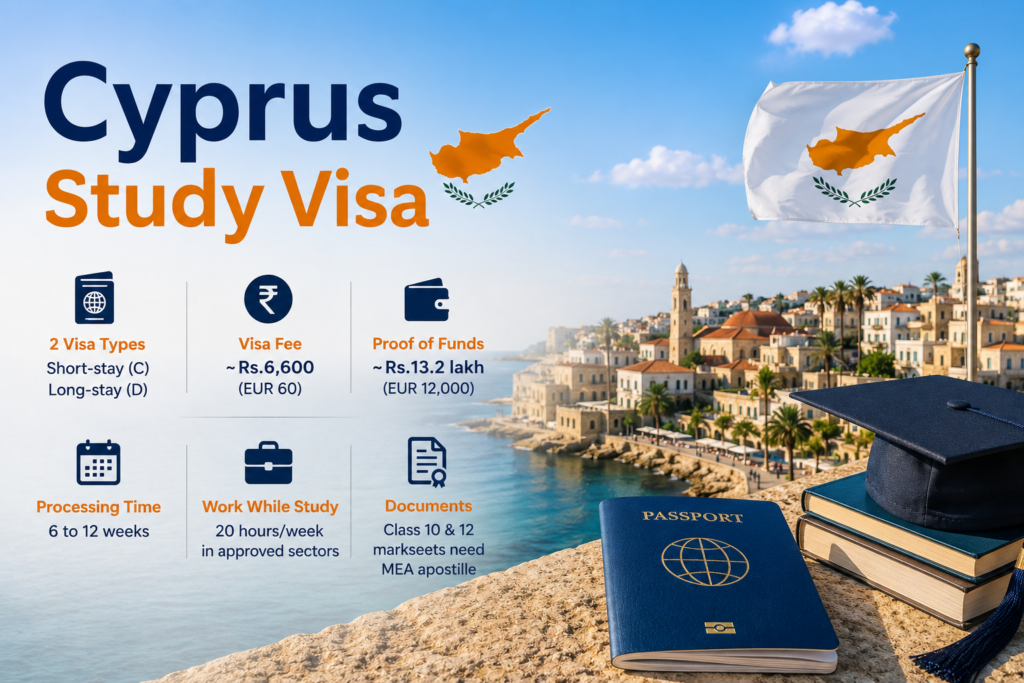
- Cyprus study visa comes in two types: short-stay Category C and long-stay Category D.
- A long-stay Cyprus study visa costs about Rs.6,600 (EUR 60) at current rates.
- Indian applicants need roughly Rs.13.2 lakh (EUR 12,000) in proof of funds.
- Processing usually takes six to twelve weeks once your file is complete.
- Cyprus study visa holders can legally work 20 hours a week in approved sectors.
- Class 10 and 12 marksheets need an MEA apostille before you submit them.
What Is a Cyprus Study Visa, and Who Needs One
India isn’t on the EU or EEA list, so if you’re planning to enroll at a Cypriot university for longer than 90 days, you need a Cyprus study visa. According to the European Commission’s official immigration portal, non-EU students must be enrolled at a recognized institution for a diploma, postgraduate diploma, or doctorate, get a visa or entry permit before travelling, and then apply for a temporary residence permit after landing.
Many students stop reading right after “get the visa” and assume the hard part is over. You still have to register with the Civil Registry and Migration Department within days of arriving, and skipping that step means sorting paperwork during your first week of classes instead of settling in.

Choose your dream country
 UK
UK
 USA
USA
 Germany
 Australia
 Ireland
 Canada
 UAE
UAE
 France
 Sweden
 Italy
Italy
 Other
Other
When do you want to study abroad?
What's your highest level of education?
Have you completed Class 12th?
What was your Class 12 CGPA/percentage?
Are you a student or a parent/guardian?
What do you want to study?
Select your current city
How Leap will help you

Personalised University Shortlist

Express Applications with Quicker Admits

End-to-End Application Support
My insight: We've had students land in Nicosia thinking the visa sticker in their passport was the finish line, only to realize on day three that the residence permit clock had already started ticking. Mark the date on your calendar before you even book your flight.
What Cyprus Is Known For and Why Indian Students Are Choosing It
Cyprus isn't mentioned alongside the UK, Canada, or Germany when Indian families start talking about studying abroad, and that's part of the appeal for some students. Here's what's actually drawing them in:
- English-taught programs: Most bachelor's and master's degrees run entirely in English, so language isn't the barrier it can be elsewhere in Europe.
- Lower tuition. Fees typically land between Rs.4.8 lakh and Rs.7.7 lakh a year (EUR 4,400 to EUR 7,000), meaningfully cheaper than similar UK programs.
- A degree with EU standing: The University of Cyprus ranked 525th globally in the QS World University Rankings 2027, holding the top national position among all evaluated Cypriot institutions, which matters if you're hoping to work in the EU afterward.
- A genuinely international campus: Students come from over 60 countries, and the presence of Indian students continues to grow year on year.
- Part-time work rights: Some study destinations shut non-EU students out of jobs almost entirely. Cyprus doesn't impose such restrictions, but there are limits, which we cover later in this guide.
None of this makes Cyprus objectively better than the bigger-name destinations. It's a different bet: lower cost and an EU-recognized degree, against a smaller Indian alumni network back home than you'd find with Canada or the UK.
Exchange rate used: Rs.109.98 per 1 EUR, as of September 2, 2026. Verify the current rate before finalizing your budget.
Cyprus Study Visa Types and Cost for Indian Students
Two categories exist, and picking the wrong one costs you time you don't have. If you're enrolling in a full degree program, and most Indian applicants are, you want Category D. Category C is meant for short courses and exchange stints, not a three-year bachelor's degree.
| Visa Type | Who It's For | Validity | Approximate Cost |
|---|---|---|---|
| Short-Stay (Category C) | Short courses, exchange programs under 90 days | Up to 90 days within a 180-day window | Rs.2,200 (EUR 20) |
| Long-Stay (Category D) / Entry Permit | Full-time bachelor's, master's, or PhD programs | Converts to a residence permit after arrival | Rs.6,600 (EUR 60) |
Source: VFS Global, Cyprus visa fee information for India
The cost of a Cyprus study visa doesn't stop at the visa fee itself, though. Once you consider the full picture, here's what the total comes to:
- The base visa fee shown above
- A separate VFS service charge, on top of the visa fee
- A residence permit application fee of roughly EUR 70 (about Rs.7,700), paid after you land
- A one-time residence permit registration fee, also around EUR 70 (about Rs.7,700)
- Both residence permit fees apply per person, so if a parent or sibling is travelling with you, multiply accordingly
Documents You Need for Your Cyprus Study Visa Application
On paper, the European Commission keeps the baseline document list fairly short: proof of admission, enough financial resources to cover living costs and health insurance, a police clearance certificate, and a valid passport. Indian applicants, as usual, end up with a longer checklist once you factor in attestation requirements.
| Document | India-Specific Detail |
|---|---|
| Letter of acceptance | From a university registered with Cyprus's Ministry of Education |
| Academic transcripts | Class 10 and 12 marksheets, plus degree certificates for postgraduate applicants |
| Document attestation | MEA Apostille is mandatory for long-stay visas, since Cyprus is a Hague Convention member |
| Proof of funds | Bank statements or an education loan sanction letter showing roughly Rs.13.2 lakh (EUR 12,000) |
| Sponsor documents | ITR of the last 2-3 years if parents are sponsoring, plus a notarized sponsorship letter |
| Police clearance | Certificate from local Indian police authorities, usually valid for six months |
| Health insurance | Coverage valid for at least your first year in Cyprus |
If your university is also asking for a Statement of Purpose, don't leave that for later either. A weak SOP won't necessarily cost you your university seat, but it can raise eyebrows at your visa interview if the officer isn't convinced your reasons for choosing Cyprus specifically add up.
Worth checking the SOP format and sample if you're starting from a blank page.
My insight: Honestly, the rejections I notice are usually because of a missing document. They are due to an unattested one. Someone submits a plain photocopy of their Class 12 marksheet, not realizing that getting the apostille alone can take two to three weeks through the MEA's regional offices, and suddenly they find themselves scrambling a month before their intake. Get the process moving the day your acceptance letter arrives, not after.
Cyprus Study Visa Age Limit and Eligibility
There isn't an official maximum age for a Cyprus study visa. The minimum, on the other hand, is clear: you need to be 18 to apply on your own. If you're younger than that, you'll need notarized consent from a parent or guardian.
That said, a few visa consultancies have noted, informally, that applicants past their early thirties sometimes get more questions about why they're choosing to study now. Nothing about this process is written into law, so don't treat it as a real barrier; just be ready for it. If you're in that bracket, having a clear, specific reason for Cyprus (not a vague "better opportunities" line) tends to help.
How to Apply for a Cyprus Study Visa Online?
The process runs from your acceptance letter all the way through to registering after you land:
- Get your acceptance letter first. Nothing else moves forward without it.
- Create an account on the VFS Global Cyprus portal and fill out the Cyprus study visa application form there. Print it, sign it, and keep a copy for yourself.
- Book your biometric appointment at the nearest VFS centre. July through September gets busy, so try to lock in a slot 8 to 12 weeks before you plan to travel.
- Show up in person to submit documents. Biometrics, fingerprints, and photos all happen the same day, along with paying your visa fee.
- Track your application through VFS. You'll hear by email or SMS once there's a decision.
- Register once you're in Cyprus. Within roughly 10 days of arrival, you need to register with the Civil Registry and Migration Department, apply for your Temporary Residence Permit, and complete a medical check.
If you're aiming for the January or Spring 2027 intake, work the dates backward. Realistically, you want your full document set, apostilled transcripts included, ready by early October 2026, with your VFS appointment locked in no later than mid-October.
Source: VFS Global, Apply for a Cyprus Visa
Cyprus Study Visa Processing Time and Approval Chances
The time it takes to process your Cyprus study visa depends almost entirely on how complete your file is on day one.
- Best case, and it's rare: 5 to 10 working days, but only for applications that are flawless and fully attested with zero follow-up queries.
- Typical case, which is most Indian applicants: 6 to 12 weeks from the day you submit a complete file.
- Worst case: up to 3 months, usually because something's missing, unattested, or the embassy wants extra verification.
Six to twelve weeks is a reasonable number to plan around. It isn't a promise from anyone.
On approval rates, there's no official government figure published for Cyprus student visas. Consultancies quote anywhere from 85% to 97%, and those are self-reported marketing numbers, not verified data. What actually affects your odds: a document file that's complete and correctly attested, a course that logically fits your academic background, and financial paperwork where names and figures match across every document. Get those three right and the percentage stops mattering.
Cyprus Study Visa Decision Framework: What Your Situation Means
Just finished Class 12 and want to apply now?
You can. There's no minimum academic gap requirement for a Cyprus study visa, so age or timing isn't the obstacle here. What will slow you down is the apostille on your Class 12 marksheet, since that document takes longer to process than most students expect.
For a wider view of what's possible straight after school, check our guide on studying abroad after 12th.
Have you had a 2- to 3-year gap since graduation?
That's generally fine, and Cyprus institutions tend not to ask for extra paperwork if you've been working during that time. If you push past 3 years without a clear explanation, you'll probably want a short cover letter explaining what you were doing and why you're coming back to studies now.
Are you worried that your family's savings don't reach the Rs.13.2 lakh proof-of-funds mark?
That won't stop you. A sanctioned education loan works as valid financial proof for most Cyprus universities and the visa office alike. What matters is the sanction letter existing, not the full amount already sitting in a bank account.
What to Do If Your Cyprus Study Visa Is Delayed or Refused
A refusal stings, but it's rarely the end of the road, and a delay definitely isn't.
If your visa is refused
You'll get a letter explaining the specific reasons. You do have the right to formally challenge residence permit decisions before the Administrative Court, since that's built into EU rules covering Cyprus. In our experience, though, most students find it faster to fix the actual problem and reapply than to go through a court process. The usual culprits can be fixed: mismatched names or figures across financial documents, transcripts that weren't attested properly, or an admission letter from an institution that isn't registered with Cyprus's Ministry of Education.
If your visa is delayed and your intake date is creeping closer
Call your university first, not last. Ask whether they'll hold your seat for a later start within the same academic year, or whether deferring to the next intake makes more sense. Keep your VFS tracking reference handy along with any correspondence, since that's your proof the application is genuinely in process. And please don't try to travel to Cyprus on a tourist visa, hoping to switch it over once you're there. That workaround doesn't exist for full-time students.
My insight: Almost every refusal we've traced back is due to inconsistent financial documentation, such as a bank statement that doesn't quite match the name on the sponsorship letter. It takes five minutes to cross-check every name and figure before you submit. Skipping that check is how a five-minute oversight turns into a three-month delay.
3 Key Takeaways on the Cyprus Study Visa
If you're working toward the January or Spring 2027 intake, here's what actually matters right now:
- Start the apostille process for your documents the day your acceptance letter arrives. It's the biggest hidden delay in this entire timeline, and most students underestimate it.
- Make sure you're applying for Category D, not Category C, if you're joining a full degree program.
- Get your proof-of-funds paperwork, savings, or loan sanction letter, matching exactly across every document before you book your VFS appointment.
Verified by: LeapScholar's Europe counseling team, who've walked dozens of Indian students through the Cyprus visa process, apostille delays, and all.
Have questions about your application for a Cyprus study visa? Book a free session with a LeapScholar counselor.
Frequently Asked Questions About Cyprus Study Visa for Indian Students
-
What are the requirements for a Cyprus study visa?
You'll need a letter of acceptance from a recognized Cypriot institution, a valid passport, proof you can cover roughly Rs.13.2 lakh in expenses, plus a police clearance certificate and health insurance for your first year. Indian applicants also need their academic documents apostilled by the MEA before submitting for a long-stay visa.
-
How long does a Cyprus study visa take to process?
Plan for six to twelve weeks if your file is genuinely complete. Some applications move faster, but missing or unattested paperwork can drag things to three months, so give yourself a three- to four-month cushion before your travel date.
-
What is the Cyprus study visa cost for Indian students?
A short-stay Category C visa costs about Rs.2,200 (EUR 20). If you're enrolling in a degree program, though, you're looking at the long-stay Category D visa instead, which costs around Rs.6,600 (EUR 60), on top of a separate VFS service fee and residence permit charges once you're in the country.
-
Is there an age limit for a Cyprus study visa?
Not officially, no. You do need to be 18 to apply independently, and anyone younger needs guardian consent. Applicants in their thirties occasionally get asked more about their study plans, but that's an observed pattern from consultancies, not an actual rule.
-
Can I apply for a Cyprus study visa after a study gap?
A gap of two to three years generally doesn't cause problems, especially if you were working during that time. If your gap is longer than that, a short cover letter explaining the gap and why you're returning to studies now can help.
-
Is IELTS compulsory for a Cyprus study visa?
Some programs want IELTS or TOEFL scores for admission, but the visa office is focused on your acceptance letter and your finances, not your English test results.
-
How do I apply for a Cyprus study visa online?
You register on the VFS Global Cyprus portal, complete the application form, and upload your documents there. You'll still need to show up in person for biometrics, though, so the online portion covers the paperwork, not the entire process.
-
What happens if my Cyprus study visa is refused?
You'll get a letter laying out the reasons, and technically you can challenge it before the Administrative Court. Most students, in practice, find it quicker to fix whatever went wrong in their file and reapply rather than pursue that route.
-
Can international students work on a Cyprus study visa?
Yes, up to 20 hours a week, which surprises a lot of people since the issue gets misreported often. Approved sectors include hospitality, retail, agriculture, and food delivery, and your employer has to get the contract certified by the Department of Labour before you start.







Have Questions? Get Guidance to reach your Dream University
Connect with India's finest counsellors and biggest study abroad community.
Get Guidance