
Quick Read
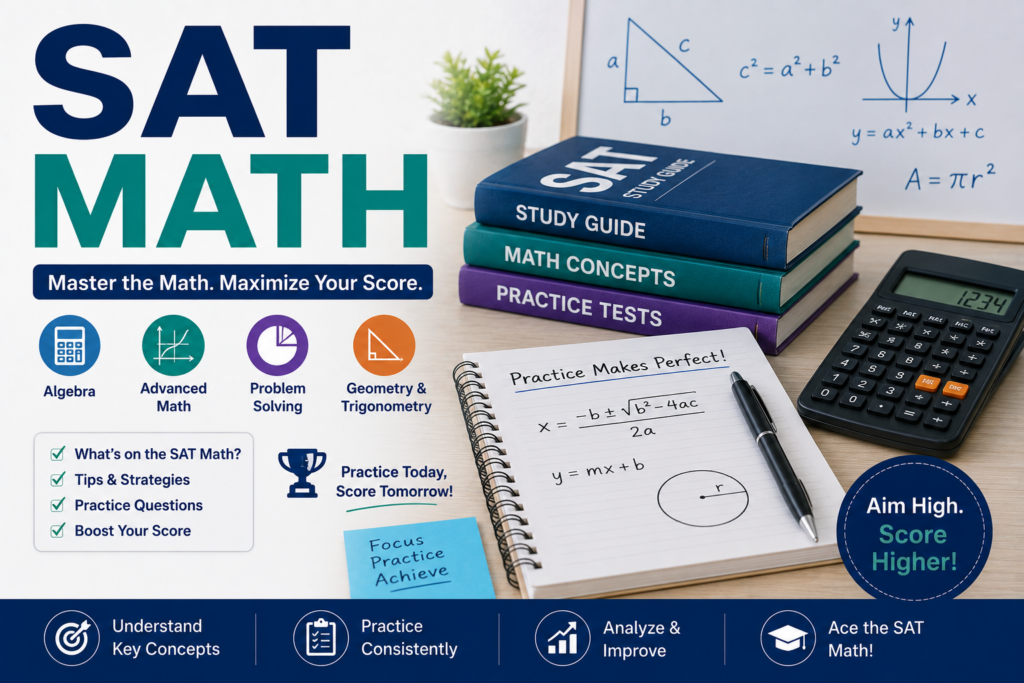
- SAT Math has 44 questions in 70 minutes, split across two adaptive modules.
- Four domains are tested: Algebra, Advanced Math, Problem-Solving & Data Analysis, Geometry & Trigonometry.
- Indian students often start SAT Math prep with an edge, since CBSE and ISC syllabi overlap heavily with the topics tested.
- A calculator, including the built-in Desmos tool, is allowed on every SAT Math question.

What Is SAT Math?
Digital SAT Math is one of the two sections on the Digital SAT, alongside Reading and Writing. It tests algebra, advanced math, data analysis, and geometry through 44 questions completed in 70 minutes, using a multistage adaptive format delivered through College Board’s Bluebook app. Your Math section score (200-800) makes up exactly half of your total SAT score (400-1600), so a strong SAT Math score has an outsized effect on your final composite.
For Indian students, SAT Math typically feels more familiar than the Reading and Writing section, as the SAT Math syllabus draws largely from Class 9 and 10 mathematics. The real difficulty comes from how the questions are framed and timed, not from the underlying math.
If you’re still deciding between exams, our ACT vs SAT comparison breaks down how the two math sections differ.
SAT Math Format: Questions, Timing & Modules
SAT Math is split into two equal, timed modules. Your performance in Module 1 determines whether Module 2 presents easier or harder questions, which is what makes the test adaptive.
| Module | Questions | Time |
| Module 1 | 22 | 35 minutes |
| Module 2 | 22 | 35 minutes |
| Total | 44 | 70 minutes |
Within these 44 questions, roughly 75% are multiple-choice and 25% are student-produced response (SPR or “grid-in”) questions, where you type in a numerical answer instead of choosing from options. There is no penalty for wrong answers on SAT Math, so every question is worth attempting.
Counselor insight: Students who rush Module 1 to “save time” for Module 2 usually do worse overall. Since Module 1 accuracy decides whether you unlock the higher-scoring Module 2 question set, a careless error early on can cap your score ceiling before you even reach the harder half of the test.

SAT Math Topics: Domain-Wise Breakdown
SAT Math questions are drawn from four content domains, each with a fixed weight. Understanding this split helps you prioritize study time instead of preparing every topic equally.
| Domain | Weight | Approx. Questions | Core Topics |
| Algebra | 35% | 13-15 | Linear equations, inequalities, systems of equations |
| Advanced Math | 35% | 13-15 | Quadratics, exponential functions, nonlinear equations |
| Problem-Solving & Data Analysis | 15% | 6-7 | Ratios, percentages, data interpretation |
| Geometry & Trigonometry | 15% | 6-7 | Area, volume, circles, right-triangle trigonometry |
Algebra and Advanced Math together make up about 70% of SAT Math, which makes them the highest-priority domains for most Indian students. Geometry and Trigonometry carry less weight, but SAT geometry questions are scoring opportunities if you know the given formulas well, since College Board provides a reference sheet at the start of the section.
If you want to work through SAT Math questions by domain and difficulty level, see our full topic-wise SAT Math practice questions guide, which breaks down easy, medium, and hard questions for each domain.
Is SAT Math Hard for Indian Students?
SAT Math difficulty depends more on preparation and pacing than on raw content. The syllabus stops around Class 9-10 level and includes no calculus, matrix algebra, or complex proofs, which is why most Indian students find the content itself manageable.
Where students lose marks is in how they frame questions. SAT Math relies heavily on word problems and real-world scenarios rather than direct calculations, and Indian students used to more formulaic school-level questions can misread what a question is actually asking. This is a comprehension gap, not a conceptual one, and it closes quickly with targeted practice.
Students preparing for JEE Main alongside their SAT often find SAT Math especially manageable, since JEE-level algebra and geometry go well beyond what SAT Math tests.
See what our counselors say about SAT Math versus JEE Main difficulty for a closer comparison.
For a broader look at how the full SAT compares for Indian test-takers, read our guide on whether SAT is easy for Indian students.
SAT Math Scoring: What Counts as a Good Score
SAT Math is scored on a 200-800 scale using item response theory, which means the difficulty of the questions you answer correctly affects your score, not just the raw count. Combined with your Reading and Writing score, this gives you a total SAT score between 400 and 1600.
| SAT Math Score | Where It Places You (Indian Applicants) |
| 530-600 | Baseline for most mid-tier US and Indian private universities |
| 650-700 | Competitive for strong public and private universities |
| 750-800 | Required range for elite STEM programs (some top US universities expect near-perfect Math scores) |
For a full breakdown of what a good total SAT score looks like across university tiers, see our guide on what counts as a good SAT score.
If Ivy League or similarly selective universities are on your list, check the specific SAT score requirements for Ivy League colleges to see where your Math score needs to land.
Counselor insight: If you’re targeting a STEM major at a selective US university, treat SAT Math as close to non-negotiable at 750+. Admissions officers weigh a strong Math subscore heavily for engineering and computer science applicants, even when the total SAT score is otherwise mid-range. For a sense of how demanding the process can get, MIT’s SAT Math score expectations sit in the 780-800 range.
Calculator Policy and Tools for SAT Math
A calculator is allowed on every SAT Math question in the digital format; there is no separate no-calculator section anymore. The Bluebook app includes a built-in Desmos graphing calculator, and you may also bring an approved external calculator such as a TI-84. College Board also provides an SAT Math formula sheet at the start of the Math section, covering standard formulas for area, volume, and the Pythagorean theorem, though it does not cover everything you’re expected to know.
Use the calculator for verification and time-saving on complex calculations, not for simple arithmetic you can do faster by hand. Overusing it on basic steps is one of the more common ways students lose pace inside a 35-minute module.
How to Prepare for SAT Math
Most Indian students need 3 to 5 months of focused SAT Math preparation, combining daily topic practice, SAT Math tips from official sources, and full-length adaptive mock tests.
- Months 1-2: Build domain fundamentals. Start with Algebra and Advanced Math as they are 70% of the part. Use the official College Board Bluebook practice sets, use the free Khan Academy SAT Math modules, and use our general SAT prep tactics for section-wide habits that also improve your Math score.
- Month 3: Switch to timed, module-style drills (22 questions in 35 minutes) instead of untimed drills to create true exam pacing.
- Months 4-5: Take full-length adaptive practice tests, review every incorrect answer, and keep an error log by domain to spot recurring weak areas.
Throughout your prep, track pacing closely. Our guide to SAT time management strategies covers module-level pacing techniques specific to the digital, adaptive format.
For practice material, working through past SAT Math papers and online SAT practice papers alongside a full SAT Math practice test on Bluebook gives you both realistic questions and the adaptive testing experience.
If you’re just starting to plan your SAT timeline, including registration and test dates, our Digital SAT syllabus and registration guide covers the full exam calendar.
What to Do If Your SAT Math Score Is Low
A low SAT Math score on a practice test or an official attempt is not a dead end, but it does call for a focused response rather than repeating the same study routine.
- Identify the domain, not just the score. Break your incorrect answers down by Algebra, Advanced Math, Data Analysis, and Geometry. Most low scores trace back to one or two weak domains, not an even spread of errors.
- Check for timing versus concept errors. If you’re getting questions right in untimed practice but wrong under the clock, your issue is pacing, not math ability, and the fix is timed module drills, not more content review.
- Consider a retake with a domain-focused plan. SAT scores are valid for several years, and colleges typically superscore, so a retake focused on your weakest domain can meaningfully move your composite without starting over.
3 Takeaways on SAT Math
- SAT Math has 44 questions across two 22-question adaptive modules, with Algebra and Advanced Math together making up 70% of the section.
- A calculator is allowed on every question, and your Math score alone accounts for half of your total 1600-point SAT score.
- Most Indian students need 3 to 5 months of domain-wise, timed practice to move from a baseline score to a competitive SAT Math score.
Building an SAT Math prep plan around your target score and timeline? Talk to a LeapScholar counselor to map out a preparation schedule that fits your application deadlines.
Frequently Asked Questions About SAT Math
-
What type of math is on the SAT?
The SAT math section includes algebra, advanced math (quadratics and functions), problem solving and data analysis, and geometry and trigonometry. The syllabus does not include calculus or matrix algebra, and Class 9-10 fundamentals cover most of it.
-
Is SAT harder than JEE?
JEE Main and Advanced go far deeper into physics, chemistry, and mathematics than the SAT does, with a much narrower margin for error. Most JEE aspirants find SAT Math comparatively manageable, though the Reading and Writing section still needs separate preparation.
-
Is 700 a good SAT Math score?
With a 700 in SAT Math, you are in a solid percentile and are competitive for most mid to high tier universities. Very selective STEM programs typically look for scores in the 750-800 range.
-
Does IIT accept SAT scores?
IITs admit students only through JEE Main and JEE Advanced. SAT scores don’t figure in the procedure. Some Indian private universities such as Ashoka, FLAME, and Shiv Nadar accept SAT scores for admission to undergraduate courses.
-
Is SAT math very hard?
Most Indian students find the SAT Math manageable, as the topics overlap with algebra and geometry at the school level. It’s not the math behind it; it is mostly time pressure and question phrasing that makes the exam hard.
-
How many Indians give SAT?
The SAT is taken by about 25,000 to 30,000 Indian students every year, and the number is continuously rising as more and more universities in India and overseas are accepting SAT scores. India now ranks among the highest non-US countries for SAT participation.
-
Can I attempt SAT from India?
The College Board’s Bluebook app offers the SAT at more than 160 test locations in over 44 cities across India. If you have a valid ID, you can register directly on the College Board website and select a test date that fits your application timetable.
-
Does SAT Math have negative marking?
No. Since there is no penalty for wrong answers on SAT Math, you should attempt all questions, even if you have to guess, rather than leave any blank.










Have Questions? Get Guidance to reach your Dream University
Connect with India's finest counsellors and biggest study abroad community.
Get Guidance