
Quick Read
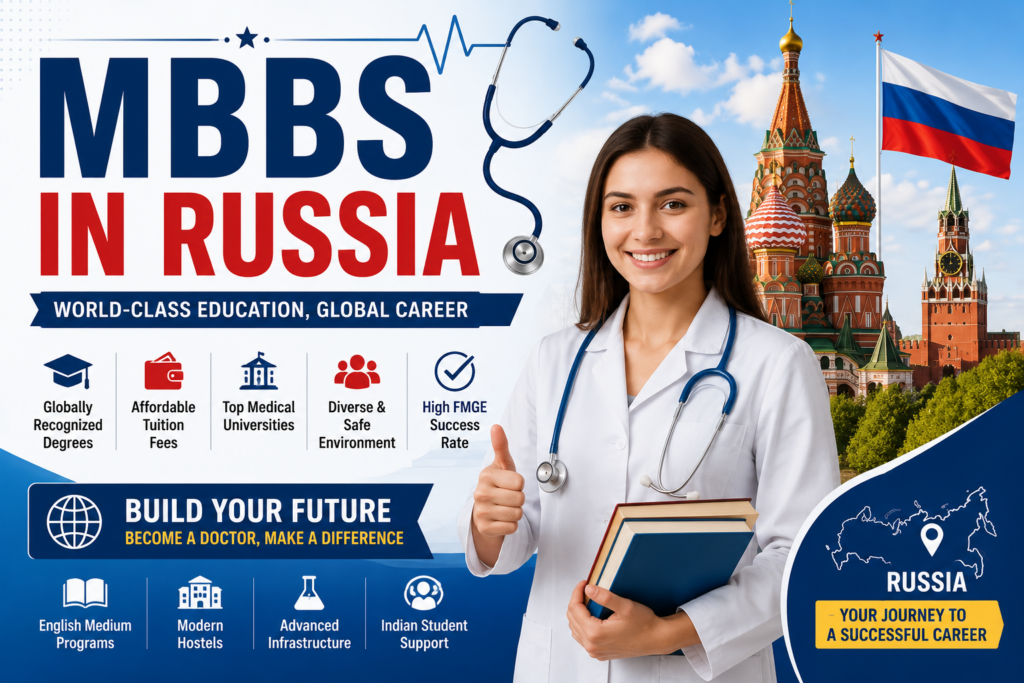
- MBBS in Russia costs Rs.29-65 lakh for the full six-year program.
- Around 54 Russian medical universities appear on India’s foreign-institution compliance route.
- FMGE pass rate for Russian graduates was 29.54% in 2024.
- MBBS in Russia runs six years, including a mandatory one-year internship.
Why Indian Students Choose MBBS in Russia
A private MBBS seat in India can cost Rs.50 lakh to over Rs.1 crore, with no guarantee of a seat even at that price. MBBS in Russia solves the seat problem directly: government-run universities admit students based on documentation and NEET qualification, not a punishing merit list, at a fraction of Indian private fees. Compare this against other best countries for MBBS abroad before you commit to one country.
The trade-offs are real. Winters in cities like Tomsk and Novosibirsk are harsh. Clinical years involve Russian-speaking patients, so verify the “fully English” claim for each university. And the FMGE licensing exam back home is tougher than most consultants admit.

Choose your dream country
 UK
UK
 USA
USA
 Germany
 Australia
 Ireland
 Canada
 UAE
UAE
 France
 Sweden
 Italy
Italy
 Other
Other
When do you want to study abroad?
What's your highest level of education?
Have you completed Class 12th?
What was your Class 12 CGPA/percentage?
Are you a student or a parent/guardian?
What do you want to study?
Select your current city
How Leap will help you

Personalised University Shortlist

Express Applications with Quicker Admits

End-to-End Application Support
Counselor insight: The number that predicts your outcome is the FMGE pass rate of your specific university, not the country average. A Rs.2 lakh cheaper college with a weak FMGE track record can cost you an extra year of coaching after you come home.
MBBS in Russia Eligibility Criteria for Indian Students
The National Medical Commission requires every Indian citizen or OCI cardholder to qualify for NEET UG before studying medicine at any foreign institution; this result also works as your eligibility certificate for admission abroad.
| Requirement | Standard for MBBS in Russia | India-Specific Detail |
| Age | 17 years by December 31 of admission year | Same as Indian NEET age rule |
| Academic background | Class 12 with Physics, Chemistry, Biology, English | Minimum 50% aggregate in PCB (40% for SC/ST/OBC) |
| Entrance exam | NEET UG qualifying score | Valid for 3 years; doubles as your foreign-study eligibility certificate |
| English proficiency | Not required by most universities | IELTS/TOEFL not mandatory, unlike UK or Canadian MBBS routes |
| Passport | Valid at time of application | Renew early; keep at least 18 months validity |
MBBS in Russia without NEET is not possible for Indian applicants. Any consultant promising this route is describing a path that will not get you registered in India. NEET UG is the fixed gate, regardless of what a Russian admission office tells you over email.
A Russian degree is only valid in India once you clear FMGE (or NExT, once implemented) and complete the required internship; the degree alone does not grant a license to practice. As of mid-2026, NExT has not been officially implemented with a confirmed schedule, so FMGE remains the operative screening test. Don't defer preparation on the assumption that NExT arrives before your graduation year.
If part of your course ran online during COVID-era or Russia-Ukraine disruptions, note that the NMC's original March 6, 2026, notice on compensatory training triggered protests from FMG associations and was withdrawn, replaced by a revised notice on March 18, 2026, further clarified through a 12-point FAQ issued June 8, 2026. Under the current rules, students admitted after November 18, 2021, must still complete a one-year CRMI internship in India after clearing FMGE; those admitted earlier fall under the older Screening Test Regulations. NMC has indicated the guidelines will keep evolving for greater fairness and clarity, so confirm your specific compensation requirement in writing with your university and State Medical Council before your final year.
Top Universities for MBBS in Russia
Russia counts roughly 54 medical universities on India's foreign-institution compliance route, but here's the nuance most competitor blogs skip: the NMC has explicitly clarified that it does not endorse or publish an official "approved list" of foreign institutions. Recognition runs through your own Eligibility Certificate and the Screening Test route, not a fixed list. Treat any "NMC-approved list" on a consultancy site as a starting point, not a guarantee, and verify each university's WHO/NMC compliance directly.
See our full list of top universities in Russia for detailed profiles.
| University | City | Fees (INR/year, tuition only) | FMGE Track Record |
| Kazan State Medical University | Kazan | Rs.4-5 lakh | Among the stronger performers in recent cycles |
| Orenburg State Medical University | Orenburg | Rs.3-4 lakh | 45.31% FMGE pass rate in 2025, among the strongest-performing Russian universities |
| Kursk State Medical University | Kursk | Rs.4-4.5 lakh | Consistently in the 40-50% band |
| Perm State Medical University | Perm | Rs.4-5 lakh | Established (est. 1916), good infrastructure |
| Bashkir State Medical University | Ufa | Rs.2.5-3 lakh | Budget-friendly, moderate results |
| Pirogov Russian National Research Medical University | Moscow | Rs.6-6.5 lakh | Higher fees, established reputation |
| Sechenov University | Moscow | Rs.6.3-7 lakh | Strong international recognition |
| Altai State Medical University | Barnaul | Rs.2.5-3 lakh | Budget-friendly, Siberian winters |
Counselor insight: Don't let QS ranking decide your future. Russian medical universities are usually unranked on general world tables because they focus on clinical throughput, not research output. FMGE pass rate matters more than global rank.
MBBS in Russia Total Cost for Indian Students
| Expense Head | Per Year, INR (RUB) | 6-Year Total (INR) |
| Tuition fees | Rs.2.52-7.56 lakh (RUB 2,00,000-6,00,000) | Rs.15.1-45.4 lakh |
| Hostel accommodation | Rs.37,800-63,000 (RUB 30,000-50,000) | Rs.2.27-3.78 lakh |
| Living expenses (food, transport) | Rs.1.51-2.27 lakh (RUB 1,20,000-1,80,000) | Rs.9.07-13.6 lakh |
| Medical insurance | Rs.12,600-18,900 (RUB 10,000-15,000) | Rs.75,600-1.13 lakh |
| Visa renewal and miscellaneous | Rs.25,200 (RUB 20,000) | Rs.1.51 lakh |
| Approximate all-in total | Rs.29-65 lakh |
Exchange rate used: Rs.1.26 per Russian ruble and Rs.95 per US dollar. Budget universities like Bashkir State and Altai State typically cost a total of Rs.29-40 lakh over six years, while premium Moscow institutions such as Pirogov RNRMU and Sechenov can cost between Rs.55-65 lakh. See our Russia cost-of-living breakdown for a city-wise split.
For comparison, a private MBBS seat in India costs Rs.50-80 lakh before capitation charges, while a government seat requires a NEET rank of roughly the top 15,000. That gap is why Russia keeps its place on Indian shortlists.
Counselor insight: Budget for the registration fee separately. Universities charge Rs.15,000-40,000 to confirm your seat once the admission letter arrives, on top of the tuition invoice.
Scholarships for MBBS in Russia
Direct scholarships for MBBS in Russia are limited, and it's worth knowing these details before you shortlist a university on a scholarship promise. Most Russian medical universities don't offer tuition waivers to first-year international applicants, and there's no centralized government scholarship scheme for Indian medical students comparable to what some other countries advertise.
What genuinely exists: a handful of universities offer merit-based fee reductions of roughly 10-25% starting from the second or third year, based on your academic performance in Russia, not at the point of admission. A few also waive hostel fees for consistently high-scoring students. If a consultant offers a guaranteed scholarship before you have even applied, consider that a negotiating tactic rather than a legitimate program.
Counselor insight: Ask the university's admissions office directly, in writing, what merit criteria and application process apply to fee reductions, and get the details in writing before you pay any registration fee. Don't rely on a verbal promise from an agent.
How to Apply for MBBS in Russia
- Confirm your NEET UG qualification. Clear the qualifying percentile (50th General, 40th SC/ST/OBC). This is your entry ticket and doubles as your eligibility certificate for admission abroad.
- Shortlist 3-5 universities. Verify each one's WHO and NMC compliance directly rather than trusting a consultant's "approved list."
- Submit your application with attested mark sheets, passport copy, NEET UG scorecard, and passport photographs.
- Receive your admission letter and pay the registration fee, typically Rs.15,000-40,000, to confirm your seat.
- Apply for your Russian student visa and arrange your medical fitness certificate at this stage, not earlier.
- Travel and register with local authorities within the mandated window after arrival.
Apply for your visa the moment your admission letter arrives. Processing usually takes 3-4 weeks, but delays are common in the June-August peak window, so build in a buffer before booking flights.
Counselor insight: Most application delays come from mismatched names or dates across your passport, marksheets, and NEET scorecard, not from academic weakness. Cross-check spelling and dates before you submit anything.
Documents Required for MBBS in Russia Admission
| Document | Purpose | India-Specific Detail |
| Passport | Visa and university registration | Minimum 18 months validity recommended |
| Class 10 and 12 mark sheets | Academic eligibility proof | Attested copies, PCB marks visible |
| NEET UG scorecard | Mandatory entrance proof | Valid for 3 years from result declaration |
| Passport-size photographs | Application and visa forms | White background, per Russian visa specs |
| Medical fitness certificate | Health clearance | HIV test often required before visa issuance |
| Invitation/admission letter | Visa application base document | Issued after the university reviews your file |
Register with Russian authorities within the mandated window on arrival. For the full visa timeline and fee breakdown, see the Russia study visa guide.
MBBS in Russia vs India
| Factor | MBBS in Russia | MBBS in India (Private) | MBBS in India (Government) |
| Total cost (6 years) | Rs.29-65 lakh | Rs.50 lakh to over Rs.1 crore | Rs.5-10 lakh |
| Entry requirement | NEET qualifying percentile | High NEET rank plus high fees | High NEET rank (roughly top 15,000) |
| Duration | 6 years (5 years plus 1-year internship) | 5.5 years | 5.5 years |
| Extra licensing step | FMGE or NExT required on return | None | None |
| Medium of instruction | English-medium classes; Russian in some clinical settings | English throughout | English throughout |
If you have a government seat in India, take it. The cost and pathway are simpler, and you skip the FMGE step entirely. If your only realistic option is a Rs.50 lakh-plus private seat, the Rs.29-65 lakh Russian route at a university with a strong FMGE track record is worth serious comparison. In practice, this decision usually hinges on budget and NEET rank, not classroom quality; mid-tier Russian medical training is roughly equivalent to a mid-tier Indian private college.
As a rough guide: a NEET-qualified student with a Rs.30-42 lakh budget who missed a government seat by a few thousand ranks is a reasonable fit for a mid-tier university like Kazan State or Bashkir State. A repeat NEET aspirant who has already lost a year should prioritize a university's FMGE track record over its price tag, even if that costs Rs.1-2 lakh more.
Counselor insight: Families comparing Russia and India rarely lose sleep over the classroom. They lose sleep over the FMGE step, since Indian MBBS graduates skip it entirely. Budget time and money for FMGE prep as part of the total cost of choosing Russia, not as an afterthought.
Career After MBBS in Russia
After MBBS in Russia, your career path runs back through India, not through Russia's job market. Here's the realistic sequence:
- Clear FMGE (or NExT, once implemented). This is the mandatory licensing exam for foreign medical graduates, and the pass rate for Russian graduates was 29.54% in the 2024 cycle. Start preparing from year four of your course, not after you land back in India.
- Complete your CRMI internship in India if you were admitted on or after November 18, 2021. This one-year internship is mandatory under current FMGL 2021 rules, regardless of any internship completed abroad.
- Register with your State Medical Council once FMGE and CRMI are both cleared.
- From there, choose your path: practice as a general physician, prepare for NEET-PG to pursue an MD or MS specialization, or take up a government or private hospital role like any Indian medical graduate.
There's no cap on FMGE attempts and no upper age limit, so a failed first attempt delays your career; it doesn't end it. Use the gap to target India-specific clinical patterns, an area Russian curricula tend to undercover.
On salary: a fresh MBBS graduate in India typically starts around Rs.6-12 lakh a year in a private hospital role, rising substantially after PG specialization. Russia itself doesn't offer a realistic long-term job or residency market for Indian medical graduates; nearly all students complete their licensing requirements and return to India to practice.
Counselor insight: The costliest career mistake we see isn't choosing the wrong university; it's picking a specialization target before checking your actual FMGE and NEET-PG scores. Get licensed first, then decide on your specialization.
3 Takeaways Before You Apply for MBBS in Russia
- Verify every "NMC-approved" claim yourself. The NMC does not publish an official endorsed list, so confirm your shortlisted university's compliance and recent FMGE pass rate before paying any fee.
- Budget Rs.29-65 lakh for the full six years at Rs.1.26 per ruble, and check the live rate instead of relying on an old blog's number.
- Start FMGE preparation in year four, not year six. Early, India-specific exam prep predicts a smooth return more than the university's brand name.
Have questions about MBBS in Russia? Book a free session with a LeapScholar counselor.
Frequently Asked Questions About MBBS in Russia
-
Is MBBS in Russia valid in India?
Yes, if you were NEET-qualified at admission, your course matches India's duration and internship norms, and you clear FMGE (or NExT) after graduation. The degree alone doesn't grant a license; State Medical Council registration comes after these steps.
-
How many years is MBBS in Russia?
Five years of academic coursework plus one year of clinical internship, for a total of six years, matching India's duration requirement for foreign medical degrees.
-
Is MBBS in Russia better than MBBS in India?
If you have a government seat in India, take it; cost and pathway are more straightforward. If your only Indian option is a Rs.50-80 lakh private seat, the Rs.29-65 lakh Russian route, which has a strong FMGE track record, is a serious alternative worth comparing university by university.
-
Can I do MBBS in Russia without NEET?
No. Every Indian citizen or OCI cardholder must hold a qualifying NEET UG score, which also serves as the eligibility certificate. Any "NEET-free" claim for Indian applicants won't lead to Indian registration.
-
How costly is MBBS in Russia?
Total cost runs Rs.29 lakh to Rs.65 lakh across six years at Rs.1.26 per ruble, covering tuition, hostel, food, and insurance. Budget universities like Bashkir State keep it near the lower end; Moscow institutions push it higher.
-
What are the disadvantages of studying MBBS in Russia?
Winters are extreme in cities like Novosibirsk and Tomsk, clinical years shift to Russian-speaking patients even in "English-medium" programs, and the FMGE pass rate sits around 29.54%. Language and licensing prep, not classroom quality, cause most of the trouble students run into.
-
Can I get PR in Russia after study?
Russia doesn't offer a straightforward permanent residency route for international medical graduates the way Canada or Australia do. Most Indian students finish their internship, clear FMGE, and return to India instead of pursuing a long-term stay in Russia.
-
Is there a scholarship for MBBS in Russia?
Direct scholarships for international MBBS students are rare; most Russian universities don't offer tuition waivers upfront. A few provide merit-based stipends after enrollment, so ask the university directly rather than expecting a discount at the application stage.
-
Is Russia safe for MBBS now?
Established university cities like Kazan, Volgograd, and Kursk remain safe for Indian students, with active Indian communities and normal campus life continuing despite the ongoing Russia-Ukraine conflict. Standard precautions apply; there's no specific advisory against studying there.
-
What is the NEET requirement for MBBS in Russia?
Clear the NEET UG qualifying percentile: 50th for General, 40th for SC/ST/OBC. There's no separate rank cutoff beyond this threshold, unlike Indian government colleges.






Have Questions? Get Guidance to reach your Dream University
Connect with India's finest counsellors and biggest study abroad community.
Get Guidance