
Quick Read
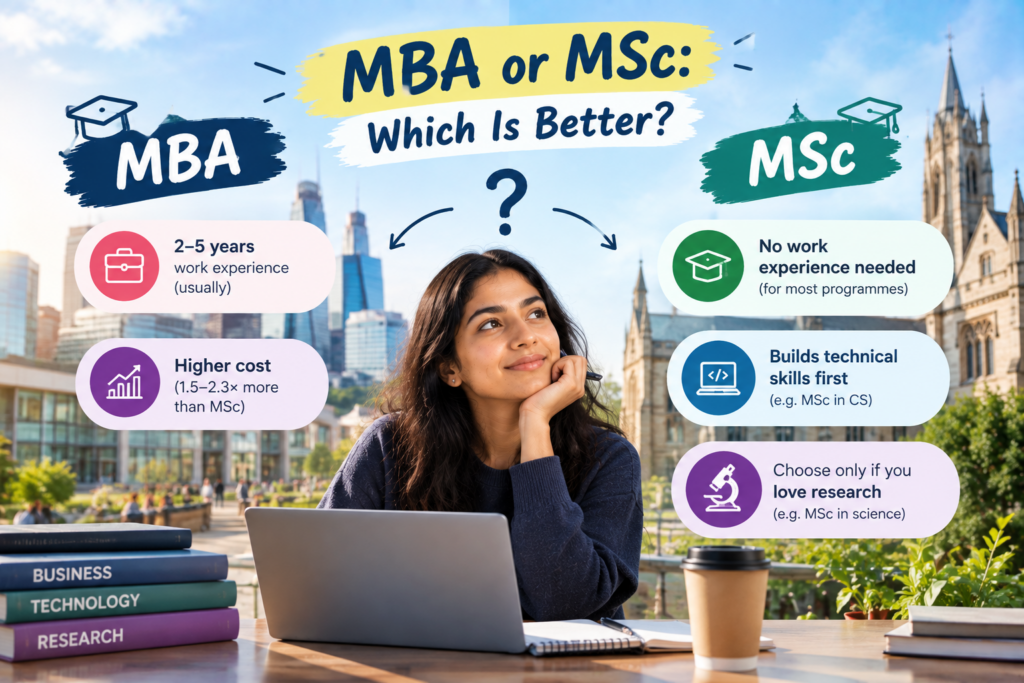
- MBAs usually require 2–5 years of work experience, while MSc programmes do not.
- Freshers wanting a business career should compare an MSc in Management (MiM) with an MBA.
- For tech careers, an MSc in CS builds deeper technical skills first; an MBA pays off later in management.
- UK MBAs cost 1.5–2.3× more than the MSc at the same school (Oxford 1.5×; LBS 2.3×).
- Choose an MSc in science only if research or a technical career genuinely interests you.
MBA vs MSc: Key Differences at a Glance
MBA or MSc: which is better? It starts with what each degree is built for.
| Factor | MBA | MSc |
|---|---|---|
| Full form | Master of Business Administration | Master of Science |
| Focus | General management, leadership, and strategy across industries | Deep specialisation in one field |
| Duration | 1–2 years | 1–2 years |
| Who it suits | Career switchers, working professionals, aspiring managers | Fresh graduates, researchers, technical specialists |
| Work experience required | Usually 2–5 years | Not required |
| Entry exam (abroad) | GMAT focus edition (LBS avg: 645; range 555–805; old 600–720 scale retired) | GRE or IELTS/TOEFL |
| Entry exam (India) | CAT, XAT, GMAT | IIT JAM, CUET-PG, university-specific tests |
| Fees in India | Rs. 10–45+ lakhs (ISB PGP exceeds Rs. 40 lakhs) | Rs. 1–10 lakhs |
| Fees in the UK (2026/27) | £59,500–£1,23,950 (Rs. 75.83–1,57.97 lakhs) | £37,500–£58,000 (Rs. 47.79–73.92 lakhs) |
| Career track | Management, consulting, leadership, entrepreneurship | Research, technical, specialised industry, academia |
| Avg. fresh graduate salary in India | Rs. 6–12 LPA (varies by college) | Rs. 4–9.24 LPA (varies by field) |
Sources: GMAC 2025 Corporate Recruiters Survey | NIRF Rankings 2025 | Lendwise UK Fees 2026/27 | PayScale India: MSc Salary
UK fees are sourced from individual university websites; verify at each institution’s official fees page before applying.

Choose your dream country
 UK
 USA
 Germany
 Australia
 Ireland
 Canada
 UAE
 France
 Sweden
 Italy
 Other
When do you want to study abroad?
What's your highest level of education?
Have you completed Class 12th?
What was your Class 12 CGPA/percentage?
Are you a student or a parent/guardian?
What do you want to study?
Select your current city
How Leap will help you

Personalised University Shortlist

Express Applications with Quicker Admits

End-to-End Application Support
Still deciding which country to pursue your MBA in? LeapScholar's MBA abroad for Indian students guide breaks down fees, realistic ROI, and what the admissions process looks like in the UK, US, Canada, and Australia.
My Insight: The most common mistake in the MBA or MSc debate is picking the degree before deciding on the career. MBA = generalist. MSc = specialist. First, decide on your career direction.
MBA or MSc: Which Is Better: Salary Comparison in 2026
Here is what the salary data says.
| Profile | MBA Avg. Salary (India) | MSc Avg. Salary (India) | Verdict |
|---|---|---|---|
| Fresh graduate (0 experience) | Rs. 6–12 LPA | Rs. 4–9.24 LPA | College brand matters more than degree type |
| 3–5 years post-experience | Rs. 15–25 LPA | Rs. 8–15 LPA (field-dependent; AmbitionBox, 2026) | MBA wins clearly |
| Tech field (CS, IT, Data) | Rs. 8–15 LPA (IT management roles) | Rs. 8–20 LPA (technical roles) | MSc wins in pure tech trajectory |
| Research and academia | Rs. 4–8 LPA | Rs. 4–10 LPA | MSc wins |
| IIM Ahmedabad, Bangalore, Calcutta and ISB | Rs. 28–35 LPA | Not applicable | MBA wins at top schools; comparison reflects college tier as much as degree type |
| US MBA median starting salary | Rs. 1.20 crore/year ($125,000) | Not applicable | MBA wins post-US experience |
Sources: NIRF 2025 Placement Data | GMAC 2025: Median US MBA Starting Salary | PayScale India: MSc Average Salary | AmbitionBox: India Salary Data
Salary note: The IIM/ISB Rs. 28–35 LPA vs. Rs. 9.24 LPA MSc gap is not directly comparable. A fairer comparison: IIT MSc graduates at 3–5 years earn Rs. 12–20 LPA vs Rs. 15–25 LPA for same-tier MBA graduates. Top US MBA: 119% salary increase within three years (GMAC, 2025); fees run $80,000–$150,000 (Rs. 76.69 lakhs–Rs. 1.44 crore).
MBA or MSc Which Is Better: By Your Field and Background
Whether an MBA or MSc: which is better depends entirely on your undergraduate background and career target.
Which is Better MBA or MSc After BSc (General Science)
- Research or government roles: MSc.
- Management, consulting, or corporate: MBA.
- Unsure: MSc first. Most MBA programmes require 2–5 years of experience anyway.
Source: Coursera: MBA vs MSc comparison
MSc CS or MBA: Which Is Better?
For students from a computer science background, an MSc in CS or an MBA, which is better, depends entirely on whether you want to code or lead.
- MSc CS takes you into the technical core: data scientist, software engineer, ML engineer, or cybersecurity analyst. Starting salaries in India sit at Rs. 6–10 LPA; senior roles cross Rs. 15–25 LPA within five to seven years.
- An MBA from a CS background moves you toward an IT manager, product manager, tech consultant, or a CTO-track leadership role. Starting salary: Rs. 8–15 LPA. The real earning gap over the MSc path only opens after 5+ years of genuine management work.
- Verdict: MSc CS first. Consider an MBA in 5–7 years if your goal is management. Skipping MSc CS for MBA straight after BTech means leaving with neither technical depth nor real management experience.
Check our blog on Masters in Computer Science in the UK for more information on the top universities in UK and fee breakdown.
Source: AmbitionBox: Data Scientist Salary India
MSc Agriculture or MBA: Which Is Better
MSc agriculture or MBA: Which is better: government/research or corporate agribusiness?
- MSc Agriculture keeps you in the field: agronomist, soil scientist, or research officer at bodies like ICAR and NABARD. Stable, meaningful work with genuine long-term demand.
- An MBA in Agribusiness puts you on the commercial side of the same industry: supply chain management, agribusiness analysis, and rural marketing at private companies. Starting salary: Rs. 6–12 LPA, with a faster growth curve than the research track.
- Verdict: For government or research, choose MSc; for private agribusiness with a corporate salary, choose MBA.
Full breakdown of course details in MSc Agriculture in the UK.
MSc Biotechnology or MBA: Which Is Better?
MSc biotechnology or MBA: Which is better depends on which side of pharma you want to work on.
- MSc Biotechnology: Research associate, QC analyst, pharma R&D. Starting salary: Rs. 3–8 LPA.
- MBA (Pharma/Healthcare): Brand manager, healthcare consultant, biotech operations. Starting salary: Rs. 8–20 LPA.
- Verdict: If bench research genuinely excites you, MSc Biotechnology is correct. If you chose biotech without loving the lab work, MBA in pharma management is a better two-year investment.
My Insight: On the MSc in Biotechnology or MBA: Which is better, question: Most students who ask it do not actually want to do research. They chose biotechnology because it felt safe and scientific. If bench work does not excite you after your BSc, please do not spend two years pursuing a research degree. Pivot to an MBA or MSc in management, where your actual interests sit.
MSc Chemistry or MBA: Which Is Better?
The verdict for MSc Chemistry or MBA, which is better, follows the same logic.
- MSc Chemistry keeps you in technical roles: research chemist, QC analyst, pharma API developer, or product formulation in FMCG. Starting salary: Rs. 3–8 LPA.
- An MBA in the same industries puts you on the commercial side: brand manager at HUL or P&G, operations manager, or business development in pharma. Entry salary: Rs. 8–18 LPA. The ceiling here moves considerably faster.
- Verdict: Unless research or academia is a genuine goal, an MBA delivers better outcomes for chemistry graduates in the FMCG, pharma, and chemical industries.
MBA or MSc: Which Is Better in UK?
MBA or MSc which is better in UK is a separate calculation from India. Fees, the Graduate Route post-study visa (currently 2 years; reducing to 18 months for January 2027 applications; verify on gov.uk), and global salary outcomes all change.
| University | MBA Fee (2026/27) | MSc Fee (2026/27) | MSc in INR |
|---|---|---|---|
| London Business School | £123,950 (Rs. 157.97 lakhs) | Masters in Management (MiM) | £52,950 (Rs. 67.48 lakhs) |
| Oxford (Saïd) | £88,800 (Rs. 113.17 lakhs) | MSc Financial Economics | £58,000 (Rs. 73.92 lakhs) |
| Cambridge (Judge) | £80,000 (Rs. 101.96 lakhs) | Master of Finance | £42,500 (Rs. 54.17 lakhs) |
| Imperial College | £78,000 (Rs. 99.41 lakhs) | MSc Management | £47,000 (Rs. 59.90 lakhs) |
| Warwick (WBS) | £59,500 (Rs. 75.83 lakhs) | MSc Management | £37,500 (Rs. 47.79 lakhs) |
Source:s london.edu (official). Oxford, Cambridge, Imperial, and Warwick fees from Lendwise 2026/27 aggregation which are sourced from university fee pages. Verify all fees at each institution's official admissions page before applying.
Key takeaway: UK MBAs cost 1.5–2.3× the MSc at the same school. Graduate Route: 2 years now; 18 months from January 2027 (verify gov.uk). Without 3+ years of experience, the UK MSc wins on ROI.
For the full UK MBA breakdown: MBA in the UK guide.
For the MSc business route: MSc in Management in the UK.
Weighing the 1-year UK program versus 2 years abroad: the 1-year MSc UK vs 2-year MSc abroad guide addresses this directly.
Decision Framework: MBA or MSc: Which Is Better for You?
If you are a final-year BTech CS or IT student graduating in 2026:
Have a job offer? Take it and revisit the MBA in 4–5 years. No offer? An MSc in CS is the better first move. MBA straight from a BTech leaves you with neither technical depth nor management credibility.
If you hold a BSc in Biology, Chemistry, Agriculture, or Pharmacy:
The real question is whether research or government roles genuinely interest you. An MSc is the right choice only if you are genuinely interested in research or government roles. If you are not drawn to research, the better path is to work for 2–3 years in any role before pursuing an MBA. Alternatively, consider an MSc in Management (MiM) now, which is designed for freshers and opens similar corporate career tracks. Do not default to a science MSc as a fallback.
If you have 2–4 years of work experience in any sector:
MBA wins. The curriculum only delivers real value when you have work experience to draw on.
For programs that waive the experience requirement, see the MBA abroad without work experience guide.
My Insight: The harder version of the MBA or MSc, which is better conversation, is when a student's parents want an MBA but the student genuinely wants research. MSc is correct in that case. Be honest about which career you want, not which one sounds better at a family dinner.
Planning Your Application: MBA vs MSc
Key documents and timelines for both degrees:
Document Checklist
| Document | MBA | MSc |
|---|---|---|
| Academic transcripts | Bachelor's degree; most schools require 50–60% minimum | Bachelor's degree; minimum 55–60% at most universities |
| GMAT score | GMAT Focus Edition (LBS avg 645; range 555–805; old 600–720+ scale retired). Some schools waive. | Not required for most programs |
| GRE score | Accepted by some MBA programs in place of the GMAT | Rarely required for UK MSc; optional or required at some US MS programmes (check each programme individually) |
| IELTS/TOEFL | IELTS 6.5–7.5 or TOEFL 100+ for MBA | IELTS 6.5+ or TOEFL 90+ for MSc |
| Work experience | Employment letters for 2–5 years | Not required |
| Statement of Purpose | 500–800 words: career switch, work experience, leadership goals | 500–700 words: research interest and career plan |
| Letters of Recommendation | 2–3 from employer or direct manager | 2 from an academic supervisor or professional |
| IIT JAM or CUET-PG | Not required for MBA abroad | Required for IIT MSc (JAM) and central university MSc (CUET-PG) |
Application Timeline: 2026–27
| Month | Action |
|---|---|
| October to November 2026 | Begin GMAT or GRE preparation; shortlist universities. |
| November to December 2026 | Request recommendation letters and draft Statement of Purpose. |
| January to February 2027 | Submit applications (UK January round; US R2 deadline). |
| March to April 2027 | Interview calls; scholarship applications |
| May to June 2027 | Accept the offer; apply for a student visa. |
| July to September 2027 | Pre-departure preparation; programme begins |
Three Things to Know Before Choosing MBA or MSc
- Work experience is the first decision point. Fresh graduates start with an MSc. An MBA comes after you have something to manage.
- Your industry matters more than the degree. MSc Chemistry or MBA, which is better for FMCG, is a different answer than for a government lab. Know your target role first.
- In the UK, MSc gives better ROI for freshers. The MBA premium runs £20,000–£70,000 over the MSc at the same university, with an identical post-study visa for both.
Verified by: LeapScholar's admissions counselling team. Our counsellors have guided thousands of Indian students through the MBA vs MSc decision across the UK, US, Canada, and Australia.
Question about your profile? Book a free session with a LeapScholar counsellor.
Frequently Asked Questions About MBA or MSc: Which Is Better for Indian Students
-
MBA or MSc: Which is better after BSc?
For research or government service: MSc. For corporate careers: MBA delivers a better salary. Most MBA programmes expect 2–5 years of experience first, so MSc now and MBA later is often the smarter path.
-
Which degree pays more in India: MBA or MSc?
IIM Ahmedabad, Bangalore, Calcutta, and ISB MBA packages run Rs. 28–35 LPA (NIRF 2025). MSc graduates across India average Rs. 9.24 LPA (PayScale, 2026). These are not like-for-like numbers: they compare India's top B-schools against every college's all-India MSc average. MBA pays more in most careers, but the gap reflects college tier as much as degree type. After a few years, MSc CS and Data Science graduates close the gap in tech.
-
Can I do an MBA after completing an MSc?
Yes. Build 3–5 years of domain expertise via MSc work experience, then use an MBA to move into management. This is common in pharma, biotech, and tech.
-
Is work experience required for MBA or MSc?
For MSc: no. For MBA at top schools: 2–5 years is standard. It is not a checkbox. MBA programmes are built around learning from classmates who have managed real teams and budgets.
-
Which is better for tech careers: an MSc in CS or an MBA?
MSc CS wins for engineering, data science, and ML. MBA is stronger for product management and IT leadership, but only after four to five years of real management experience.
-
Is MBA or MSc which is better in UK for Indian freshers?
The UK MSc is smarter financially for most fresh applicants: fees are roughly half an MBA at the same school. Graduate Route: currently 2 years; reduces to 18 months for January 2027 applications. UK MBA is worth the premium only with 3+ years of work experience.
-
Which is better MSc biotechnology or MBA for pharma careers?
MSc Biotech is better for R&D and QC (Rs. 3–8 LPA), while an MBA is better for pharma management and consulting (Rs. 8–20 LPA). These are different careers, not two routes to the same destination.
-
Which course is better, an MSc or MBA for research careers?
MSc, without exception. It provides the academic foundation that PhD programmes and research institutes need. MBA has no connection to research hiring.
-
MSc in Management or MBA: which is better for freshers?
MiM is for freshers wanting business careers with no prior experience. LBS, Imperial, and Warwick offer strong MiM programmes. MBA is for career changers with 3+ years of experience.
-
Is an MSc in Business Analytics better than an MBA?
MSc in Business Analytics suits you if you want to stay technical: data-driven decision-making, analytics consulting, or tech product roles, with starting salaries in India of Rs. 8–15 LPA. MBA suits you if you want to lead teams, manage P&Ls, or move into general management. MSc in Business Analytics is increasingly valued because it qualifies for in-demand occupation lists under UK and US post-study work visa frameworks. If data and analytics is your intended career, the MSc is more targeted and typically costs significantly less than an MBA.









Have Questions? Get Guidance to reach your Dream University
Connect with India's finest counsellors and biggest study abroad community.
Get Guidance